
 Google
 Yelp
 Facebook
 Twitter
 ChEnected
320779 Solar Hydrogen Production From Metal Sulfide (ZnS-CuS-CdS) Photocatalysts
SOLAR HYDRPGEN PRODUCTION FROM METAL SULFIDE (ZnS-CuS-CdS) PHOTOCATALYSTS
Eunpyo Hong, and Jung Hyeun Kim, University of Seoul, Seoul (Korea)
1. Introduction
Hydrogen has long been considered as a clean and eco-friendly energy source. However, conventional methods such as steam reforming and electrolysis of the water require high-energy consumption for hydrogen production. In that sense, hydrogen production from water splitting reaction using photocatalysts is one of the ideal ways because it uses only water and solar light, as shown below for the complete consumption and regeneration cycle.
Generation: H2O + energy(solar) 경 H2 + 1/2O2 (1)
Consumption: H2 + 1/2O2 경 H2O + energy (2)
Such a photocatalytic process was first developed by Fujishima and Honda [1], and later many researchers have devoted to improve photocatalytic performance in various ways. In this study, the ZnS photocatalyst is used as a base material. However, the ZnS photocatalyst solely is not so effective to use because of its relatively large band gap energy. Therefore, we applied two primary concepts for improving the electron usage efficiency on hydrogen production.
First, CuS nanoparticles were introduced on the ZnS photocatalyst surface to improve interfacial electron transfer. The main role of the CuS nanoparticles is providing a driving force for electron movement. The CuS materials accept electrons from ZnS surface, and these electrons reduce the protons (H+). The similar phenomenon is observed from the CuS/ZnO (nanowire) and CuS/ZnS (nanosheet) [2, 3]. The major electron transfer mechanisms on photocatalysts under light illumination are shown below.
CuS/ZnS + hv 경 CuS(e-)/ZnS(h+) (3)
2CuS + 3e- 경 Cu2S + S2- (4)
Cu2S + 2H+ + S2- 경 2CuS + H2 (5)
Second, the third material is used for composite semiconductor fabrication for expanding the light harvesting region. Various composite semiconductor materials such as CdS, CdSe, CdTe, and CuO were reported. Amongst them, the CdS material is a promising light sensitizer considering the band gap energy and band position (valence and conduction bands).
Therefore, the ZnS-CuS-CdS semiconductor compounds are utilized for hydrogen production under visible light illumination condition in order to achieve high electron usage efficiency.
2. Results and Discussion
The ZnS nanoparticles were formed in ionic solutions (Zn2+ + S2-), and a cation exchange reaction was used for the ZnS-CuS compound fabrication. Finally, the CdS quantum dots were deposited on the as-prepared particle surface by a chemical bath deposition method. Schematic view of the ZnS-CuS-CdS nanoparticle compounds and the ideal electron paths are demonstrated in Fig. 1.
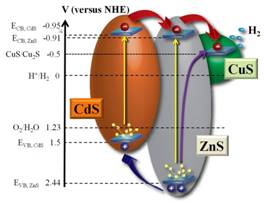
Fig. 1. Schematic energy diagram of ZnS-CuS-CdS composite photocatalysts.
Three major experimental variables were used for fabrication of semiconductor nanoparticle materials: 1) thermal sintering of the ZnS nanoparticles, 2) varying Cu contents for the ZnS-CuS compound, and 3) varying Cd content for the ZnS-CdS. Fig. 2 shows hydrogen production results from only ZnS case and ZnS-CuS composites. The ZnS-CuS composite evolved much more hydrogen than from the only ZnS nanoparticle case. Thermal treatment of the ZnS nanoparticles improves hydrogen production activity for both the only ZnS case and ZnS-CuS composites.
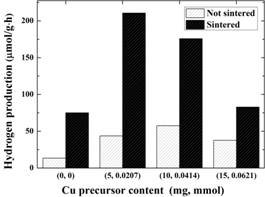
Fig. 2. Amount of evolved hydrogen of the ZnS-CuS particles as a function of Cu precursor content.
Fig. 3 shows amounts of evolved hydrogen from the photocatalyst samples during the experimental time period. As a result, photocatalytic performance is greatly increased by introducing two concepts (CuS and CdS junction), in our experimental system. This result demonstrates that the electron transfer through the semiconductor composite material (CdS 경 ZnS 경 CuS) is very efficient and its usage for hydrogen production is remarkably improved.
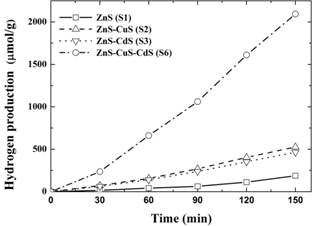
Fig. 3. Amounts of evolved hydrogen from four different types of photocatalysts.
Other material properties characterized by HR-TEM, XRD, UV-vis, and XPS analyses are also helpful in understanding this improved hydrogen production phenomenon with semiconductor composite photocatalysts under the solar light illumination.
References
1. A. Fujishima, K. Honda (1972), Nature, 238, 37.
2. J. Zhang, J. Yu, Y. Zhang, Q. Li, and J.R. Gong (2011), Nano Letters, 11, 4774.
3. M. Lee and K. Yong (2012), Nanotechnology, 23, 194014.
See more of this Group/Topical: Nanoscale Science and Engineering Forum