
 Google
 Yelp
 Facebook
 Twitter
 ChEnected
321189 Thermogravimetric Analysis For Wood Fiber Reinforced Polypropylene Base Composites
THERMOGRAVIMETRIC ANALYSIS FOR WOOD FIBER REINFORCED POLYPROPYLENE BASE COMPOSITES
Jae Gyoung Gwon, and Jung Hyeun Kim, University of Seoul, Seoul (Korea)
Introduction
Needs for the WPC have been increased due to effective application of limited natural resources and environmentally friendly characteristics. Because of the outdoor durability and low maintenance cost, the WPC is being widely used in various applications such as deck, fence, marina, sound-proof wall, furniture, and automotive parts. Although the WPC has been commercialized in various applications, the base materials are so sensitive to flame that their usages have been limited [1, 2].
Metal hydroxides can release water vapor above their decomposition temperature due to their endothermic reaction. In addition, their solid residues after the reaction can reduce the heat release rate from burning[3]. Aluminum hydroxide (AH, 1) and magnesium hydroxide (MH, 2) decompose according to the following reactions:
2Al(OH)3(s) à Al2O3(s) + 3H2O(g) (1)
Mg(OH)2(s) à MgO(s) + H2O(g) (2)
These two
reactions were well summarized in a literature [3]. The endothermic loss of
water resulting from the thermal decomposition of aluminum hydroxide is between
1170 J/g and 1300 J/g, and the decomposition starts at about 180-200°. In case
of magnesium hydroxide, the endothermic loss is between 1244 J/g and 1450 J/g ,
and it starts to decompose at about 300-330°.
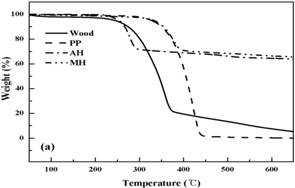
Results and Discussion Thermal degradation behavior of base components Fig.
1 shows thermal degradation curves of the base materials used in fabrication of
WPC, under dehumidified N2 atmosphere. As can be seen in Fig. 1a, PP
is completely degraded before the temperature reaching around 465°, whereas AH
and MH reveal substantial amounts of residue after the primary decomposition
process due to the remaining metal oxide materials. Furthermore, the wood fiber
case shows gradual weight loss after the first abrupt reduction as the
temperature increases.
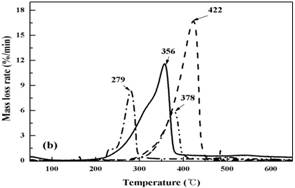
In
addition, in Fig. 1b, the mass loss rate is plotted as a function of
temperature, and it clearly demonstrates different decomposition temperatures
of all constituent materials (wood fiber: 200°~385°, PP: 276°~465°, MH:
277°~ 394°, and AH: 209°~295°). In addition, their maximum mass loss rates
(Tmax) are observed at 356°, 422°, 378°, and 279°,
respectively.
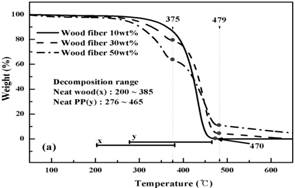
Thermal degradation behavior of WPC Thermal stability of WPC materials combining
those two base components is much dependant on the amount of wood fiber. Fig. 2
shows thermo-gravimetric analysis results of WPC containing various amount of
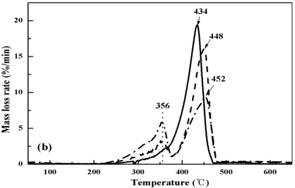
wood fiber as a function of temperature. Fig. 2a demonstrates one step weight
loss for the wood fiber 10wt% composite and two step weight losses for the wood
fiber 30wt% and 50wt% composites. The resulting degradation
temperatures increased from 422° for the PP base material to 434°, 448°, and 452° for the
wood fiber 10wt%, 30wt%, and 50wt%, respectively. Therefore, thermal protective
carbonaceous layer produced from the degradation of wood fibers can enhance the
thermal stability of the PP base WPC materials.
Fig. 2.
Weight change (a) and mass loss rate (b) curves for various amount of wood
fiber contents in WPC.
Thermal degradation behavior of metal hydroxides filled
WPCs Tmax
of the PP degradation step of the MH filled WPC case is slightly higher than
that of the AH case (463~466°). The thermal degradation of MH occurs at
300~400°, but the degradation occurs at 200-300° in the AH case. Therefore,
the MH case shows high thermal stability in the WPC system because the
endothermic reaction directly affects the retardation of the PP decomposition.
References
2. M.
B. A. Bakar, Z. A. M. Ishak, R. M. Taib,H. D. Rozman, and S. M. Jani (2010),
"Flammablility and Mechanical Properties of Wood Flour-Filled Polypropylene
Composites," Journal of polymer science, 116, pp. 2714-2722.
3. L.
A. Hollingbery and T. R. Hull (2010), "The Thermal Decomposition of Huntite and
Hydromagnesite-A Review," Thermochimica acta, 509, pp. 1-11.
See more of this Group/Topical: Materials Engineering and Sciences Division