322112 Fluidization of Particles and Agglomerates in Wet Gas-Fluidized Beds
Tuesday, November 5, 2013: 5:49 PM
Golden Gate 7 (Hilton)
Matthew Girardi1, Stefan Radl2 and Sankaran Sundaresan1, (1)Department of Chemical and Biological Engineering, Princeton University, Princeton, NJ, (2)Institute for Process and Particle Engineering, Graz University of Technology, Graz, Austria
Gas-fluidized
beds of dry particles exhibit complex behavior with instabilities giving rise
to inhomogeneities that span a wide range of time and length scales. Adding
liquid to the system such that particles support a liquid film coating
introduces further complexity, allowing for the fluidization of both particles
and agglomerates. Constitutive models for the effective fluid-particle drag
force in such systems must account for inhomogeneous structures1,
such as agglomerates. Thus, our primary goal is to develop an effective drag
force model for use in large-scale simulations of wet gas-fluidized beds.
We
perform Euler-Lagrange simulations of a fluidized bed using a 3D periodic
domain 2 cm3 in size with as many as 250,000 particles. The
domain-average slip velocity serves as a quantitative measure of the
inhomogeneous structure within the system. We find that the system behavior
may be characterized by a modified Bond number: Bo Φα ,
where α is a constant and Φ is the liquid loading level. Bo = 3γ/(2r2ρg),
where γ is the surface tension, ρ is the liquid density, and r is the
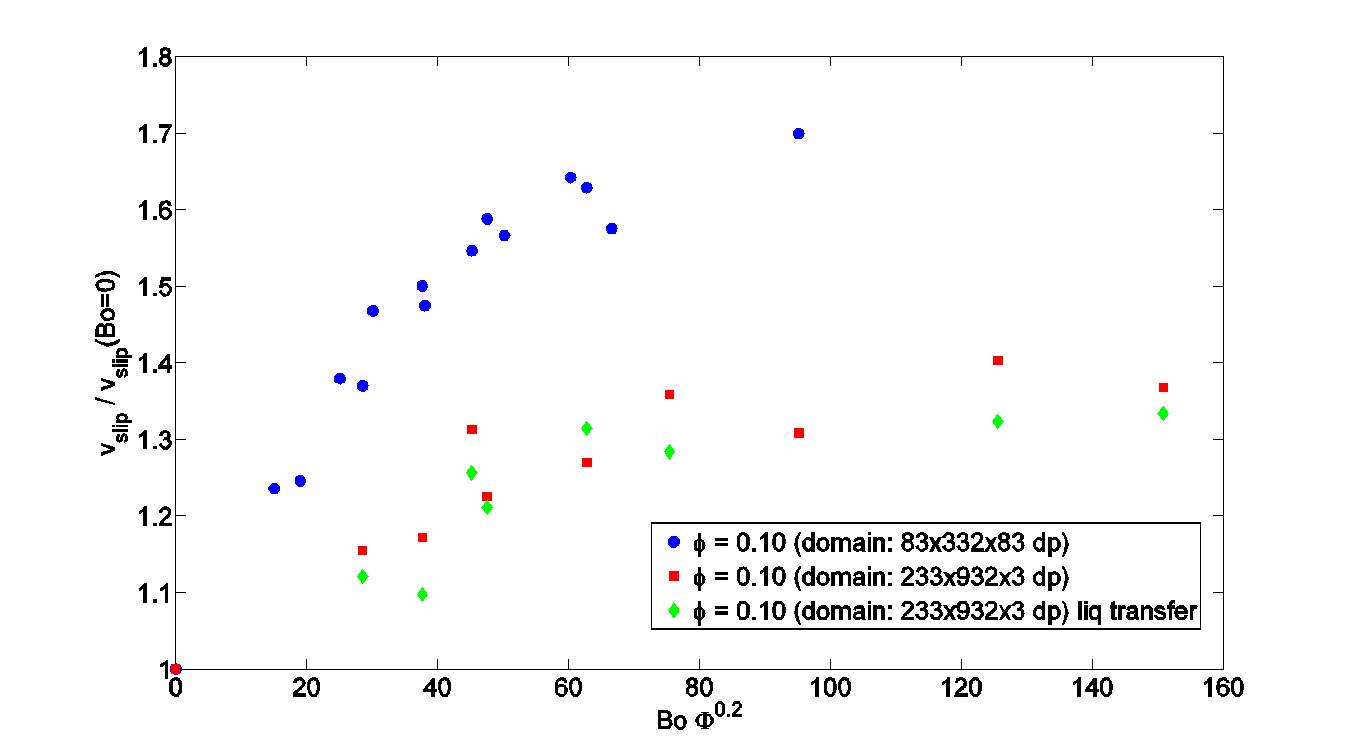
particle radius. As shown in Figure 1, the collapse of the domain-average slip
velocity with respect to modified Bond number is achieved regardless of domain
size or whether liquid spreading is permitted. This observation suggests that
the approximation of constant liquid bridges is valid2,3; moreover,
the robust collapse suggests that the drag in a wide variety of systems may be
predicted with a simple model.
[1] Igci, Y., Andrews, A. T.,
Sundaresan, S., & O'Brien, T. (2008). Filtered Two-Fluid Models for
Fluidized Gas-Particle Suspensions. AIChE Journal, 54(6),
1431–1448.
[2] Mikami, T., Kamiya, H.,
& Horio, M. (1998). Numerical simulation of cohesive powder behavior in a
fluidized bed. Chemical Engineering Science, 53(10), 1927–1940.
[3] Shi, D., & McCarthy, J.
J. (2008). Numerical simulation of liquid transfer between particles. Powder
Technology, 184(1), 64–75.
 Figure
1: Domain-average slip velocity vs. modified Bond number. Domain-average slip
velocity is scaled against that of a comparable dry system. Bo is Bond number,
φ is solid volume fraction, and Φ is liquid loading level.
Extended Abstract: File Not Uploaded

 Google
 Yelp
 Facebook
 Twitter
 ChEnected