
 Google
 Yelp
 Facebook
 Twitter
 ChEnected
322168 Preparation of Pt-Ru Bimetallic Catalysts Using Electroless Deposition Methods and Applications for Upgrading of Biomass and Direct Methanol Fuel Cells
Preparation of Pt-Ru bimetallic catalysts using electroless deposition methods and applications for upgrading of biomass and direct methanol fuel cells
Weijian Diao, John Meynard M. Tengco, Taylor R. Garrick, John W. Weidner, John R. Regalbuto and John R. Monnier
Department of Chemical Engineering, University of South Carolina, Columbia SC 29208 USA
Monometallic catalysts have been replaced by bimetallic catalysts for a wide range of catalytic applications. Bimetallic catalysts often exhibit enhanced selectivity, stability, and/or activity relative to their corresponding monometallic components. Such catalysts may be prepared using many different methodologies [1]. However, the typical methods of co-impregnation and successive impregnation have poor control of metal-metal interaction and surface composition. Electroless Deposition (ED) has been used for the preparation of true bimetallic catalysts with controlled, bimetallic surface compositions [2, 3]. We have recently expanded our program to include platinum-ruthenium bimetallic catalysts that are widely used in fuel cells and bio-mass conversion [4]. My research has focused on the preparation and characterization of both Ru deposited on carbon-supported platinum catalysts (Ru-Pt/C) as well as platinum deposited on carbon-supported ruthenium catalysts (Pt-Ru/C).
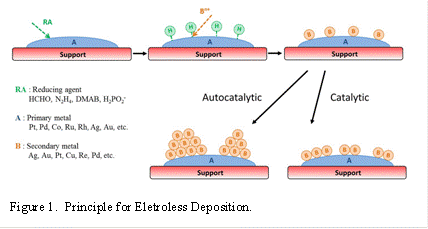
Eletroless deposition is the catalytic or autocatalytic process for deposition of metals by the pre-existing metal (catalysis) or the metal which is being deposited (auto-catalysis). Figure 1 shows a typical electroless deposition process.
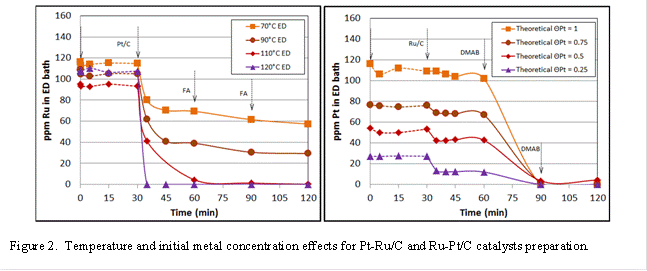
In catalyst synthesis part of my research, formic acid (FA), hexammineruthenium(III) chloride (Ru(NH3)6Cl3) and commercially available 20 wt% Pt/C were used for the preparation of Ru-Pt/C catalysts. This ED bath used formic acid as the reducing agent (which was catalytically activated on the Pt surface) and Ru(NH3)6Cl3 as the reducible Ru salt. The working pH of this bath was maintained below pH 4.8, the measured point of zero charge of the Pt/C catalyst to avoid strong electrostatic adsorption of Ru(NH3)63+ on the carbon surface. Dimethylamine borane (DMAB), chloroplatinic acid (H2PtCl6) and commercially available 20 wt% Ru/C) were used for the preparation of Pt-Ru/C bimetallic catalysts. This ED bath used DMAB as the reducing agent and H2PtCl6 as the reducible Pt salt. By controlling different reaction temperatures and initial metal salt concentrations, a series of different weight loading and coverage Pt-Ru/C and Ru-Pt/C catalysts were synthesized, which are shown in Figure 2.
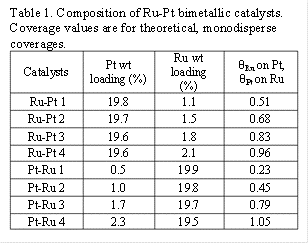
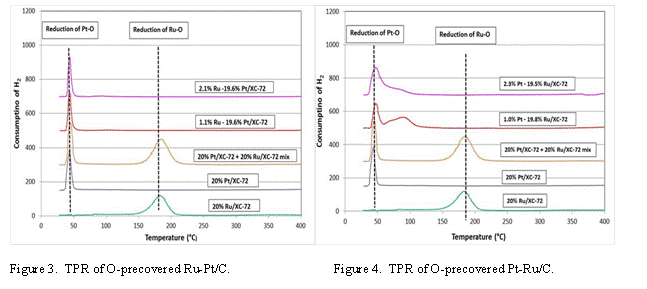
The catalysts prepared in this study are summarized in Table 1. Temperature Program Reduction (TPR) of O-precovered surfaces was used to infer the surfaces of the bimetallic catalysts and selective chemisorption was used to measure the concentration of surface sites for both monometallic catalysts. The TPR results for a select number of the Ru-Pt/C and Pt-Ru/C catalysts are shown in Figures 3 and 4, respectively. Reduction of Pt-O sites occurs rapidly at 40°C, while temperatures of approximately 180°C are required to reduce Ru-O sites. For the bimetallic surfaces, Pt-assisted reduction of Ru-O occurs, with higher atomic ratios of Pt/Ru giving lower reduction temperatures. The absence of Ru-O reduction peaks at 180°C confirms the existence of Pt-Ru bimetallic surfaces, and not separate Ru and Pt particles.
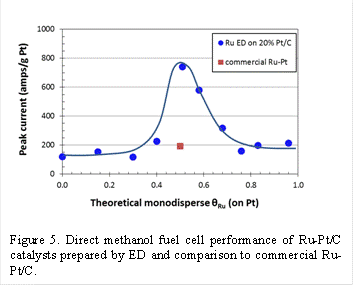
The Ru-Pt compositions have also been examined for direct methanol fuel cell (DMFC) activity and the results are shown in Figure 5. The Ru-Pt/C catalysts prepared by ED have much higher activity than commercial Ru-Pt/C composition of 6.8 wt% Ru-13.2 wt% Pt/C. The optimized composition is 1:1 atomic ratio for Pt and Ru.
The next part of my research will be testing Pt-Ru/C and Ru-Pt/C bimetallic catalysts prepared by electroless deposition for biomass upgrading. The initial reaction is levulinic acid hydrogenation.
References
[1]. Regalbuto, J.R. in "Catalyst Preparation: Science and Engineering" CRC Press, Boca Raton, 2007.
[2]. Schaal, M.T., Pickerell, A.C., Williams, C.T., and Monnier, J.R. J. Catal. 254, 131 (2008).
[3]. Rebelli, J., Rodriguez, A.A., Ma, S.G., Williams, C.T., and Monnier, J.R. Catal. Today 160, 170 (2011).
[4]. Hamnett, A. Catal. Today 38, 445 (1997).
See more of this Group/Topical: Catalysis and Reaction Engineering Division