
 Google
 Yelp
 Facebook
 Twitter
 ChEnected
322468 Concomitant Co-Crystallization On Engineered Surfaces
Concomitant Co-Crystallization on Engineered Surfaces
Xingyi Shi, Shin Yee Wong, Xiaochuan Yang and Allan S. Myerson
Department of Chemical Engineering, Massachusetts Institute of Technology, 77 Massachusetts Avenue, 66-568, Cambridge, Massachusetts 02139, United States
Co-crystals are crystalline materials made up of two or more components. In pharmaceutical systems, co-crystals are used to enhance the physical properties (e.g. solubility or melting point) of a drug substance via non-covalent interactions with a co-former. Numerous high throughput screening methods have been proposed1. However, few of these studies examine polymorphism of the co-crystals. In our previous work2, patterned self-assembled monolayers (SAMs) were shown to be an attractive tool for polymorph screening. To expand the application to co-crystals, the patterned SAMs substrates were used for the concomitant co-crystallization of caffeine-oxalic acid.
Bi-functional patterned SAMs were prepared by photolithography using silicon wafers as the base substrate coated with 5 nm titanium and 50 nm gold layers. The patterned gold substrates have an island diameter of 500 µm, with the hydrophilic gold island functionalized with the –COOH group, and hydrophobic long-chain alkyl group on the silicon substrate. Co-crystallization experiments were conducted by forming an array of droplets of caffeine and oxalic acid solution (2:1 molar ratio) in chloroform: methanol (7:2 v/v) onto the SAMs. Then, the solvents were allowed to evaporate. Once the co-crystal is formed, the crystals were characterized by Raman spectroscopy and X-ray diffraction. Compared to the Raman spectrum of the co-crystal (reference) reported earlier3, polymorphs with distinct Raman peaks at 1076 and 1588 cm-1 were observed. With six repeated experiments, more than 50% of the islands were found to be the reference co-crystal. On non-reference co-crystal islands, majority of the crystals have peaks at 1076 and 1588 cm-1 in addition to the co-crystal reference peaks, with some of them having a lone peak at either 1076 or 1588 cm-1. Besides, the XRD diffraction pattern also showed additional peaks at 2θ of 30o and 32.3o, further confirming the presence of a new co-crystal form.
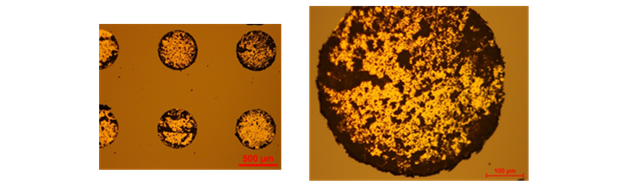
Figure 1. Co-crystals grown on SAMs at increasing magnification
Reference:
1. Elbagerma, M. A.; Edwards, H. G. M.; Munshi, T.; Hargreaves, M. D.; Matousek, P.; Scowen, I. J. Crystal Growth & Design 2010, 5, 2360-2371.
2. Singh, A.; Lee, I. S.; Myerson, A. S. Crystal Growth & Design 2009, 2, 1182-1185.
3. Trask, A. V.; Motherwell, W. D. S.; Jones, W. Crystal Growth & Design 2005, 3, 1013-1021.
See more of this Group/Topical: Pharmaceutical Discovery, Development and Manufacturing Forum