
 Google
 Yelp
 Facebook
 Twitter
 ChEnected
322825 Modeling a Fixed-Bed Reactor for the Oxidative Dehydrogenation of Ethane On a Multimetallic Mixed Oxide Catalyst
Catalytic oxidative dehydrogenation of ethane (ODH-Et) has become an attractive alternative to replace the current processes for ethylene production, i.e., pyrolysis, steam cracking, catalytic dehydrogenation and fluid catalytic cracking [1,2]. In the context of catalysts, several formulations have been evaluated for ODH-Et, the multimetallic mixed oxide system Mo-V-Nb-Te-O being one of the most promising materials in view of its high efficiency for ethylene production [3,4]. In the process scenario, however, the most convenient reactor configuration is still under investigation from a potential industrial point of view due to the high exothermicity of the main and, mostly, the secondary reactions associated to the ODH-Et. In this regard, the aim of this work is to simulate the catalytic behavior of a Mo-V-Nb-Te-O catalyst in a single-tube wall-cooled fixed-bed reactor for the ODH-Et.
A 2D pseudo-homogeneous fixed-bed reactor model that couples heat and mass transport phenomena to kinetics was proposed to describe the ODH-Et on a Mo-V-Nb-Te-O catalyst. The effective heat and mass transport parameters were obtained from a previous study wherein the role of hydrodynamics was assessed with some detail [5]. The reactor model was given in terms of a set of parabolic partial differential equations, which were solved numerically by the method of orthogonal collocation using 30 and 50 interior collocation points at the radial and axial coordinates, respectively, employing shifted Legendre polynomials [6]. The resulting set of ordinary differential equations was then solved by the Runge–Kutta–Fehlberg method [7]. A kinetic model based on a Langmuir-Hinshelwood-Hougen-Watson mechanism considering a single type of active sites over the catalyst surface was developed. It considered that surface reactions are RDS while adsorption/desorption steps were in quasi-equilibrium. The corresponding kinetic parameters estimation was carried out using the multi-response and multi-parameter optimization method of Levenberg-Marquardt [8].
For a 10 m length and 2.5 cm ID reactor and the following operating conditions, viz., coolant inlet temperature: 400-480 °C; reaction mixture inlet temperature: 100-200 °C, inlet molar concentration of 9/7/84 for C2H6/O2/Inert and Reynolds particle number of 630, predicted dimensionless concentration and temperature profiles along the reactor indicate that ethane conversion varies from 15%-75% and ethylene selectivity from 80%-95%, with a slightly temperature increment in the range 5-70 °C indicating the presence of a slightly hot spot, see Figures 1-3. These results suggest, in principle, that the wall-cooled fixed-bed reactor represents a promising alternative to carry out the ODH-Et over the mentioned catalyst formulation.
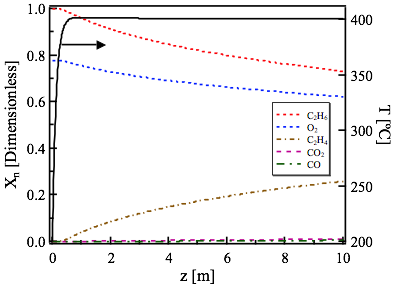
Figure 1. Simulated dimensionless concentration and temperature profiles of ethane in the reactor length. Operating conditions as follows: coolant temperature of 400 °C, an inlet temperature of 200 °C, an inlet molar concentrations of 9/7/84 for C2H6/O2/Inert and a Reynolds particle number of 630.
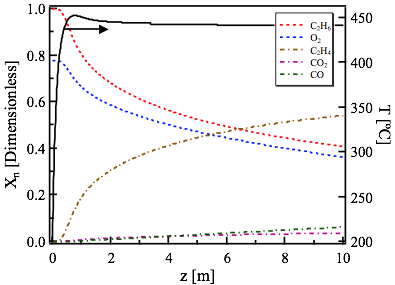
Figure 2. Simulated dimensionless concentration and temperature profiles of ethane in the reactor length. Operating conditions as follows: coolant temperature of 440 °C, an inlet temperature of 200 °C, an inlet molar concentrations of 9/7/84 for C2H6/O2/Inert and a Reynolds particle number of 630.
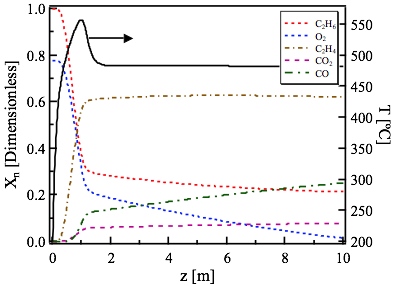
Figure 3. Simulated dimensionless concentration and temperature profiles of ethane in the reactor length. Operating conditions as follows: coolant temperature of 480 ¼C, an inlet temperature of 200 ¼C, an inlet molar concentrations of 9/7/84 for C2H6/O2/Inert and a Reynolds particle number of 630.
[1] F. Cavani, N. Ballarini and A. Cericola, Catal. Today 127, 113-131, 2007.
[2] X. Liu, H. Zhu, Q. Ge, W. Li and H. Xu, Prog. Chem. 16, 900-910, 2004.
[3] J. M. L—pez Nieto, P. Botella, M. I. V‡zquez and A. Dejoz, Chem. Commun. 1906-1907, 2002.
[4] P. Botella, E. Garc'a-Gonz‡lez, A. Dejoz, J.M. L—pez Nieto, M.I. V‡zquez and J. Gonz‡lez-Calbet, J. Catal. 225, 428-438, 2004.
[5] C.O. Castillo-Araiza, H. JimŽnez-Islas and F. L—pez-Isunza. Ind. Eng. Chem. Res. 46, 7426-7435, 2007.
[6] B. Finlayson. Nonlinear Analysis in Chemical Engineering. McGraw-Hill, New York, 1980.
[7] L. Lapidus and J. Seinfeld. Numerical Solution of Ordinary Differential Equations. Academic Press, New York, 1971.
[8] W. E. Stewart, M. Caracotsios and J. P. Szrensen, AIChE Journal. 38, 641-650, 1995.
See more of this Group/Topical: Catalysis and Reaction Engineering Division