
 Google
 Yelp
 Facebook
 Twitter
 ChEnected
323721 Effects of Cs-Exchanged Heteropolyacid (CsxH3-xPW12O40) On the Hydrocracking of Extra-Heavy Oil
The global demand for crude oil which has limited reserves in the nature has changed radically in the first years of the 21st Century. It is due to Emerging Countries such as China and India etc., whose dynamic economies resulted in a remarkable 1.8% global growth in demand for crude oil in 2009. However, easy drilling oil or high-quality light crude oil such as gasoline, diesel and naphtha reserves had reached their limits. Accordingly, various efforts have been tried to solve the problem of lack of crude oil. There is growing interest for non-conventional oil such as extra-heavy oil, residue and bitumen as a way to solve the shortage of crude oil. The extra-heavy oil and bitumen are estimated to have about 5.4 trillion barrels of oil reserves. So the petroleum industry is increasingly concerned about extra-heavy oil processing. Such extra-heavy oils are characterized by a low API gravity (<10°Æ) which is denser than water and contain excess of asphaltene, sulfur and metals such nickel and vanadium etc. Due to these poor qualities, many problems has been encountered while the upgrading process.
In upgrading process of heavy oil, the supported catalysts were generally used. In extra-heavy oil hydrocracking process, however, it cannot be used anymore. Because, pore-plugging problem and chemical deactivation were occurred due to the excess of coke, sulfur and metal contaminants in reactant. These deposited metal and coke cause a decrease in the number of catalytic active site, hinder the transport of reacting molecules to the internal catalyst surface. And eventually cause the complete plugging of catalyst pore. Recently, hydrocracking reaction using non-supported catalysts have been studied by many researchers in an effort to overcome the chemical and physical problem associated with supported catalysts.
In this study, we chose Cs substituted Heteropolyacid catalyst as candidate dispersed catalyst, and applied to extra-heavy oil hydrocracking. We prepared with a variation of cesium contents (x=0, 1, 2, 2.25, 2.5, 2.75, 3) using an ion-exchanged method and high temperature (500°ÆC) calcination. This study was performed to clarify the two factors, first is thermal stability of Heteropolyacid catalysts at high reaction temperature. Second is determining the optimum Cs content and key catalytic properties of extra-heavy oil hydrocracking, through the analysis of ICP, XRD, TGA, BET, FT-IR, NH3-TPD.
The catalysts which are substituted by Cesium more than 1.8 keep keggin structure in the high temperature (500°) calcination. And as Cs substitution, Heteropolyacid physical and chemical properties change dramatically. Especially, the surface acid sites of Cs2.2 (18.0) increase more than about 3.2 times than HPW (5.5). Among the tested catalysts, Cs2.2 shows the highest activity with the largest surface acid sites. After the hydrocracking reaction using a Cs exchange Heteropolyacid, oil qualities were drastically increased. C/H ratio and API gravity value improved more than 8.1 and 16°Æ (the value corresponding to the heavy crude oil) respectably and obtained more than 90% HDM conversion. The correlation clearly shows that hydrocracking of extra-heavy oil is closely related to the surface acid sites of the catalyst.
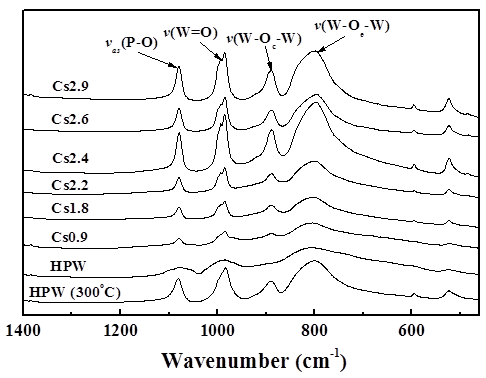
Figure 1. FT-IR spectra of HPW (treatment at 300°ÆC) and Cesium-exchanged Heteropolyacid (CsxH3-xPW12O40, x=0, 0.9, 1.8, 2.2, 2.4, 2.6, 2.9) after treatment at 500°ÆC
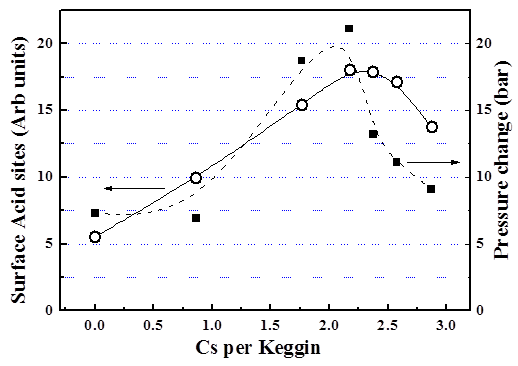
Figure 2. Surface acid sites of Cs-exchanged Heteropolyacid (CsxH3-xPW12O40, x=0, 0.9, 1.8, 2.2, 2.4, 2.6, 2.9) and pressure change during the reaction.
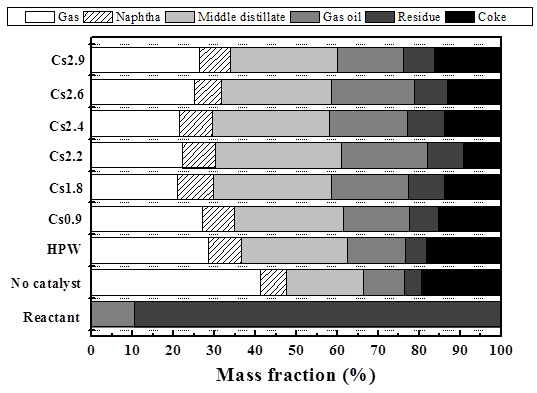
Figure 3. The product yield classified as gas, liquid (Naphtha, Middle distillate, Gas oil, Residue based on the results of SIMDIS) and solid for CsxH3-xPW12O40 (x=0, 0.9, 1.8, 2.2, 2.4, 2.6, 2.9).
See more of this Group/Topical: Catalysis and Reaction Engineering Division