
 Google
 Yelp
 Facebook
 Twitter
 ChEnected
323924 CFD Simulations of Rotating Zigzag Bed Hydrodynamics
The concept of process intensification was first proposed in the late 1970s. High gravity technology (abbreviated to HIGEE), which substitutes terrestrial acceleration for higher centrifugal acceleration (up to 1000 g) achieved by rotating a specially shaped bed, is a promising alternative to enhancing heat and mass transfer in the process intensification field. Compared to conventional distillation columns, the HIGEE can make dramatic reductions in equipment volume, and reduces the capital and operation costs accordingly.
Generally, an HIGEE device mainly consists of a rotor housed in a stationary casing and driven by a motor. The structure of rotor determines the characteristics of different HIGEE devices. There are several types of rotors, such as packing bed, wave form disk, helical bed, multi-staged spraying bed and split packing bed. Another type of HIGEE device, referred to as rotating zigzag bed (RZB), was invented by Ji et al. and patented in China and the United States. It has been successfully applied in continuous distillation service after unremitting improvements and tests. The simplified sketch of the RZB is shown in Figure 1. Tow series of concentric circular sheets are alternately fixed on the rotational (lower) and stationary (upper) disk, respectively; one series as rotational baffles and the other as stationary baffles. The clearance between rotational baffles and the stationary disk as well as between the stationary baffles and rotational disk offers zigzag flow channels for fluids. The gas is introduced into the casing and flows inward radially driven by pressure difference. The liquid is fed at the center of the rotational disk flowing outward countercurrent to gas by virtue of centrifugal force. In the interior of the rotor, the gas flows as continuous phase along a zigzag path and the liquid undergoes multiple dispersion-accumulation recycles. The liquid is dispersed in fine droplets by rotational baffles. These droplets are intercepted by stationary baffles and then accumulate to form liquid film which falls onto the rotational disk again. Then the liquid flows radially outward to the next rotational baffle and is dispersed, and so on. During this process, impingement and spray of the liquid in the rotor results in fast-renewed gas-liquid interface with very large specific surface area available for mass transfer.
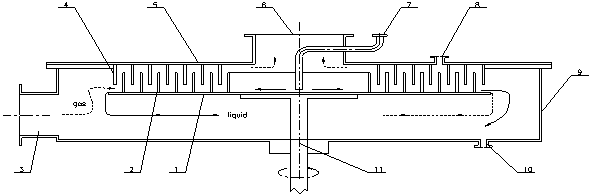
Figure 1. Simplified sketch of the rotor of the RZB.
1-Rotational disk, 2-Rotational baffles, 3-Gas inlet, 4-Stationary baffles, 5-Stationary disk, 6-Gas outlet, 7-Liquid inlet, 8-Intermediate feed, 9-casing, 10-Liquid outlet, 11-Rotating axle
Mass transfer performances of RZB and other HIGEE devices have been experimentally studied in the literature, but few studies on the hydrodynamics have been reported. The understanding of the two-phase hydrodynamic phenomenon in the rotor is helpful for the fine tuning and optimization of HIGEE device design.
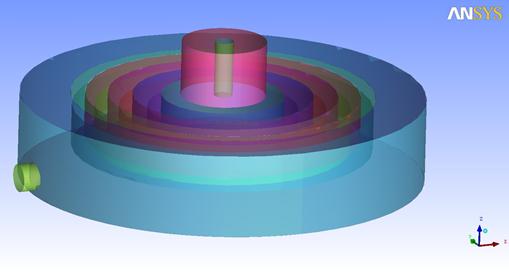
Figure 2. 3D physical model of RZB.
Due to progresses in computer hardware and software and consequent increase of the calculation speed, the computational fluid dynamics (CFD) modeling technique becomes a powerful and effective tool for understanding the complex hydrodynamics in chemical engineering processes. In this study, a three-dimensional CFD model was developed to predict the hydrodynamics of RZB as shown in Figure 2. The model considered gas- and liquid-flow within the Eulerian-Eulerian framework in which both phase were treated as interpenetrating continuum having separate transport equations. With the model focusing on the interphase contacting region, the liquid phase has been taken as the disperse phase, while the gas phase has formed the continuous phase. Interphase momentum transfer term was employed for describing the interfacial forces between the two phases. Since the focus is on the hydrodynamics behavior of RZB, energy and mass transfers have not been considered in this study.
See more of this Group/Topical: Separations Division