
 Google
 Yelp
 Facebook
 Twitter
 ChEnected
324244 MINLP Optimization of a Membrane-Absorption-Hybrid System for the Removal of CO2 From OCM Product Gas
The Oxidative Coupling of Methane (OCM) presents a possibility for catalytically turning methane into longer hydrocarbons, especially ethylene and ethane. Hence, it could be an opportunity for replacing oil with methane from natural or biogas for producing base chemicals such as polymers, ethylene oxide etc.
As part of the Cluster of Excellence “Unifying Concepts in Catalysis”, funded by the German Research Foundation, a mini-plant has been built at Berlin University of Technology (Technische Universität Berlin). The mini-plant features several types of reactors, e.g. fixed-bed, membrane, and fluidized-bed reactors. For the subsequent product gas separation an absorption-desorption process, two gas separation membranes, and an adsorption-desorption unit for the removal of carbon dioxide (CO2) are installed. An initial introduction of a single membrane module upstream to the absorption unit showed a decrease of the energy required for the removal of 90% of the CO2 contained in the feed gas from 5.02 MJ to 2.76 MJ per captured kilogram of CO2 [1].
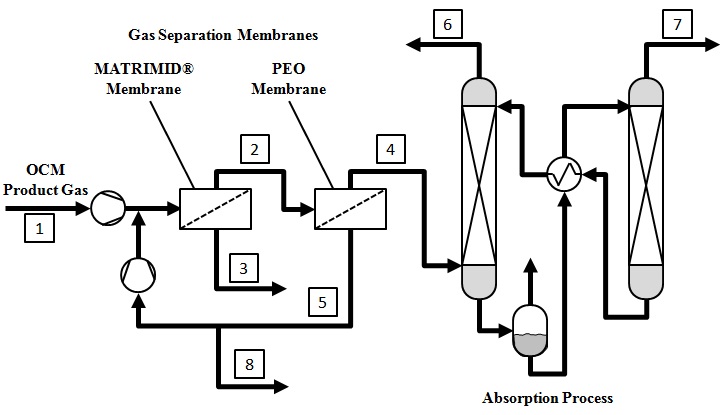
Figure 1: Simplified process flow sheet for the initial membrane-absorption-hybrid system for the removal of CO2 from OCM product gas [2].
Hereby, the determination of the optimal combination and operation conditions of these reaction and separation units only through experimental investigations has proven to be challenging. On top of that, there are fluctuations in all mass and energy flows, which have to be taken into regard to ensure a safe and reliable operation. Consequently, simulative optimization under uncertainty of the entire superstructure is proposed. As a first step, the stand-alone amine-based absorption desorption process was modeled and fitted to mimic the actual behavior of the installed unit in the mini-plant. As a second step the two-stage membrane system was added upstream to the absorption unit to achieve a decrease of the required energy duty for the CO2 removal. The OCM product gas is fed to a first polyimide (MATRIMID®) membrane module, which shows a high selectivity for CO2 compared to ethylene, ethane, and methane. Additional CO2 is removed in the second module, which contains a polyethylene oxide (PEO) membrane. Given a slightly lower CO2/C2H4 selectivity a part of its permeate stream is recycled and added to the OCM product gas at the inlet. The retentate flow of the second membrane module is then fed to the absorption desorption unit to achieve the required CO2 removal of 90%. Initial NLP optimization studies of the proposed structure depicted in Figure 1 [2] showed a further decrease of the energy required per captured kilogram of CO2 from 2.76 down to 2.57 MJ, while keeping the ethylene loss in the hybrid system below 5%. This is mostly achieved by a considerably lower feed gas pressure of 21.2 instead of 32.0 bar and an increase of the CO2 concentration after the recycle before the first membrane. In order to optimize the system validated process models have been developed both for the membrane models as well as the absorption process [2], which will be adapted here.
In this contribution, the complexity of the membrane section of the hybrid system is increased. Apart from the two-stage combination of Matrimid® and PEO membrane modules several other combinations with even more membrane types are of interest. A possible superstructure with a maximum of six membranes is given in Figure 2.
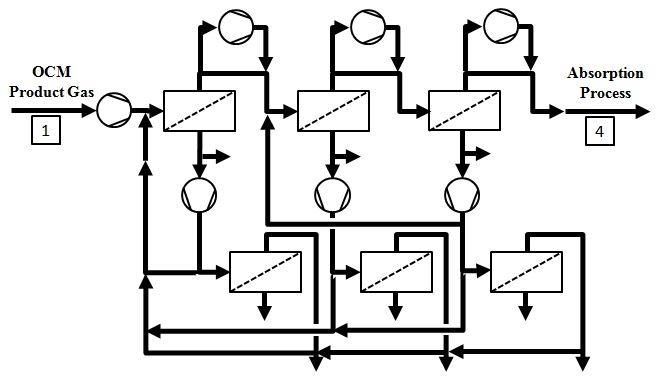
Figure 2: Superstructure showing a variety of possible connections to combine up to four membrane modules before feeding the gas to the absorption process. The membranes can contain either Matrimid® or PEO as permeable polymers.
Based on this superstructure alone, 4096 different structures for the membrane section by itself are possible. Seeing as the two-stage membrane together with the absorption system showed a nice behavior in terms of computation time and complexity, an MINLP formulation of the new system is done. The superstructure shown above is added to the absorption process. The whole system is mathematically described with the models already derived in previous studies [2] using the web-based modeling environment MOSAIC [3] from the Berlin University of Technology to formulate and to export the optimization problem to AMPL. Therein, various solvers such as Couenne [4] and Bonmin [5] are employed to solve the MINLP. To increase the numerical stability of the MINLP optimization a method is implemented to update the starting values of inactive parts of the superstructure.
The objective of the MINLP optimization is the minimization of the specific energy required per kilogram of CO2 removed, while keeping the CO2 removal rate at 90% and the ethylene loss below 5%. Apart from the structural binary variables, the decision variables consist of the membrane types, the length and operation pressure of each membrane module, recycle flow rates as well as the main operational variables of the absorption process, i.e., feed gas pressure, absorbent flow rate, as well as heating duty in the desorption.
In this contribution details on the modeling and optimization of the MINLP are presented to discuss the benefit of more complex gas separation process structures to reduce product loss as well as the required energy. Additionally, the experimental validation in the actual mini-plant will be discussed.
Acknowledgements: This work is part of the Cluster of Excellence “Unifying Concepts in Catalysis” coordinated by the Berlin University of Technology (TechnischeUniversität Berlin). Financial support by the German Research Foundation (Deutsche Forschungsgemeinschaft, DFG) within the framework of the German Initiative for Excellence is gratefully acknowledged.
References
[1] Stünkel, S., Bittig, K., Godini, H., Jaso, S., Martini, W., Arellano-Garcia, H., and Wozny, G. (2012) Process Development in a Miniplant Scale – A Multilevel - Multiscale PSE Approach for Developing an Improved Oxidative Coupling of Methane Process, 11th International Conference on Process Systems Engineering, Singapore.
[2] Esche, E., Müller, D., Song, S., Wozny, G. (2013) Optimization of a Membrane-Absorption System for the Removal of CO2 from OCM Product Gas, 6th International Conference on Process Systems Engineering (PSE ASIA 2013), accepted for publication.
[3] Kuntsche, S., Arellano-Garcia, H., and Wozny, G. (2011) MOSAIC, an environment for web-based modeling in the documentation level, Computer Aided Chemical Engineering 29, 1140-1144 ISBN 978-0-444-54-298-4.
[4] Belotti, P., Lee, J., Liberti, L., Margot, F., Wächter, A. (2009) Branching and bounds tighteningtechniques for non-convex MINLP, Optimization Methods and Software 24 (4-5), 597 – 634.
[5] Bonami, P., Biegler, L.T., Conn, A.R., Cornuéjols, Grossmann, I.E., Laird, C.D., Lee, J., Lodi, a., Margo, F., Sawaya, N., Wächter, A. (2005) An algorithmic framework for convex mixed integer nonlinear programs. Tech. rep., IBM Research Report RC23771. To appear in Discrete Optimization.
See more of this Group/Topical: Separations Division