
 Google
 Yelp
 Facebook
 Twitter
 ChEnected
324683 From High Throughput Lab to Pilot-Plant Scale – Parallel Testing of Hydroprocessing Catalysts
From high throughput
lab to pilot plant scale –
Parallel testing of Hydroprocessing Catalysts
Sascha Vukojevic*, Florian Huber, Tilman Sauer, Jochen Berg, Alfred Haas
hte Aktiengesellschaft -the high throughput experimentation company-, Kurpfalzring 104, 69123 Heidelberg, Germany
*Sascha.Vukojevic@hte-company.de
Introduction
Increasing global demands for fuels, the tightening of environmental regulations and the optimization of refineries has led to an increasing demand for commercial catalyst testing capacity for refining applications. High throughput catalyst testing is a time and cost efficient approach that can meet this demand. In the past, the domain of high throughput testing was the evaluation of powder samples (typically below 200 μm). Over the last couple of years hte has developed standard operating procedures (SOP) for parallel testing of commercial catalyst sizes (typical diameter for extrudated hydroprocessing catalysts of around 1.5 mm) at scales of 1 to 100 ml.
A typical example for comparative testing of commercial catalysts in the refining area is the ranking of hydroprocessing catalysts for HDS, HDN and HAD applications. Depending on the scope of the catalyst evaluation, different bench-scale reactor systems can be used. Catalyst development and discovery, hence screening of a large number of powder-, or full-size extrudated catalyst samples with main focus on catalyst activity and basic product characteristics calls for small catalyst amounts (typically 1-3 ml) and high degree of parallelization (typically 16-fold high throughput systems). Ranking of catalysts for commercial scale installations with focus on catalyst performance as well as detailed product characteristics requires somewhat larger catalyst amounts (typically 5 – 50 ml) and modest degree of parallelization (typically 4-fold pilot plant reactor systems).
In the present case study, we will discuss the progress in experimental procedures and workflows developed at hte company for ranking commercial catalysts at these different scales in parallel fixed-bed trickle flow reactor systems. The latest developments in the field of high throughput reactor technology for refinery applications will also be shown, including parallel catalyst testing technology in a pilot-plant scale with higher catalyst volumes.
Results and Discussion
Figure 1 shows the comparison of two commercial HDS catalysts in a 16-fold high throughput reactor system with a catalyst volume of 1.5 ml. The comparison is based on the ratio of the reaction rate constants. Figure 2 shows the comparison for the same two catalysts tested in a 4-fold pilot plant reactor system with a catalyst volume of 35 ml. When comparing both figures, it can be seen that catalyst ranking at different scales gives the same result when proper experimental procedures are applied. In addition, it can be seen that small scale high throughput setups can have higher data resolution and better statistics.
The aim of the hte workflows is not only to rank catalysts at a certain scale under given fluid dynamic conditions, but even more important to get the same quantitative ranking at different scales by tuning the fluid dynamic environment in the reactor systems. For instance, the comparison of Figure 1 and 2 shows that despite a scaling factor of around 20, the ranking in the small scale 16-fold high throughput reactor system and the larger scale 4-fold pilot plant reactor system gives the same quantitative result. Consequently, these workflows allow up- or downscaling of commercial catalyst testing in bench-scale reactor systems depending on the focus of a testing campaign.
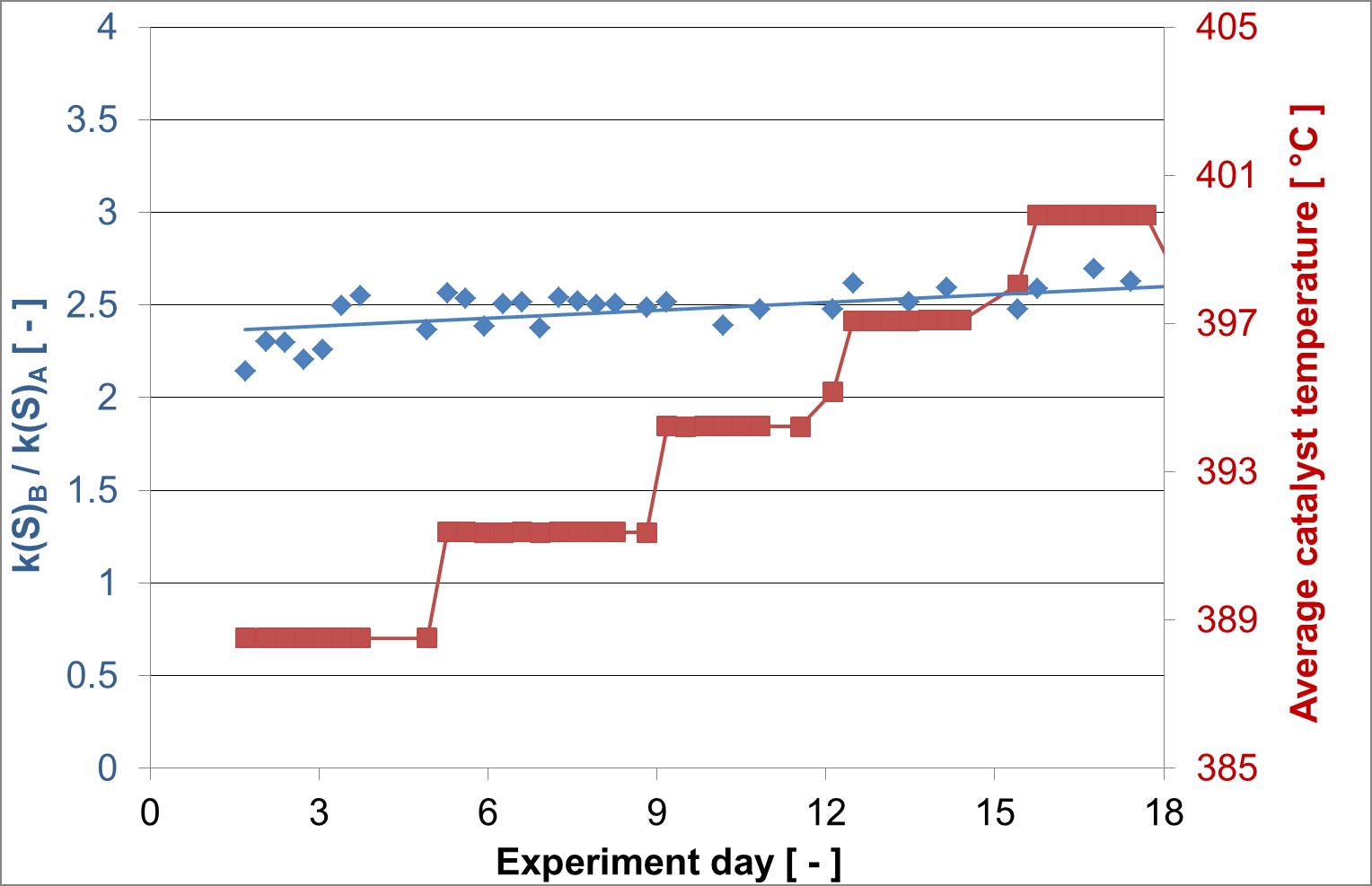
Figure 1 Comparison of two commercial HDS catalysts, A and B, in a 16-fold high throughput reactor system (catalyst volume of 1.5 ml). Ratio of reaction rate constant kB/kA and operation temperature as function of time on stream.
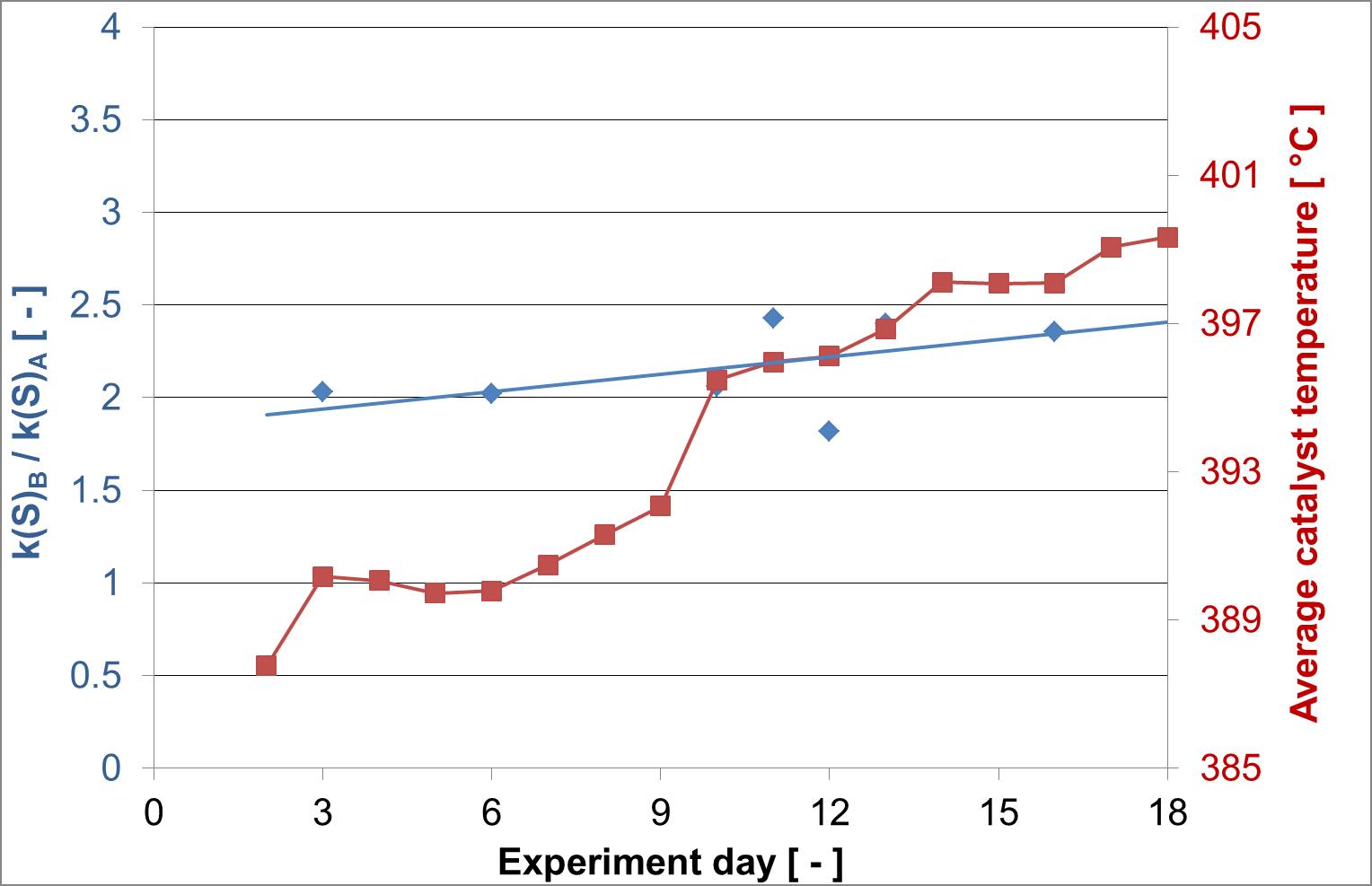
Figure 2 Comparison of two commercial HDS catalysts, A and B, in a 4-fold pilot plant reactor system (catalyst volume of 35 ml). Ratio of reaction rate constant kB/kA and operation temperature as function of time on stream.
In our case study, we will present the latest trickle-flow reactor technology developments at for high throughput experimentation in heterogeneous catalysis and discuss the variables that can be tuned to control and compare the hydrodynamics of gas and liquid flow at different scales – from lab scale to pilot plant scale. Especially the importance of reproducible reactor packing and controlling the particle size distribution of diluent materials will be emphasized.
See more of this Group/Topical: Catalysis and Reaction Engineering Division