
 Google
 Yelp
 Facebook
 Twitter
 ChEnected
324733 Process Intensification in Millistructured Extraction Columns
Process intensification in millistructured extraction columns
The downstream process of biochemical and pharmaceutical products can account up to 80% of the cost of production. [1,2] To reduce the cost it is necessary to develop new process intensified equipment with higher time-volume-yield. Process intensification is one important part to make the industry more economical and ecological. Some mass or heat transport limited chemical reactions are only technical possible or cost-efficient with process intensified equipment. The small channels and structures in this equipment gives the potential to control the fluids on the sub-millimeter scale. The known characteristics of transport phenomena enable an easy and fast scale up for bulk chemicals from lab to industrial scale.
We investigated the process intensification in millistructured extraction columns with an inner diameter of 15 mm, see figure 1. The column has 20 stirred cells and an active extraction high of 440 mm. The total internal volume with head and bottom is 220 ml with total height of 760 mm. With stirred cells we achieved high energy input, high specific surface between the two phases and thus good mass transfer. The backflow was decreased with narrow plates between the plates. Thus, the dispersed phase coalesces at the plates and plugs the stirred cells. With axial pulsation of the fluid the coalescence area is destroyed and the dispersed phase is transported into the next cell. This new technique allows for controlled flow of the dispersed phase into the next stage. The retention times for counter current processes can be adjusted for transport limited processes or reactive extraction systems.
The hydrodynamics and mass transfer inside the column was characterized with the European Federated Chemical Engineering (EFCE) testsystem n-butylacetate(d)/acetone/water(c). The mass transfer from continuous-to-disperse (c-d) and from dispers-to-continuous (d-c) and the droplet size distribution with extraction efficiency was investigated. Different to conventional columns, the energy input inside the stirred cells are higher and the influence on the coalescenc and mass transport direction is not so large. We achieved specific surfaces between the two fluids up to 3200 m^2/m^3 and measured the mass transfer up to 7 theoretical extraction stages per active high (H = 440 mm). This correspondsto 16 theoretical stages per meter, see figure 1. The experiments show that higher total throughput yields higher extraction efficiencies, hence, high mass flow rates are preferred.
The enantioselective extraction of (R/S)-α-cyclohexyl-mandelic acid will be investigated as an example; see the molecules in figure 2. The enantioselective extraction is an organic/aqueous reactive extraction. The enantiomers create in the aqueous phase a complex with hydroxy-propyl-ß-cyclodextrin. The (S)-complex is preferred to the (R)-complex, so that the extraction is selective. The whole process is mass transport limited and has a low selectivity. In conventional columns the extraction is impossible, because the retention time of the dispersed phase and the specific surface between the two fluids are too small. In process intensified extraction columns with high specific surfaces and many extraction stages the counter current extraction is possible. First results show a considerable separation of the two enantiomers.
[1] Lowe C. R., Lowe A. R., Gupta G., New developments in affinity chromatography with potential application in the production of biopharmaceuticals, J. Biochem. Biophys. Methods 49, 2001, 561–574
[2] Strube J., Sommerfeld S., Challenges in biotechnology production—generic processes and process optimization for monoclonal antibodies, Chemical Engineering and Processing, 44, (10), 2005, 1123-1137
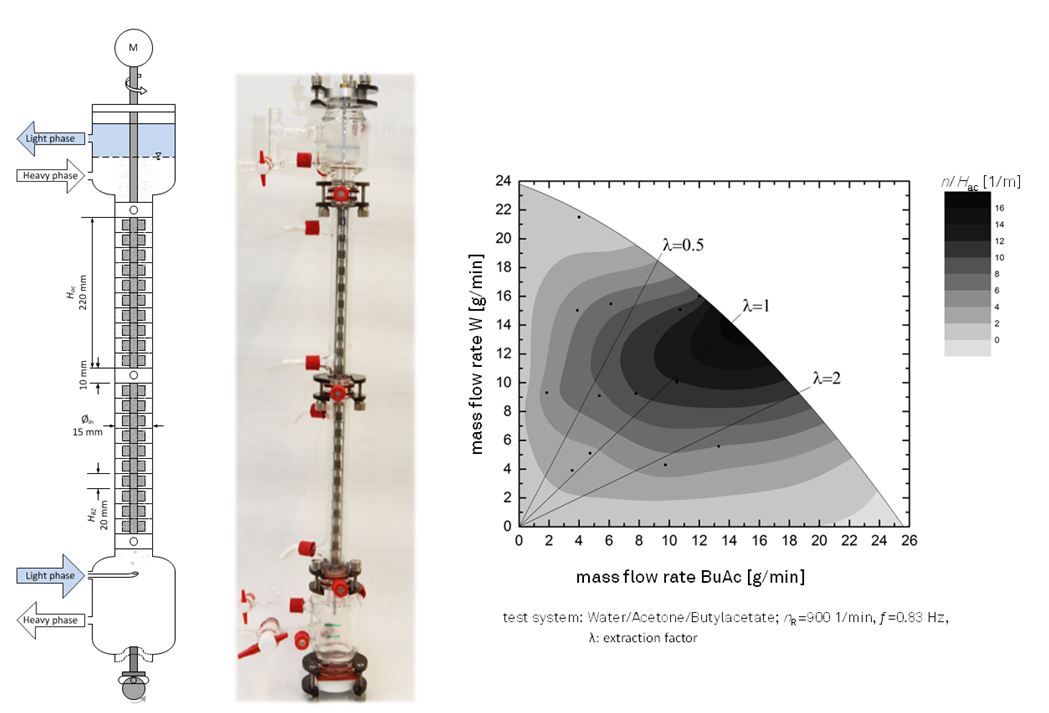
Figure 1: Millistructured extraction column; left side: sketch and picture of the column with two sections; right side: experimental extraction efficiency with different mass flow rates
| (S)-α-cyclohexyl-madelic acid
|
| (R)-α-cyclohexyl-madelic acid
|
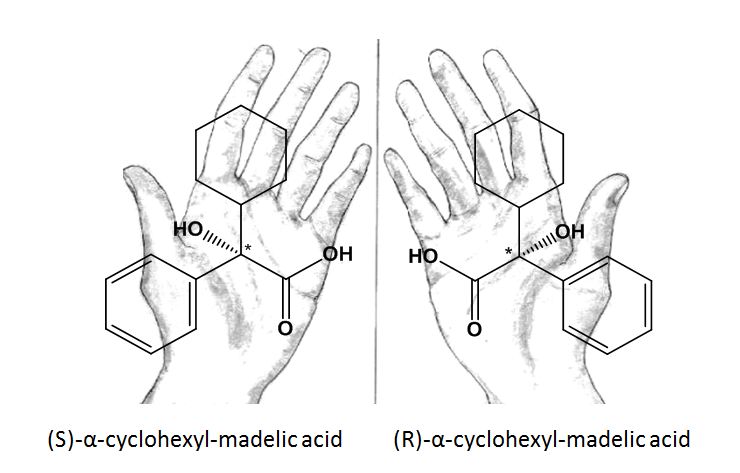
Figure 2: Molecular structure of (S) and (R)- α-cyclohexyl-madelic acid
See more of this Group/Topical: Process Development Division