
 Google
 Yelp
 Facebook
 Twitter
 ChEnected
325307 Detailed Kinetic Modeling of Selective Catalytic Reduction of NO With C3H6 On Cu-Chabazite Monolithic Catalyst
Detailed Kinetic Modeling of Selective Catalytic Reduction of NO with C3H6 on Cu-chabazite Monolithic Catalyst
Richa Raj, Michael P. Harold and Vemuri Balakotaiah
Department of Chemical & Biomolecular Engineering, University of Houston, Houston, TX, United States.
Abstract
NOx storage and reduction (NSR) and selective catalytic reduction (SCR) are the two commercialized aftertreatment technologies for the reduction of NOx emissions from lean–burn engines The combined LNT-SCR systems are emerging as promising technology for NOx reduction as NOx can be stored during lean phase and NH3 and hydrocarbons (C3H6, C2H4 etc.) released during rich phase can be stored on SCR catalyst and these stored reductants can reduce the NOx coming out from LNT during lean phase. The storage of hydrocarbons and their role as co-reductants of NOx lead to an intricate system. Hence it is important to study the HC-SCR chemistry. A systematic steady state and transient experimental studies were performed to elucidate the mechanistic pathways involved in NOx reduction with C3H6 [1].
The steady state experiments were performed for different feed compositions for CO+O2, C3H6+O2 and C3H6+NO+O2 reaction systems. Fig.1a shows that C3H6 light-off curves for C3H6 oxidation for varying O2 concentration (0.5-5%) in the feed. Similarly, fig.1b shows the C3H6 conversion with temperature for different C3H6 concentration (200-500 ppm). Fig.2a and 2b show the C3H6 and NO conversion in temperature range of 200-550oC for feed with 500 ppm C3H6, 500 ppm NO and 1% and 5% O2 respectively. A steady state detailed kinetic model for NO reduction with C3H6 on Cu-chabazite (Cu-SSZ13) monolith catalyst is developed based on bench scale flow reactor experiments The following mechanistic sequence is proposed based on experimental studies:
R1: C3H6 + S ↔ C3H6-S
R2: O2 + S ↔ O2-S
R3: O2-S + S ↔ 2O-S
R4: C3H6-S + O-S → C3H4-S + H2O
R5: C3H4-S + O-S → C3H4O-S
R6: C3H4O-S + 4O-S → 3CO-S + 2H2O
R7: CO –S↔ CO + S
R8: CO-S + O-S ↔ CO2 + 2S
R9: C3H4O-S + NO → C2H2-NCO-S + H2O
R10: C2H2-NCO- S +3O-S → 3CO-S + N-S + H2O
R11: N-S + N-S ↔ N2 + 2S
. Kinetic Parameters estimated capture the experimental trends and meet the thermodynamic constraints. The spatially 2D (1D + 1D) mathematical model of the catalytic monolith reactor coupled with the detailed kinetic model is used to study the complex reaction system. The kinetic model developed capture the main reaction pathways and predicted conversion (CO, C3H6 and NO) and product distribution (CO, CO2 and N2) are in good qualitative and quantitative agreement with the experimental data. The model predicts for the light off curves for three reaction systems CO+O2, C3H6+O2 and C3H6+NO+O2 for different feed compositions. The kinetic model is used to determine the trends in species surface coverages to explain the experimentally observed trends in selectivities.
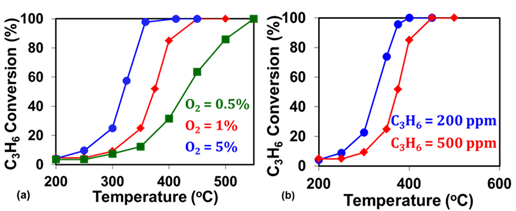
Figure 1 (a) Light- off curves of C3H6 for different oxygen concentrations in the feed (C3H6 = 500 ppm, O2 = 0.5 or 1 or 5%, Balance gas: Ar), (b) Light- off curves of C3H6 for different C3H6 concentrations in the feed (C3H6 = 200 or 500 ppm, O2 = 1 %, Balance gas: Ar),
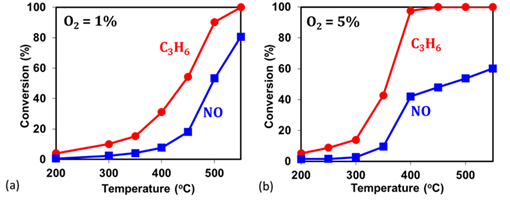
Figure 2(a) C3H6 and NO conversion with temperature (C3H6 = 500 ppm, NO = 500 ppm, O2 = 1%, Balance gas: Ar) (b) C3H6 and NO conversion with temperature (C3H6 = 500 ppm, NO = 500 ppm, O2 = 5%, Balance gas: Ar)
Keywords: SCR, Kinetic Modeling, Cu-chabazite, Propylene
References:
[1] R. Raj, M.P. Harold, V. Balakotaiah, Industrial & Engineering Chemistry Research, revisions pending (2013)
See more of this Group/Topical: Environmental Division