
 Google
 Yelp
 Facebook
 Twitter
 ChEnected
325695 A Detailed Microkinetic Model for SO2 Oxidation From Diesel Engine Exhaust
Hom N. Sharma1, Ashish B. Mhadeshwar1,x and Rampi Ramprasad1, 2,*
1Department of Chemical and Biomolecular Engineering, University of Connecticut, Storrs, CT
2Material Science and Engineering, University of Connecticut, Storrs, CT
x Currently at ExxonMobil Research & Engineering, Annandale, NJ
Currently used ultra-low sulfur diesel (USLD) contains up to 15 ppm sulfur, consistent with the United States Environmental Protection Agency (US-EPA) regulations [1]. In typical diesel engine exhaust, this results into ~1 ppm of sulfur in the oxide form [2], which can deactivate the diesel oxidation catalyst (DOC) after long term exposure as well as result in increased particulate matter (PM) emissions [3-4]. The noble metals (Pt/Pd) based DOC is one of the most expensive components of the emissions aftertreatment system. Despite the extensive research conducted on DOC performance, the interaction of DOC with sulfur oxides in the exhaust is not clearly understood. In this work, first we will discuss the development of a detailed 24 elementary-step microkinetic model for Pt-DOC that accounts for SO2 oxidation. The detailed mechanism development is carried out using several parameter estimation techniques, such as semi-empirical Unity Bond Index-Quadratic Exponential Potential (UBI-QEP), Transition State Theory (TST), quantum mechanical Density Functional Theory (DFT), and temperature programmed experiments in literature. Model predictions for catalytic oxidation of SO2 in fixed bed and monolith reactors under practically relevant operating conditions will be presented (see Figure). The microkinetic model is validated against experimental data and reaction pathways are analyzed. Next, we explore the SOx (x = 0 ─ 4) interactions and reaction pathways of SO2 oxidation on Pt and Pd surfaces using first principles DFT. Our results show good agreement with the experimental observations. The elementary-step surface reaction mechanism and DOC-SOx interactions could be utilized for improved design and control of the aftertreatment system as well as for appropriate DOC sizing.
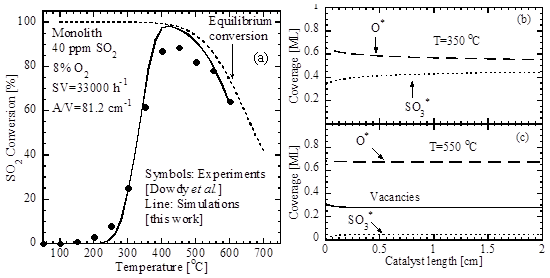
Figure: Panel a: performance of the microkinetic model [5] for SO2 oxidation on Pt. Symbols represent experimental data; solid lines represent our simulations; and dashed lines represent the calculated equilibrium conversion. Panel b: simulated axial coverage profiles at 350 °C. Panel c: simulated axial coverage profiles at 550 °C.
References
[1] Environmental Protection Agency, Federal Register. Vol. 71, No. 83 (2006).
[2] O. Kröcher, M. Widmer, M. Elsener, D. Rothe, Ind. Eng. Chem. Res. 48 (2009) 9847-9857.
[3] M. Lemmetty, T. Rönkkö, A. Virtanen, J. Keskinen, L. Pirjola, Aerosol Sci. Technol. 42 (2008) 916-929.
[4] T. Kolli, M. Huuhtanen, A. Hallikainen, K. Kallinen, R. Keiski, Catal. Lett. 127 (2009) 49-54.
[5] H.N. Sharma, S.L. Suib, A.B. Mhadeshwar, in: Novel Materials for Catalysis and Fuels Processing, ACS, 2013, In press.
See more of this Group/Topical: Environmental Division