
 Google
 Yelp
 Facebook
 Twitter
 ChEnected
325718 On the Filling Rate of a Liquid Bridge Between Wet Particles
While previous research in the area of wet granular flows mainly focused on forces connected to liquid bridges, there is much less theory concerned with the process of liquid transfer upon particle-particle or particle-wall collision. For example, to study the liquid transfer upon bridge rupture, solution of the Navier-Stokes equation (i.e., direct numerical simulations, DNS), or solution based on a quasi-static approximation of the bridge shape can be used [1,2]. For this second stage of the liquid transfer (i.e., liquid bridge rupture), models are already available in literature [3]. However, for the initial fast process of bridge filling, little is known about the rate with which liquid drains into the meniscus.
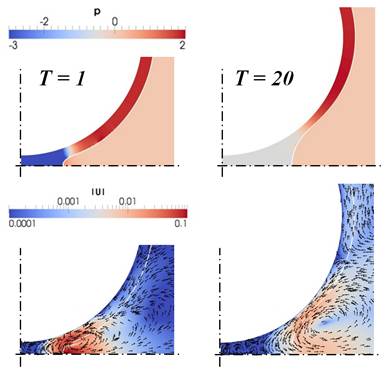
We study the drainage process of free liquid at the surface of two wet particles using (i) DNS (see Figure), as well as (ii) solution of the film height equation. The latter approach neglects the fluid's inertia, and is based on a fixed shape of the velocity profile across the film height. By scanning a large parameter space using DNS, we parameterize a dynamic model for the bridge volume during filling. This model assumes that the particles' relative motion has no effect on the filling rate. Finally, we present results of DNS of moving liquid coated particles to illustrate the effect of a finite Stokes number on the filling process.
References
[1] P. Darabi, T. Li, K. Pougatch, M. Salcudean, D. Grecov, Modeling the evolution and rupture of stretching pendular liquid bridges, Chemical Engineering Science. 65 (2010) 4472–4483.
[2] S. Dodds, M. Carvalho, S. Kumar, Stretching liquid bridges with moving contact lines: The role of inertia, Physics of Fluids. 23 (2011) 092101.
[3] D. Shi, J.J. McCarthy, Numerical simulation of liquid transfer between particles, Powder Technology. 184 (2008) 64–75.
See more of this Group/Topical: Particle Technology Forum