
 Google
 Yelp
 Facebook
 Twitter
 ChEnected
325839 First Principles Investigation of SOx (x = 0 - 4) Chemistry On Pt (111) and Pd (111)
Hom N. Sharma1, V. Sharma2, Ashish B. Mhadeshwar1,3 and R. Ramprasad1, 2,*
1Department of Chemical and Biomolecular Engineering, University of Connecticut, Storrs, CT
2Material Science and Engineering, University of Connecticut, Storrs, CT
3Currently at ExxonMobil Research & Engineering, Annandale, NJ
Sulfur oxides (SOx (x = 0 ─ 4)) in the diesel engine exhaust are one of the major factors contributing toward deactivation of the noble metals (Pt/Pd) based emissions aftertreatment catalysts [1, 2]. Interactions of SOx with the catalyst metals and supports are associated with changes in various structural, morphological, and electronic properties, which can lead to sulfate formation [3, 4]. Despite many experimental and computational studies, SOx interactions with metal surfaces and their impact on catalytic activity are not clearly understood. In the present study, we explore the SOx (x = 0 ─ 4) chemistry in terms of interactions and oxidation pathways on Pt(111) and Pd(111) surfaces using first principles density functional theory (DFT) [5]. We have identified various stable configurations (figure 1), which reveal the charge redistribution patterns, and molecular orbital interactions of SOx on both surfaces during adsorption. The possible reaction pathways and estimated activation barriers for SOx oxidation on the metal surfaces – identified using climbing image nudged elastic band (CI-NEB) method [6] – are found to be in good agreement with the experimental observations. This comprehensive and comparative study provides important insights about SOx chemistry on Pt and Pd surfaces, which can be useful to design and improve sulfur resistance catalyst materials.
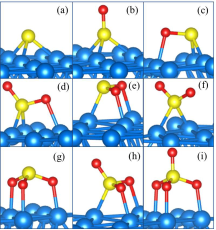
Figure 1: Representative stable configurations of SOx molecules on Pt(111): (a) S (fcc) η1 Sf , (b) SO (fcc) η1-Sf , (c) SO (fcc) η2 SbOa, (d) SO2 (fcc) η2 SbOa, (e) SO2 (fcc) η3 SaOaOa, (f) SO2 (bridge) η1 S┴, (g) SO3 (fcc) η3 OaOaOa, (h) SO3 (fcc) η3 SaOaOa, and (i) SO4 (fcc) η3 OaOaOa. The number super-scripted to η represents the number of atoms in a molecule coordinated to the metal surface; and the subscripts a, b, and f represent the atop, bridge, and fcc hollow sites, respectively.
References
[1] T. Kolli, M. Huuhtanen, A. Hallikainen, K. Kallinen, R. Keiski, Catal. Lett. 127 (2009) 49-54.
[2] A. Russell, W.S. Epling, Catal. Rev. Sci. Eng. 53 (2011) 337-423.
[3] J.A. Rodriguez, J. Hrbek, Acc. Chem. Res. 32 (1999) 719-728.
[4] H.N. Sharma, S.L. Suib, A.B. Mhadeshwar, in: Novel Materials for Catalysis and Fuels Processing, ACS, 2013, In press.
[5] G. Kresse, J. Furthmüller, Phys. Rev. B. 54 (1996) 11169.
[6] G. Henkelman, B.P. Uberuaga, H. Jonsson, J. Chem. Phys. 113 (2000) 9901-9904.
See more of this Group/Topical: Catalysis and Reaction Engineering Division