
 Google
 Yelp
 Facebook
 Twitter
 ChEnected
325961 Monolithic Columns in Thin Layer Format for TLC-MS Separations
Porous polymer monoliths are applicable as stationary phases for a variety of chromatographic modes. Among them, thin layer chromatography (TLC) is a facile and inexpensive separation method, where the mobile phase is propagating through a porous layer by capillary actuation. Owing to its flat format, TLC may be coupled with advanced mass spectrometric (MS) detection methods, like matrix-assisted laser desorption/ionization (MALDI) and laser ablation electrospray ionization (LAESI). It also offers the advantage of increased throughput by permitting to run several samples in parallel lines, while the developed plates can be stored for archiving. Motivated by the increasing attention that TLC is receiving during the last decade, very thin polymeric monolith layers have been prepared on suitable supports and applied for the separation of biomolecules, i.e. peptides, proteins and nucleosides.
The performance of such monolithic thin layers is controlled by both their porous structure and surface chemistry. Thus polystyrene-based, as well as polymethacrylate-based layers have been prepared using UV- or thermally-initiated polymerizations, in the presence of different porogenic mixtures. Their pore surface was subsequently modified via photografting or attachment of functional moieties via chemical reactions.
Specifically, the styrene-based thin layers were hypercrosslinked by Friedel-Crafts alkylation, in order to create a multiplicity of additional mesopores (see Figure 1). Hence, excellent separations of small molecules were achieved (see Figure 2). The methacrylate-based layers were photografted with different functional monomers, whereby the exposure to the initiating UV light was spatially controlled in a fashion that enabled the formation of a diagonal hydrophobicity gradient. Through this adjustment, during two sequential developments in reversed phase and ion-exchange mode, the solutes were able to encounter the gradient twice. Thus truly 2-dimensional separations, with superior resolution and selectivity were realized.1,2
In another implementation, noble metal nanoparticles were attached on the methacrylate-based thin layers, followed by a final modification with polar branched polymer chains, enabling the separation of peptides and nucleosides in hydrophilic interaction (HILIC) mode. Moreover, a functional monomer bearing weakly acidic groups, together with conjugated double bonds may be directly copolymerized with a crosslinker and appropriate porogens. The resulting monolithic thin layers can be used
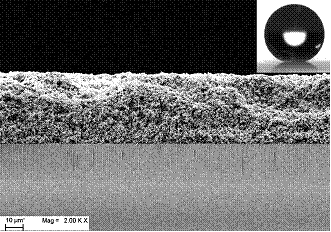
Figure 1. Hydrophobic hypercrosslinked polystyrene-based thin monolithic layer (Scanning Electron Microscopy image).
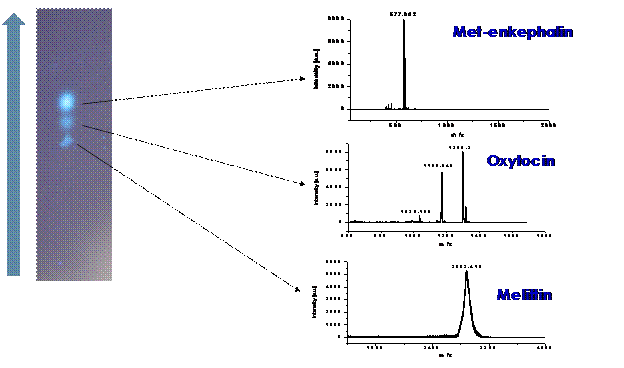
Figure 2. Separation of three peptides on a polystyrene-based thin monolithic layer (left) and subsequent analyte detection by MALDI (right). Mobile phase was 65% acetonitrile in water, with 0.1% trifluoroacetic acid, Development time was 15 min.
as weak-cation exchangers, as well as assist the energy transfer from a laser beam to the adsorbed analytes, thus being ideal substrates for MS detection immediately after the separation. The desorption/ionization of the separated compounds from such functional plates, as well as from those bearing noble metal nanoparticles was actually facilitated without the addition of any matrix medium, which is typically applied. Coupling TLC separation with direct MS detection provides the advantages of simplified sample preparation, as well as improved analytical sensitivity and reproducibility.
1. Han, Y.; Levkin, P.; Abarientos, I.; Liu, H.; Svec, F.; Frechet, J. M. J., Analytical Chemistry 2010, 82 (6), 2520-2528.
2. Urbanova, I.; Svec, F., J. Sep. Sci. 2011, 34, 2345-2351.
See more of this Group/Topical: Separations Division