
 Google
 Yelp
 Facebook
 Twitter
 ChEnected
327347 Packing Economy Analysis for Post-Combustion CO2 Capture
Packing Economy Analysis for post-combustion CO2 capture
by Chao Wang1,2, Micah Perry2, Frank Seibert2, Gary T. Rochelle1
1Department of Chemical Engineering, The University of Texas at Austin
2Separations Research Program, The University of Texas at Austin
Austin, TX 78712
Packing is widely used in post-combustion CO2 capture because of its low pressure drop, good mass transfer efficiency, and ease of installation. In the post combustion CO2 capture process, absorber and stripper costs can be divided into two parts: the capital costs and the operation costs. Economy analysis of these costs has been done by changing the operating gas velocity, liquid flow rate, column diameter, packed height, packing type( including the total area and the corrugation angle) to find the optimum costs.
Capital costs include the one-time investment of building the column, packing costs and auxiliaries such as pump and blower costs. The column and packing costs are determined by the diameter of the column, the packed height, as well as the packing type. The blower purchased costs is determined by the maximum gas flow rate and pressure drop while the pump purchased costs is determined by the maximum liquid flow rate. Operation costs include the running costs and the maintenance costs. The running costs are related to the work of the blower and pump while the maintenance costs are estimated.
The column is operated with 7m MEA at 40°æ with a capacity of approximately 1 mol CO2/kg solvent. The required Number of Transfer Unit (NTU) is calculated based on 90% removal of CO2 with an inlet CO2 concentration of 12mol%. The Height of Transfer Unit (HTU) is calculated by equation HTU=uG/KOGaeRT. The effective area is calculated from modified Tsai's area model:
The overall mass transfer coefficient KOG
is calculated from the gas film mass transfer coefficient kG, liquid
film mass transfer coefficient kL, and the mass transfer coefficient
related to the chemical reactions by this equation: 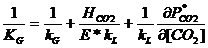
The chemical reaction constant can be obtained from reports; kG and kL values for different packings are from mass transfer models developed from this work based on measured values. Thus, the packed height can be calculated.
For this case, the column is operated with a fixed ratio of gas and liquid flow rate (L/V). The column diameter is calculated by the operating gas velocity (uG). Therefore, the variables can be reduced to two: the gas velocity and the packing type. Eight structured packings with different total area and corrugation angle are chosen to run case by case. An Excel program including all the required information to calculate the total costs is build. The SOLVE function is utilized to optimized the total costs by varying gas velocity throughout the operating range.
For data analysis, the equipment costs are converted to total fixed plant costs by a multiplication factor of 4 based on the Chilton method. The total fixed plant costs is then converted to annualized costs with the assumption of a 1-year start-up time, a 2-year construction time, and a 10-year project life. Finally, the overall costs are described as the costs per tonne CO2 by dividing the annualized costs and the annual CO2 output of the plant.
Results of economy analysis for each packing are shown. For each case, the optimized gas velocity, column diameter, packed height, and the minimized costs per tonne CO2 are listed in tables. The figure of overall costs varying with operating gas velocity is shown. Figure 1 shows the case for packing MP250Y, running in a pilot plant with an annual output of 250MW. Comparison of minimum costs between different packings is made to find the optimized packing total area and corrugation angle.
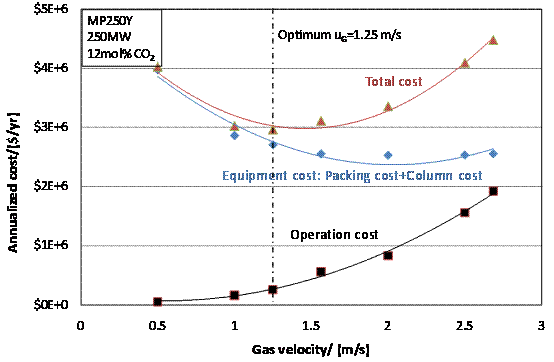
Figure 1. Economy analysis for MP250Y in a 250MW pilot plant
See more of this Group/Topical: Topical Conference: CO2 Capture