
 Google
 Yelp
 Facebook
 Twitter
 ChEnected
327358 Low Temperature Non-Catalytic Transfer Hydrogenation of Coal in Supercritical CO2
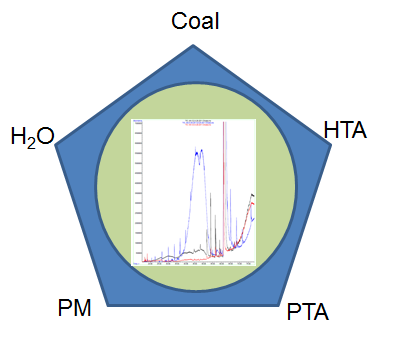
The paper describes the findings from experimental investigations related to the development and characterization of a low temperature (<150 oC) non-catalytic process using a hydrogen transfer agent (instead of molecular hydrogen) for coal dissolution in supercritical CO2. The key idea is that one hydrogen atom from water (W) and one hydrogen atom from the hydrogen transfer agent (HTA) will be used to hydrogenate the coal. Since the products of coal dissolution are expected to be non-polar and polar while the supercritical CO2, which is expected to promote disruption the coal structure, enhance the rates of hydrogenation and dissolve the non-polar molecules and remove them from the reaction site, is non polar, a polar modifier (PM) modifier for CO2 is added to aid in the dissolution and removal of the polar components. In addition, to allow a seamless transport of the ions (HTA) and byproduct (reduced HTA) between the aqueous and organic phases, a phase transfer agent (PTA), is added.
COAL + HTA +H2O → COAL.H2 + reducedHTA
The attractive feature of this process is that the liquid chemicals are obtained without requiring to first convert coal to CO and H2 units. The results show that the process can extract chemicals from coal at temperatures ranging between 80 - 140 oC. The results also show that straight chain hydrocarbons for transportation fuels as well as chemicals such as aromatics with one two or three benzene rings that are needed as chemical precursors for commercial organics, can be extracted from coal by this process. The amount of liquid produced was found to be enhanced if a coal structure disruption step is carried out before the coal hydrogenation step. This can be achieved by the sudden expansion of the supercritical CO2. Incidentally the use of supercritical CO2 not only provides high dissolution strength but also allows for easy separation of the chemicals from the solvent (normally gaseous under room conditions). The effect of the mixture composition of coal/W/HTA/PM/PTA as well as the effect of temperature and pressure will be presented. It should be noted that this process can be used for the extraction of chemicals from biomass, presumably even from lignocellulosic materials.
 |
See more of this Group/Topical: Catalysis and Reaction Engineering Division