
 Google
 Yelp
 Facebook
 Twitter
 ChEnected
327499 An Integrated Solar Photocatalysis‐Organic Membrane Separation and SBR Process for the Treatment of Pharmaceutical Wastewater
1. Introduction
Due to strong oxidation ability, no secondary pollution and mild reaction conditions [1], photocatalysis treatment of pharmaceutical wastewater with refractory organic is becoming attractive recently, and related research have been carried out widely. There is, however, little information about the solar photocatalysis degradation of pharmaceutical wastewater available, and the majority of published solar photocatalysis researches are focused on the compound parabolic collector(CPC) reactor with immobilization of TiO2 on solid supports, which exists mass transfer limitation compared with suspension photocatalytsis, to eliminate the difficult separation and recycling of TiO2.
Based on high separation efficiency and easy operation for organic membrane separation, the paper firstly introduced a novel type of three-phase fluidized bed equipment of solar photocatalysis-organic membrane separation (the equipment) which TiO2 can be recycled, then the combined process of the equipment with SBR (Sequential Batch Reactor) for pharmaceutical wastewater treatment were investigated.
2. Experimental
2.1 Introduction of the equipment
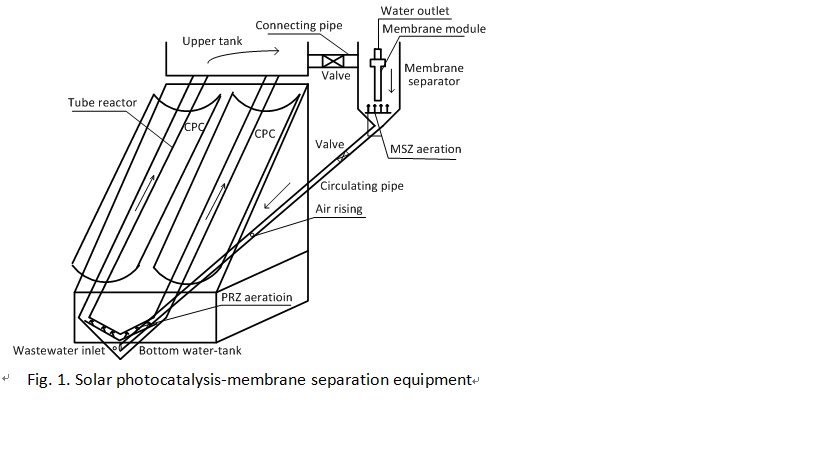
The equipment consists of photocatalytic reaction zone (PRZ) and membrane separation zone (MSZ), which PRZ is comprised of bottom water-tank, casing tube reactor, CPC, upper water-tank and PRZ aeration device, there also are wastewater inlet and sludge outlet in bottom tank, UV lamp (main wavelength of 254 nm, power of 15 W) which is set in the centre of tube reactor. MSZ is comprised of membrane separator shell, submerged membrane module and MSZ aeration device. The water outlet is connected with membrane module. Membrane separator is connected with upper and bottom water-tank by connecting pipe and circulating pipe with air rising jet, respectively. CPC and tube reactor were facing the equator with the certain angle to horizontal plane, which equals local latitude.
Wastewater entering into bottom water-tank rapidly mixes with TiO2 to form three phase fluidized bed under PRZ aeration flow. When the wastewater, containing air bubble and TiO2, flows through shell sides of tube reactor, photocatalytic degradation reaction happens under UV irradiation. Air bubbles escape out of the wastewater when degraded wastewater flows into upper water-tank. Wastewater with only TiO2 flow back bottom water-tank by circulating pipe again after they come into membrane separator by connecting pipe. Obviously, the wastewater in the equipment is always in circulating flow state. TiO2 is intercepted when the wastewater in membrane separator is passing through membrane module and the intercepted TiO2 flows back to the bottom water-tank by circulating flow. Air rinsing makes deposited TiO2 suspend again to keep TiO2 suspension concentration invariable [2].
2.2 Experimental methods
The pharmaceutical wastewater was first pre-treated by flocculation with Poly Aluminium Chloride (PAC), and then the pre-treated wastewater obtained under the appropriate flocculation conditions was diluted 50 times and used to photocatalytic degradation experiment. The photocatalyzed wastewater was also treated by SBR under the aeration time of 8 h, anaerobic stir of 5 h and hydraulicretention time of 15 h.
3 Results and Discussion
3.1 Pretreatment of pharmaceutical wastewater
After flocculation pre-treatment with PAC, the CODCr, chromaticity and turbidity of pharmaceutical wastewater decrease from 294500 mg/L, 4100, 95NTU to 266000 mg/L, 3150, 31NTU respectively, and the appropriate PAC dosage is 400 mg/L. Although the photocatalytic degradation rate of the pre-treated wastewater always increases with its dilution ratio, the appropriate dilution ratio can be regarded as 50 in the paper.
3.2 Effect of solar UV intensity and UV light sources
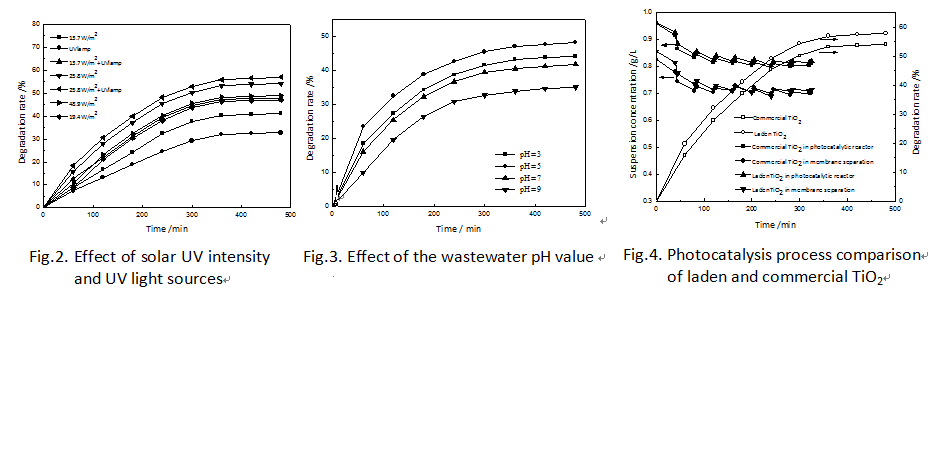
The more the total UV light intensity, whether under only solar or the double light sources of solar and UV lamp, the higher the photocatalytic degradation rate of the wastewater. Besides, there is more obvious influence of UV lamp on the increase of photocatalytic degradation rate under cloudy day than clear day, which indicates that UV lamp made the equipment still keep high degradation rate in cloudy day.
3.3 Effect of the wastewater pH value
Generally, the photocatalytic degradation rate of the wastewater increase with the decrease of the wastewater pH value. Nevertheless, the rate under pH value of 3.0 is lower than that of 5.0. Therefore, the appropriate pH value of the pharmaceutical wastewater is 5.0.
3.4 Photocatalytic processes comparison of laden and commercial TiO2
Air rinsing makes TiO2 deposited in recycle pipe suspend again to keep the suspension concentration of laden and commercial TiO2 0.715g/L, 0.710g/L respectively, which the concentrations of two kinds TiO2 almost equal each other. However, the photocatalytic degradation rate of laden TiO2 for the wastewater is obvious higher than that of commercial TiO2.
3.5 Treatment by combined solar photocatalysis and SBR process
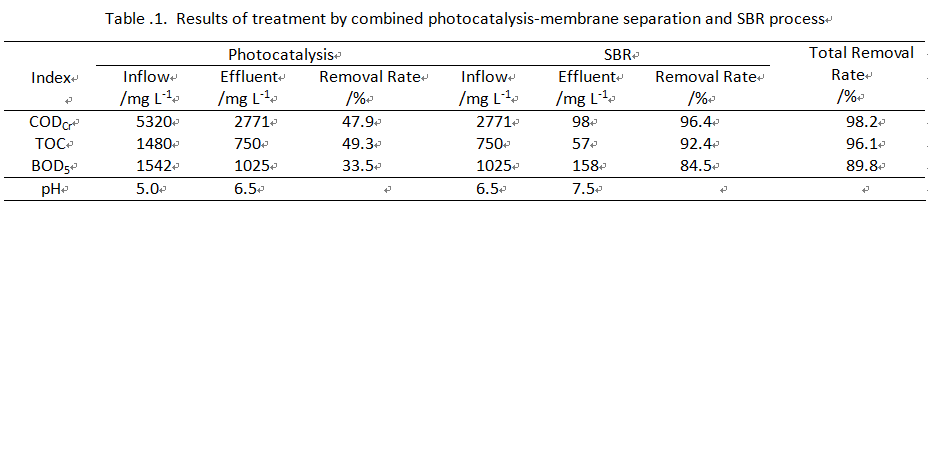
After single solar photocatalytic degradation for 6 hours under cloud day, the B/C value of pharmaceutical wastewater increases from 0.29 to 0.37, which indicates that biochemical degradability of the wastewater is improved evidently, and the CODCr, TOC, BOD5 also decline greatly. In the SBR stage, the pollutants in the wastewater are removed further, and the SBR effluent meets with the Second Chinese Effluent Standard. It is feasible to treat pharmaceutical wastewater by combined solar photocatalysis - membrane separation and SBR processes.
4 Conclusion
Combined process of solar photocatalysis-organic membrane separation and SBR can effectively treat pharmaceutical wastewater, and UV lamp in the equipment makes the combined process still effectively work even in cloudy day.
Acknowledgements
This work was sponsored by Tianjin Research Program Key Projects of Apply Base and Frontier technology (11JCZDJC24900) and Open Fund of State Key Laboratory of Hollow Fiber Membrane Materials and Processes (201022).
Literature Cited
[1] Marcela Boroski, Angela Claudia Rodrigues, Juliana Carla Garcia,Luiz Carlos Sampaio, Jorge Nozaki1, Noboru Hioka. J Hazardous Materials 162, 448 (2009)
[2] CHANG Qing, XIE Liping, FEI Xuening, DAI Xiaohong, JIANG Yuanguang. J Sichuan University(Engineering Science Edition) 44, 249 (2012)
See more of this Group/Topical: Environmental Division