
 Google
 Yelp
 Facebook
 Twitter
 ChEnected
327560 Solute-Solvent-Membrane Interactions in Organic Solvent Nanofiltration
Solute-solvent-membrane interactions in Organic Solvent Nanofiltration
In recent years, nanofiltration (NF) has been applied in organic solvents more and more widely [1,2,3]. In the pharmaceutical industry, for example, NF has been proposed as an emerging technique to perform concentration, separation, and salt/solvent exchange of peptide solutions, as a consequence of the increasing interest in peptides as pharmaceuticals, which has been challenging the peptide industry to develop economically competitive methods for large scale manufacturing. Application of NF to peptide processes has permitted the improvement of the overall peptide downstream processes.
Since application of membrane technology in non-aqueous media is a recently emerging field, understanding the transport mechanism of organic solvent mixtures through NF and UF membranes is still an open research topic. Straight extension of steric and electrostatic separation mechanisms, typical of aqueous environments, to non-aqueous systems is complex, due to the significant differences in the structures and properties of the solvents [1,4,5,6]. It has been observed that the NF performance is much less predictable in the presence of organic solvents, than in aqueous solutions [4,5] and the molecular weight cut-off (MWCO) is an insufficient descriptor for the separation capability of the membrane in organic solvents [4]. In comparison to well-established aqueous processes, non-aqueous processes are characterized by the increase in the number of solute-solvent-membrane interactions [3], which play a determining role in the understanding of both solvent flux and solute rejection.
The factors affecting the molecular interactions at the nanoscale can be classified in terms of solvent-membrane and solute-membrane affinity interactions. Solvent-membrane affinity is a function of solvent nature and composition of the solvent mixture. Solute affinity is generally a function of four factors:
(i) chemical nature of the molecule, in terms of steric, electrostatic, hydrophilic/phobic and polar properties;
(ii) electrostatic interactions between solute and membrane charge, already extensively studied in water, as Donnan effects [6], and questioned for Organic Solvent Nanofiltration (OSN) [1,2,5];
(iii) composition of the solvent mixture. When a solute is dissolved in a mixture of two or more solvents, solute-solvent interactions may differ in strength for each solvent. This may cause the composition of the solvation shell of the solute to be different from that of the bulk solution. In this case, the solute is said to be preferentially (or selectively) solvated by one of the two solvents [7].
(iv) concentration of salts/ions, often present in a typical peptide process solution. On one hand, ions affect the charge interaction, by affecting the solution pH or ionic strength. On the other hand, ions can affect the solute solubility, depending on their kosmotropic ("order-maker") or chaotropic ("disorder-maker") nature [9], via salt formation or water-mediated ion pairs.
The aim of this work is to study the effect of solute-membrane vs. solvent-membrane affinities on the OSN performance. The work is divided in three parts.
Firstly, permeation of water, organic solvents and their mixtures is investigated through hydrophilic nanofiltration and ultrafiltration (UF) ceramic membranes (Inopor® Nano 450 Da, Inopor® Nano 750 Da and Sulzer 1000 Da, all composed of TiO2/Al2O3, and Inopor® Ultra 2000 Da, composed of ZrO2/Al2O3). Experimental results clearly indicate that the Hagen-Poiseuille viscous flow, which assumes the viscosity as the key parameter influencing permeation, fails in describing solvent permeation through NF membranes, whereas it is able to describe the experimental permeability through UF membranes. This is ascribed to the significance of surface effects against bulk effects (i.e. viscosity) for high specific surface systems (such as NF membranes), compared to low specific surface systems (such as UF membranes). Several correction factors are considered in this work, to account for the surface phenomena that arise in a nanotube due to solvent-membrane surface interactions. These correction terms (namely interfacial tension, polarity and molecular dimension) are included into an improved phenomenological model for solvent permeation [10]. As expected, they are functions of the pore size, and, namely, significant for small pores (cf. NF), and negligible for large pores (cf. UF).
Afterwards, permeation of single salts and acids (NaCl, KCl, LiCl, NaI, NaF, HCl and trifluoroacetic acid, TFA-H) in water and organic/water mixtures through the same NF and UF ceramic membranes is investigated. Salts/acids are chosen for three reasons. Firstly, salts are not affected by steric retention, and therefore electrostatic and molecular affinity effects can be isolated and analyzed separately. Afterwards, charge effects have been largely studied in water [6] and have been well explained by the Donnan theory. The extension of these considerations to organic solvents is therefore possible. Finally, preferential solvation data for common inorganic ions are either available in the literature or easily derivable from theoretical models. Availability of these data permits one to look for a correlation between permeation performances and solvation characteristics. The effects of pore dimension, nature of the organic solvent and nature of anion/cation for different salts and acids are presented and discussed in this paper. The effect of the type of solvent on the ion rejection is found to be a function of the Hansen solubility parameter of the solvent, the Hansen solubility parameter of the ion, and the preferential solubility parameters of the ion in the aqueous mixture. The solute-solvent competition has a more significant effect at low pore dimension and becomes more negligible for large pore dimension (UF range). This is shown in Figure 1, by the more significant negative rejection (i.e. enhanced solute transport vs. solvent transport) for NaCl in acetonitrile/water mixtures through the tighter membrane (Inopor Nano 450) than through the looser one (Inopor Nano 750).
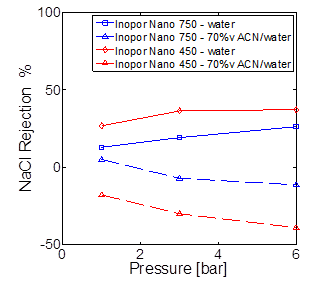
Figure 1. NaCl rejection during NaCl NF in water and 70%v ACN/water (CNaCl = 1 mM).
This demonstrates that the affinity effects are more significant in the NF range, due to the high specific surface that characterizes these membranes, and confirms our previous findings from the investigation of pure solvent permeation.
Finally, rejections of one small organic molecule, Npys, and one model peptide, synthesised by Lonza (Visp, Switzerland) and named PEP1 in this study, through the same hydrophilic ceramic membranes, are studied as a function of solvent composition (%v ACN/water) and ion content (Na+, H+, Cl-, and TFA-,). The effects of solvent composition, ion nature (kosmotropic or chaotropic) and ion concentration affect the solute rejection, by affecting the solute preferential solvation, i.e. its affinity with the membrane. The effect of ions on the composition of the solute solvation shell is explained by the hydration/dehydration mechanism proposed by Collins [9].
In conclusion, this work demonstrates that surface effects and molecular affinity interactions influence permeation of solutes and solvents through NF membranes. For solute+solvent systems, additionally to steric and electrostatic retention mechanism, preferential solvation of organic molecules in solution affects the membrane transport, by changing the molecule hydration degree, and in turn the hydrophilic/hydrophobic interactions with the membrane. Solvent composition, ion nature and concentration are therefore significant additional effects for the pressure-driven permeation through ceramic NF membranes.
Bibliography
[1] Y. Zhao, Q. Yuan, A comparison of nanofiltration with aqueous and organic solvents, J. Membr. Sci. 279 (2006) 453-458.
[2] D. Bhanushali, S. Kloos, D. Bhattacharayya, Solute transport in solvent-resistant nanofiltration membranes for non-aqueous systems: experimental results and the role of solute – solvent coupling, J. Membr. Sci. 208 (2002) 343-359.
[3] S. Darvishmanesh, J. Degréve, B. Van der Bruggen, Mechanisms of solute rejection in solvent resistant nanofiltration: the effect of solvent on solute rejection, Phys. Chem. Chem. Phys. 12 (2010) 13333-13342.
[4] J. A. Whu, B. C. Baltzis, K. K. Sirkar, Nanofiltration studies of larger organic microsolutes in methanol solutions, J. Membr. Sci. 170 (2000) 159-172.
[5] X. J. Yang, A. G. Livingston, L. Freitas dos Santos, Experimental observations of nanofiltration with organic solvents, J. Membr. Sci. 190 (2001) 45-55.
[6] W. Bowen, J. Welfoot, Modelling the performance of membrane nanofiltration critical assessment and model development, Chem. Eng. Sci. 57 (2002) 1121-1137.
[7] A. Bagno, M. Campulla, M. Pirana, G. Scorrano, S. Stiz, Preferential solvation of organic species in binary solvent mixtures probed by intermolecular 1H NOESY NMR spectroscopy, Chem. Eur. J. 5 (1999) 1291-1300.
[8] Y. Marcus, Preferential solvation of ions in mixed solvents. 2. The solvent composition near the ion, J. Chem. Soc. Faraday Trans. 1 84 (1988) 1465-1473.
[9] K. D. Collins, Ions from the Hofmeister series and osmolytes: effects on proteins in solution and in the crystallization process, Methods 34 (2004) 300-311.
[10] P. Marchetti, A. Butté, A. Livingston, An improved phenomenological model for prediction of solvent permeation through ceramic NF and UF membranes, J. Membr. Sci. 415-416 (2012) 444-458.
See more of this Group/Topical: Separations Division