
 Google
 Yelp
 Facebook
 Twitter
 ChEnected
328165 Dielectric Properties Of Simulated Green Coconut WATER From 500 To 3,000 Mhz At Temperatures Between 10 and 80 ºc
Introduction
Green coconut water is a known refreshing beverage and is distinguished for its content of minerals, vitamins and sugars. It can be consumed naturally from the fruit or processed in order to extend its shelf life. Nowadays, conventional thermal treatments such as pasteurization and sterilization are used to preserve this kind of product (Zhu, et al., 2012). However, high temperature is required to inactivate the target enzymes peroxidase and polyphenol oxidase, resulting in degradation of color, taste and nutritional value (Matsui et al., 2008; Zhu, et al., 2012).
Liquid foods can also be heated by electromagnetic waves, such as microwaves (Decareau, 1985; Ryynänen, 1995). Microwave heating is supported on the ability of a dielectric material to absorb electromagnetic energy and convert part of it to heat (Datta et al., 2005; Nelson and Datta, 2001). This method offers advantages in pasteurization and sterilization processes when compared to conventional heating methods. For instance, this treatment allow more rapid heating and shorter processing time as a consequence of the molecular level interactions of the food and the alternating electric field (Decareau, 1985; Venkatesh and Raghavan, 2004). Microwave heating has also disadvantages; the main limitation of this technology is the non-uniform temperature distribution during the process as a result of the limited power penetration of electromagnetic waves in liquid water (Giese, 1992; Thostenson and Chou, 1999).
Knowledge about dielectric properties of liquid foods is required in order to design thermal treatments for preservation using microwave energy (Giese, 1992). Dielectric properties characterize the interaction of electromagnetic waves with the media (Datta et al., 2005; Ryynänen, 1995) and provide information regarding heating rate and penetration depth.
Dielectric properties of materials are defined in terms of relative permittivity e' and dielectric loss factor e”. The relative permittivity represents the material energy storage capability in response to an applied electric field and the dielectric loss factor refers to energy dissipation as heat (Datta et al., 2005; Sosa-Morales et al., 2010). The power penetration depth of electromagnetic waves in materials is defined as the depth in which the power is reduced to 1/e (e = 2.7183) (Ryynänen, 1995; Venkatesh and Raghavan, 2004). These properties are affected for many factors; the main are composition, temperature and the electric field oscillation frequency (Içier and Baysal, 2004).
In this work, dielectric properties of simulated green coconut water were studied at frequencies from 500 to 3,000 MHz and temperatures between 10 and 80 ºC in view of continuous thermal processing of green coconut water.
Materials and methods
Simulated green coconut water was obtained dissolving fructose, glucose, sucrose, calcium chloride, magnesium chloride, monobasic potassium phosphate, sodium sulfate and potassium sulfate in distillated water to mimic the average composition of this product. The samples were cold stored and temperature was adjusted from 10 to 80 °C using an oil bath TC-550 (Brookfield, USA).
The dielectric properties measurements were carried out using the open-ended coaxial line probe technique with a Dielectric Probe Kit 85070E connected to an E5061B Network Analyzer (Agilent Technologies, Malaysia). An Electronic Calibration Module 85093C (Agilent Technologies, Malaysia) was used for improving the measurement quality. Before the measurements, the network analyzer was allowed to warm up for at least 90 min. The system was calibrated using the equipment standard configuration: air, short-block and deionized water. The measurements were performed for field frequencies between 500 and 3,000 MHz at temperature intervals of 10 ºC from 10 to 80 ºC. In this work, the dielectric properties were analyzed at 915 and 2,450 MHz which are used industrially and household, respectively. The measurements were carried out in triplicates at each temperature and the standard deviations were calculated. Results were correlated with temperature and the penetration depths were calculated using proper equations for electromagnetic wave penetration (Datta et al., 2005; Ryynänen, 1995; Zhu et al., 2012).
Results and discussion
Figure 1 shows the relative permittivity and the loss factor of the simulated green coconut water at temperatures from 10 to 80 °C as a function of the frequency. It can be seen that these dielectric properties significantly depend on both temperature and frequency. For all testing temperatures, the relative permittivity e' decreased with increasing frequency between 500 and 3,000 MHz, which can be justified by the decreased ability of the water molecule dipole in accompanying the oscillating electric field at increasing frequency. In addition, this property also decreased with temperature increase at any given frequency, because the thermal agitation disturbs the dipole alignment with the electric field.
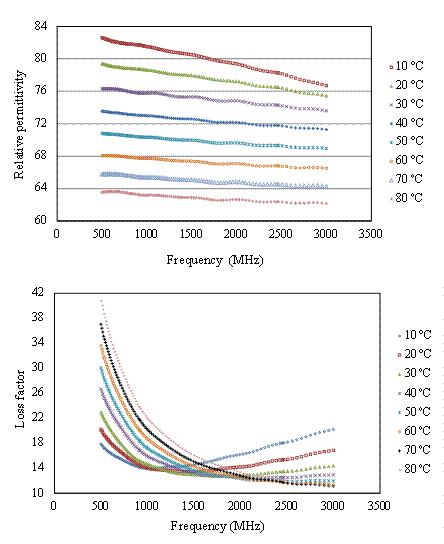
Figure 1: Dielectric propeties of simulated green coconut water as affected by frequency and temperature
The dielectric loss factor e” showed in interesting dependence with temperature and frequency, as can be seen in Figure 1. The drop on the loss factor for frequencies between 500 and 1,000 MHz is associated with the ionic conduction in the solution. This mechanism does not contribute with the polarization of the media and only generate energy loss due to heating. For increasing field frequency, there is less ionic movement and, therefore, a decrease in the loss factor.
For higher frequencies, it can be seen In Figure 1 that there is an increase in the loss factor, which as associated with the dielectric relaxation of the water molecule. The dipole of the water molecule is unable to follow very rapid field reversals, generating heat and increasing the loss factor. The relaxation frequency of water at 20 ºC is 17,004 MHz (peak of the relaxation curve) and this value increases with the temperature, in accordance to the trend of the curves in Figure 1 (lower temperatures show a stronger increase in the loss factor). It is known that for frequencies beyond the relaxation frequency, the water dipole gradually losses the ability to follow the oscillating field, reducing both the relative permittivity and the dielectric loss factor (Datta et al., 2005).
The relative permittivity and the dielectric loss factor of the simulated green coconut water were successfully correlated with temperature for the commercial frequencies of 915 and 2,450 MHz. The coefficients of the linear correlation for the relative permittivity are a0 = 8.392E+01, a1 = –2.648E-01 for 915 MHz (R2 = 0.9975) and a0 = 8.099E+01, a1 = –2.335E-01 for 2,450 MHz (R2 = 0.9986) and of the polynomials adjusted for dielectric loss factor are a0 = 1.340E+01, a1 = 4.058E–02, a2 = 1.118E–03 for 915 MHz (R2 = 0.9956) and a0 = +2.037E+01, a1 = –2.873E–01, a2 = 2.326E–03 for 2,450 MHz (R2 = 0.9873). The power penetration depth decreased with the temperature increment at lower frequencies. At frequencies above 2,450 MHz, penetration depth increased with temperature increment from 10 to 50 ºC and decreased at temperatures between 60 and 80 ºC.
Conclusions
Dielectric properties of simulated green coconut showed a temperature and frequency dependent behavior, which was characterized. The relative permittivity decreased with temperature increasing from 10 to 80 ºC at any given frequencies in the studied range. The loss factor and penetration depth are generally lower at high frequencies from 500 to 3,000 MHz. At temperatures from 50 to 80 ºC and frequencies between 2,000 and 3,000 MHz the loss factor has the lowest values.
Acknowledgements
The authors would like to acknowledge financial support from FAPESP 2012/04073-0 (The State of São Paulo Research Foundation) and to CNPq (National Council for Scientific and Technological Development).
References
Datta, A. K.; Sumnu, G. and Raghavan, G. (2005). Dielectric Properties of Food. In: M. A. Rao, S. Rizvi and A. K. Datta (Eds.). Engineering properties of foods (pp. 101–147). USA: CRC Press.
Decareau, R. V. (1985). Microwaves in the Food Processing Industry. Orlando: Academic Press.
Giese, J. (1992). Food Technology. 46(9), 118-123.
Içier, F. and Baysal, T. (2004). Critical Reviews in Food Science and Nutrition. v. 44, 465-471,
Matsui, K. N.; Gut, J. A. W.; De Oliveira, P. V. and Tadini, C. C. (2008). Journal of Food Engineering. 88, 169-176.
Nelson, S.O; Datta A. K. (2001). Dielectric Properties of Food Materials and Electric Fields Interactions. In R. C. Anantheswaran and A. K. Datta. Handbook of Microwave Technology for Food Applications. New York: Marcel Dekker, Inc.
Ryynänen, S. (1995). Journal of Food Engineering. 26, 409-429.
Sosa-Morales, M. E.; Valerio-Junco, L.; Lopez-Malo, A. and Garcia, H. S. (2010). Food Science and Technology. 43, 1169-1179.
Thostenson, E. and Chou, T. (1999). Composites Part A: Applied Science and Manufacturing. 30, 1055-1071.
Venkatesh, M. and Raghavan, G. (2004). Biosystem Engineering. 88(1) 1-18.
Zhu, X.; Guo, W. and Wu, X. (2012). Journal of Food Engineering. 109, 258-266.
See more of this Group/Topical: Food, Pharmaceutical & Bioengineering Division