
 Google
 Yelp
 Facebook
 Twitter
 ChEnected
328311 Virus-Templated Three-Dimensional Photoanodes for Dye-Sensitized Solar Cells With Efficient Electron Collection and Plasmon-Enhanced Light Absorption
Virus-Templated Three-Dimensional Photoanodes for Dye-Sensitized Solar Cells with Efficient Electron Collection and Plasmon-Enhanced Light Absorption
Presenter: Po-Yen Chen
Principal Authors: Prof. Paula T. Hammond and Prof. Angela M. Belcher
Session Selection: Nanostructured Photovoltaics
Keywords: M13 bacteriophage; Three-dimensional network; Localized surface plasmon; Dye-sensitized solar cells.
Abstract
M13 virus is a filamentous bacteriophage of 880 nm in length and 6.5 nm in diameter, and has been demonstrated as a versatile bio-template to assemble and to nucleate a broad range of materials. The targeted materials can be assembled along the phage surface, and used to assemble functional materials into two- and three-dimensional structures for various device applications, including photovoltaics. Dye-sensitized solar cells (DSSCs) are a promising solution-processed photovoltaic technology. The power conversion efficiency (PCE) of DSSCs is mainly determined by light harvesting and electron collection. In general, to efficiently harvest light and collect electrons, different design criteria must be considered. For efficient electron collection, nanostructures of titanium dioxide (TiO2) with high aspect ratio have been proven to be effective, compared to the commonly used architecture of photoanodes composed of randomly-packed nanoparticles (NPs). However, the reduced surface area of one-dimensional structures leads to insufficient dye adsorption and thus restricts light harvesting. As a result, achieving sufficient light harvesting requires developing strong-absorbing dye-molecules or various mechanisms to increase optical absorption, e.g. localized surface plasmon (LSP)-enhanced optical absorption by using metal NPs. Therefore, different functional materials are required for electron collection and light harvesting, which makes it attractive to develop an approach to assembling different functional components together into a homogeneously distributed composite with a three-dimensional (3-D) structure.
Here, we report a novel 3-D viral network as a versatile platform for DSSCs which can template TiO2 nanowires for improved electron transport, and can also bind Au NPs and then incorporate them uniformly into the photoanodes for the LSP-enhanced light harvesting of dye-molecules. The virus-templated TiO2 nanowires promote electron transport from the photo-excited dyes to the current collector (Figure 1) in the photoanodes, resulting in an increased electron diffusion length compared to conventional NP-based photoanodes. In addition, the M13 virus can bind Au NPs prior to the templated synthesis of TiO2; the resulting TiO2-coated gold nanoparticles generate LSP effects that improve the photo-absorption of dye-molecules adsorbed on the Au@TiO2 nanocomposites (Figure 1). The 3-D thin film is composed of tightly packed TiO2 crystallites forming interconnected nanowires (scanning electron microscopy image in Figure 1). Compared to the size of individual viral particles, the virus-templated TiO2 nanowires are approximately 100 nm in diameter and 2-3 mm in length, which suggests that each nanowire in the photoanode is templated by a bundle of viruses. In addition, the mesoporous structure of the interconnected nanowire network with interconnected pores maximizes interfacial contact with the electrolyte, which increases the mobility of redox couples and also minimizes back recombination.
The ability of M13 viruses to bind with Au NPs can fabricate the virus-templated Au@TiO2 photoanodes to improve the optical absorption. The resulting Au@TiO2 nanocomposite results in the LSP-improved light harvesting of dye molecules in the DSSC photoanodes. The device performance of the virus-templated Au@TiO2 photoanodes is optimized by varying the concentration of the plasmonic Au NPs and the thickness of the photoanodes (Figure 1). The virus-templated Au@TiO2 DSSCs (concentrations of Au NPs, ~0.24 wt.% and ~0.8 wt.%) always show higher PCE than the virus-templated TiO2-only DSSCs with similar thicknesses of the photoanodes. However, PCE decreases when the concentration of Au NPs is increased to 2.4 wt.%, probably due to the increased trapping of photo-excited electrons by Au NPs and competing light absorption of Au NPs with dye-molecules. Moreover, the LSP from Au NPs in nanowire-based photoanodes has the ability to increase the light harvesting without affecting the high diffusion length achieved by the virus-templated nanowire network, and thus maintain the efficiency of electron collection at 99.4%. Thus, the optimal concentration of incorporated Au NPs was found to be 0.8 wt.%, and the best virus-templated plasmon-enhanced DSSC achieves an increased efficiency of 8.46% due to the efficient electron collection and the LSP-improved light harvesting simultaneously.
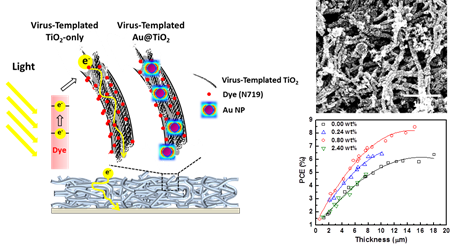
Figure 1.
See more of this Group/Topical: Materials Engineering and Sciences Division