
 Google
 Yelp
 Facebook
 Twitter
 ChEnected
328313 Ultrathin Coatings Tethered to Commercial Membranes Via Vapor Phase Treatment for Fouling and Chlorine-Resistance
Division: membrane based separation—membrane surface engineering
Ultrathin coatings tethered to commercial
membranes
via vapor phase treatment for fouling and chlorine-resistance
Rong Yang, Hongchul Jang, Roman Stocker, Karen K. Gleason
Fouling refers to the unintended accumulation of organic matters, biomolecules or organisms on wetted structures, and the subsequent formation of biofilms. It is very prevalent in membrane-based separation processes and is extremely undesirable as fouling leads to impaired membrane performance and shortened membrane lifetime. It has become the bottle-neck to improve the efficiency of membrane-based separation processes, especially for reverse osmosis (RO) operations.1 The current antifouling methods in industrial practice are insufficient, costly and time consuming; methods such as periodic cleaning also shortens the membrane lifetime. Membrane surface engineering such as physical adsorption and chemical bond formation are potential solutions to the membrane fouling problem.1 However, surface modification is no longer effective in preventing fouling once the first layer of foulants has adsorbed to the membrane surface. Therefore, stable coatings that impart ultralow-fouling characteristics to a surface are highly desired for membrane-based separations. Zwitterionic coatings are promising candidates to reduce fouling during membrane separations given the ultra-low absorption of protein and high resistance to bacteria adhesion and biofilm formation in long-term tests.2
Most membranes are made of polymeric materials for the low cost and ease of fabrication. However, such membranes usually lack solvent- or thermal-resistance, which makes the existing coating methods for zwitterionic materials inapplicable. A vapor phase deposition method at low temperature avoids the potential for such damages. Here, we report on the synthesis of zwitterionic polymers through vapor phase treatment. A copolymer containing sulfobetaine zwitterionic groups was synthesized through an initiated chemical vapor deposition (iCVD) technique and was grown directly on various membrane substrates including commercial membranes as well as electrospun nanofiber mats. Thin film composite (TFC) RO membranes were chosen because of the significant impact of fouling on the membrane performance. This also demonstrates the benignness of the iCVD conditions; although TFC RO membranes are extremely sensitivity to heat and solvent,1 full membrane function was retained after iCVD without compromising the delicate polyamide layer. It is worth noting that the coating procedure is substrate-independent and no re-optimization is required for other membrane substrates.
The iCVD zwitterionic coating is unique because the antifouling zwitterionic groups are highly concentrated on the surface, precisely where the antifouling properties of the zwitterionic groups can be exploited. Angle-resolved photoelectron spectroscopy (ARXPS) measurements revealed that 97% of the total nitrogen was in the zwitterionic form within the top 3 nm, whereas when we probed the top 9 nm, only 30% was zwitterion (Fig. 1). It is important to note that the currently observed high concentration of zwitterionic groups at the surface is exactly opposite to that for films formed by solution-phase methods.3 Coated surfaces exhibited 93% and 98% reduction in surface absorption of bovine serum albumin (BSA) and sodium alginate (SA), as measured with the quartz crystal microbalance with dissipation monitoring (QCM-D). Cell adhesion tests were carried out using Escherichia coli and Vibrio cyclitrophicus, and the coated RO membranes showed greatly reduced bacteria attachment while on the bare RO membrane surface, significant bacteria adhesion and formation of a confluent biofilm were observed.
The in situ monitor of polymer coating growth inside an iCVD chamber enabled the precise control over coating thickness; ultrathin and pin-hole free coating with the thickness of ~30 nm was deposited on commercial RO membranes. The inherent crosslinking in the iCVD copolymer made the coating insoluble in water. A strategy to covalently attach the coating to RO membranes was developed to increase the stability of the coating and adapt the coated membrane for long-term usage in water processing. This is the first time that the library of iCVD functional groups has been extended to charged zwitterionic moieties, and the zwitterionic coatings have been applied on delicate substrates, such as RO membranes.
The iCVD zwitterionic coatings were then improved to possess chlorine-resistance. Chlorine-resistance is of interest for membrane-based separation because chlorine bleach is the most economical and prevalent disinfection technique in water industry. To be compatible with the disinfection procedure and to further reduce surface fouling by using chlorine in addition to surface engineering, the resistance to oxidizing agents is highly desirable for antifouling coatings. However, currently available zwitterionic coatings are fabricated almost exclusively with acrylate monomers containing ester and/or amide linkages and do not stand up to oxidizing agents.4, 5 For example, continuous exposure to water containing even a few parts per billion (ppb) chlorine degrades the amide chemistry significantly.6 The highly desirable chlorine-resistant zwitterionic coatings have not been fabricated to the best of our knowledge. Here, we report for the first time, a novel zwitterionic chemistry that is also chlorine-resistant. The coating derives from a polymer that contains no labile linkages susceptible to oxidative damages by chlorine.
The scale-up of the iCVD process has been demonstrated in a roll-to-roll system,7 which is compatible with the existing infrastructures in membrane industries. Combining the significant antifouling performance with high stability in strong oxidizing agent, as well as the scalability of the iCVD process, this surface modification scheme can reduce the energy usage, improve the reliability and lower the environmental impact of RO and potentially other membrane-based separation processes.
Reference
1. Elimelech, M.; Phillip, W. A. Science 2011, 333, (6043), 712-717.
2. Jiang, S.; Cao, Z. Adv. Mat. 2010, 22, (9), 920-932.
4. Chiantore, O.; Trossarelli, L.; Lazzari, M. Polymer 2000, 41, (5), 1657-1668.
7. Gupta, M.; Gleason, K. K. Thin Solid Films 2006, 515, (4), 1579-1584.
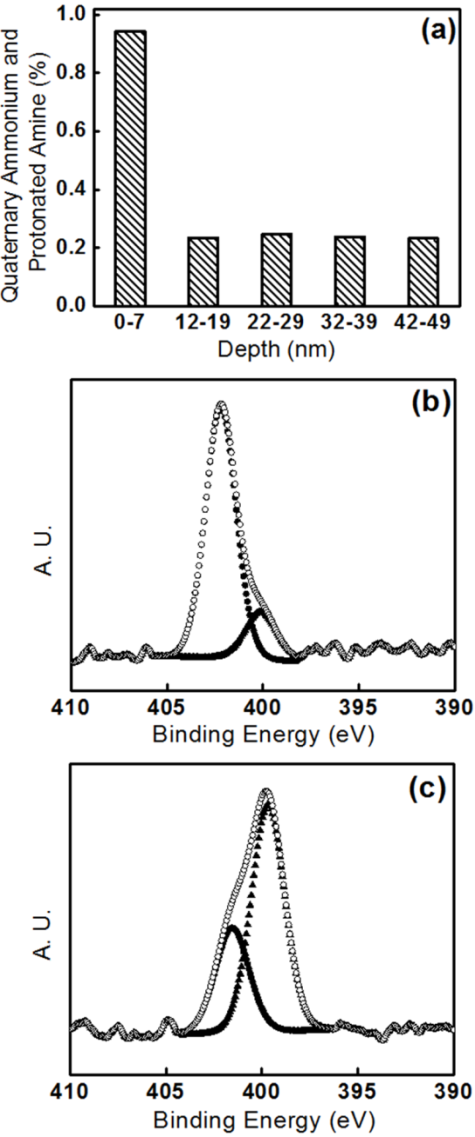
Figure 1. The concentrations of quaternary ammonium and protonated amine along the coating cross-section and ARXPS spectra. a) Composition of the zwitterionic component (quaternary ammonium) at different depth in the film, obtained by depth-profiling XPS. b) High resolution ARXPS N (1s) scans with photoelectron takeoff angles of 19.5o and c) 90o.
See more of this Group/Topical: Separations Division