
 Google
 Yelp
 Facebook
 Twitter
 ChEnected
328371 Modeling and Validation of the Continuous Htst Thermal Processing of Liquid Foods With Plate Heat Exchangers
Thermal processing of liquid foods aims the inactivation of micro-organisms and enzymes that compromise the safety or the shelf life of the product. The design of continuous processes using heat exchangers usually rely on simplifying assumptions that provide a wide safety margin and facilitate calculations, such as isothermal processing only at the holding tube at the minimum residence time. These assumptions can impair sensory or nutritional attributes of the product because of over-processing. The aim of this work was to develop and validate a phenomenological model to simulate the continuous HTST pasteurization with plate heat exchangers in order to determine the distribution of the temperature of the fluids and of the concentration of the target micro-organism or activity of the target enzyme throughout the process.
The considered pasteurizer comprises the inlet tank, a plate heat exchanger (PHE) with three sections (heating, cooling and heat regeneration), the holding tube, the tubular connections between the exchanger and the holding tube, the hot water circuit and the cold water circuit (Figure 1). The model includes equations for flow, heat exchange and lethality. Main assumptions are: steady-state operation, plug-flow in the channels of the PHE and tubes, uniform flow distribution among PHE channels, heat exchange with ambient air only in the tubular sections, no axial diffusion and uniform thermo-physical properties in each section.
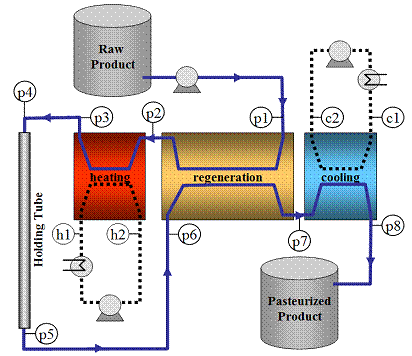
Figure 1: Representation of the HTST thermal process unit
Each PHE channel or tube provides one differential equation for heat transfer and one for thermal inactivation with the corresponding boundary conditions. The sterilization value was evaluated as the number of decimal reductions on the target micro-organism. Space time (length velocity ratio) can be replaced in the thermal inactivation equations by the experimental mean residence time or by the minimum residence time, depending on the desired study (evaluation, validation, design or optimization). Model simulation provides axial distribution of product temperature and the associated lethality, allowing the assessment of the contribution of each section of the process.
In order to test and validate the model, a FT-43A laboratory scale plate pasteurizer (Armfield) was used. The sections of the PHE were configured for series flow (one channel per pass) with 11 thermal plates in the heating section, 7 thermal plates in the cooling section and 19 thermal plates in the heat regeneration section. Product flow rate was 20 L/h and the flow rate of the service fluids was 1,0 L/min (hot water and cold water). The tested product was phosphate buffer (pH = 6.6) with alkaline phosphatase (EC 3.1.3.1) acting as an enzymatic time temperature integrator (TTI), as proposed by Aguiar et al. (2012, DOI: 10.1016/j.lwt.2011.12.027). Enzymatic activity was measured using a reflectometric method and the inactivation kinetic model used was first order with two isoenzymes.
Processing temperatures were 70, 75, 80 and 85 ºC and the controller manipulated the inlet temperature of the hot water in order to achieve the desired temperature at the end of the holding tube. Temperatures at 12 points along the process were registered using thermocouples and a data acquisition system (National Instruments). Samples of the TTI were collected at the exit of the heating section of the PHE (p3 in Figure 1) and after the cooling section (p8 in Figure 1). Samples were immersed in ice-water bath to stop the inactivation, prior to activity assessment.
The process was simulated using the proposed mathematical model in order to compare experimental and predicted results of temperature and lethality. Parameters provided for model simulation were: geometrical parameters of plates and tubes, mean thermo-physical properties, inlet temperatures and flow rates, inlet concentration or activity of target, kinetic parameters of thermal inactivation, heat exchange parameters and mean residence times. The model was solved using a finite difference method in software gPROMS 3.2 (Process System Enterprise). Discretized variables were the temperature of the fluids and target concentration.
The mean residence time in the channels of the PHE were obtained from Gutierrez et al. (2011, DOI: 10.1016/j.applthermaleng.2011.02.015) and the mean residence time in the holding tube were obtained from Gutierrez et al. (2010, DOI: 10.1016/j.jfoodeng.2010.01.004). Space time was calculated for the tubular connections. The Nusselt x Reynolds correlation for the heat transfer in the PHE was obtained according to Gut et al. (2004, DOI: 10.1016/j.ces.2004.07.025) for series pass arrangements. Mean overall heat transfer coefficients for the tubular section were acquired from experimental data.
The model simulation provided the temperature history of the product along the process and the distributed residual activity of the enzymatic TTI. Figure 2 presents the obtained results for temperature and residual activity of the TTI. There was an excellent agreement between predicted and experimental temperatures at the registered points with a mean absolute error of 1.1+–1.0 ºC for all four processing conditions.
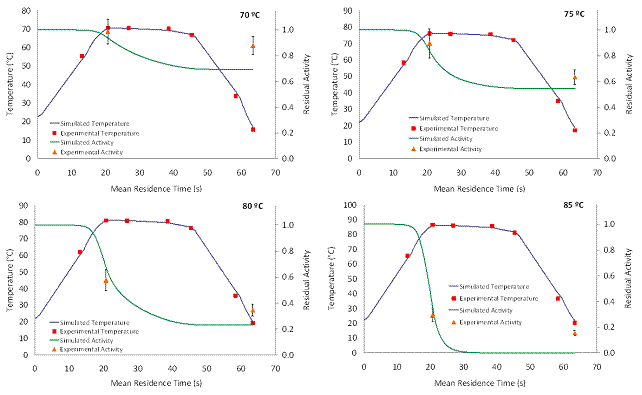
Figure 2: Obtained experimental and simulated results for temperature distribution and residual activity of the TTI for the four processing temperatures
The results of temperature history and residual activity of the enzyme showed that the inlet and outlet connections of the holding tube play an important role on the process lethality. The lethality associated with the heat exchangers was also significant. There was a very good agreement between predicted and measured residual activities at the end of the heating section because the simulated values were in the confidence interval of the experimental values. However, the simulated values of residual activity at the end of the process were consistently inferior to the measured values. This deviation can be explained by the use of the space time instead of the mean residence for the tubular connections. Since the experimental mean residence time is shorter than the calculated space time, the predicted residual activity was smaller.
The proposed model allows the simulation of a continuous HTST thermal processing with plate heat exchangers in order to determine the temperature history and process lethality. With the experimental data used in this work it was possible to validate this model, which can be used for analysis, design or optimization problems, depending on the residence time used for each process step (space time, experimental mean residence time or minimum residence time).
See more of this Group/Topical: Food, Pharmaceutical & Bioengineering Division