
 Google
 Yelp
 Facebook
 Twitter
 ChEnected
328382 Layer-By-Layer/M13 Virus Assembled Porous Photoanodes for Efficient Electron Collection in Dye-Sensitized Solar Cells
Layer-by-Layer/M13 Virus Assembled Porous Photoanodes Facilitating Electron Collection in Dye-Sensitized Solar Cells
Presenter: Po-Yen Chen
Principal Authors: Prof. Angela M. Belcher and Prof. Paula T. Hammond
Session Selection: Thin Film and Organic Photovoltaics
Keywords: Layer-by-layer assembly; M13 bacteriophage; Electron transport; Electron diffusion length; Dye-sensitized solar cells.
Abstract
Dye-sensitized solar cells (DSSCs) represent a promising solar technology because of their ease of fabrication and high power conversion efficiency (PCE). Two important factors determining the device performance, light harvesting and electron collection, are influenced by the architecture of the titanium dioxide (TiO2) photoanode. However, the widely-used architecture of randomly-packed nanoparticles, made via screen printing or doctor blading, are optimized for light harvesting but not necessarily for electron collection. Controlling the nanoscale morphology of the TiO2 photoanode is required to minimize electron recombination; however, this control is not necessarily accessible via doctor blading or screen printing. To address this challenge, strategies have been developed to create oriented nanostructures and process them into photoanodes to form directional electron pathways and to improve the electron collection. While these methods improve the electron collection of DSSC, complicated processes limit their application in mass production. Layer-by-layer (LbL) assembly is a widely-used thin film deposition method, which offers several advantages: it is a simple and cheap process with strong potential for scalability and a high degree of nanoscale control over thickness, morphology, and chemical composition of films. Nano- and micro-porous LbL assemblies have been formed using a simple pH post-treatment developed by Rubner et al, and these porous films have been used to template DSSC photoanodes.
Herein, we present a facile process to generate an oriented porous TiO2 photoanode via dip and spray LbL assemblies, using alternating layers of positively charged linear poly(ethylenimine) (LPEI), negatively charged poly(acrylic acid) (PAA) and phage. In this study, bilayer architectures without phage (LPEI/PAA)n and tetralayer architectures with phage (LPEI/PAA/LPEI/phage)m are both assembled via dip and spray LbL. A porous transition occurs to the nonporous (LPEI/PAA)n or (LPEI/PAA/LPEI/phage)m films when they are exposed to a low pH environment. A liquid phase deposition reaction is then used to achieve a conformal surface coating of TiO2. The subsequent calcination step removes the sacrificial polymer and phage template to generate an anatase TiO2 photoanode. Moreover, the presence of the high aspect ratio M13 bacteriophage (phage) further optimizes electron collection by incorporating into the LbL-assembled porous films to generate interconnections among the TiO2 crystallites inside the oriented photoanode.
The DSSCs employing the LbL-templated photoanodes show excellent photocurrent and high PCE with relatively low dye loading compared to nanoparticle DSSC. The dip and spray LbL-templated DSSC show ~98% and ~106% of photocurrent with only ~52% and ~64% of the adsorbed dye compared to the nanoparticle device, respectively. This is due to the efficient electron collection in both interconnected porous LbL-templated photoanodes, while the randomly packed nanoparticle photoanode is designed for sufficient light harvesting but is not ideal for efficient electron collection. To further optimize the electron pathway inside the TiO2 pore structure, the high aspect ratio phage nanowire as a biomineralization template is incorporated within the LbL templates. The phage templates form a percolative network to generate interconnected TiO2 crystallite chains throughout the photoanode. To realize the effect of the interconnected TiO2 wires embedded in the architecture, the phage-containing LbL-templated device performance was investigated. Both phage-containing dip and spray LbL-templated devices can further achieve 114% of the photocurrent compared to the nanoparticle device, while the dye loadings (and thus light harvesting) almost remain the same. Also, the inclusion of phage-templated nanowires further enhances the electron diffusion length (Ln) of LbL-templated devices. The Ln between the LbL-templated devices without and with phage templates was improved by a factor of from ~4-5 and ~7-8, respectively. These results shows that the inclusion of phage-templated nanowires in LbL-templated photoanodes can help the crystallite interconnection and optimize the electron pathway, which further reduces interfacial recombination and thus further enhances electron collection.
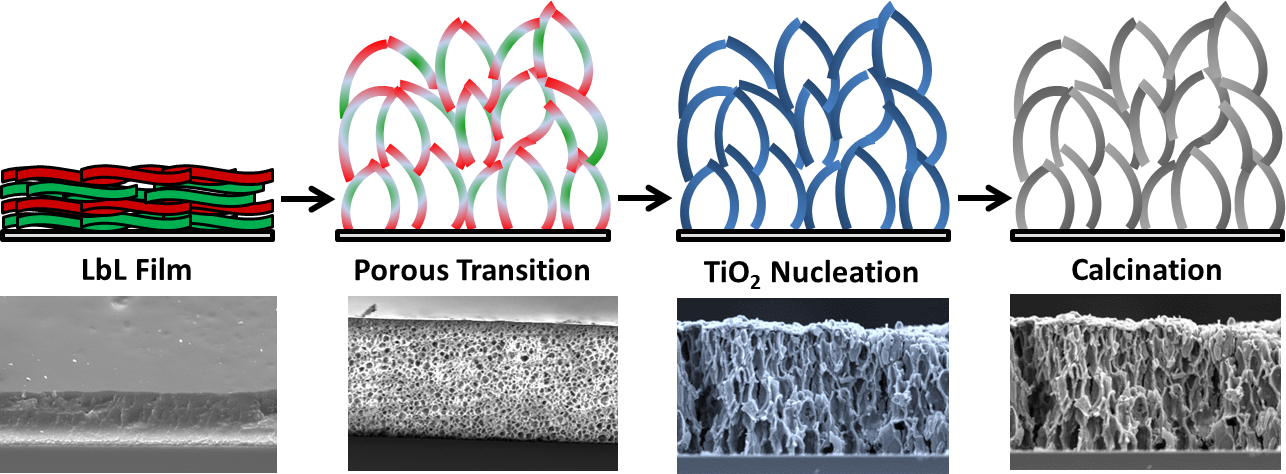
Figure 1.
See more of this Group/Topical: Materials Engineering and Sciences Division