
 Google
 Yelp
 Facebook
 Twitter
 ChEnected
328649 Continuous Co-Production of H2 and Biomass From Cyanothece 51142 Cultivated in a Two-Stage Chemostat
Continuous Co-production of H2 and Biomass from Cyanothece 51142 Cultivated in a Two-Stage Chemostat
P. Dechatiwongse, G.C. Maitland and K. Hellgardt
Imperial College London, London, SW7 4ND, UK.
Abstract
Due to a rapid rise in global population, demands on food and energy have been projected to increase significantly over the coming decades [1, 2]. At the same time, increasing concerns over global warming have emphasized the need to transform our means of food production and energy usage into more environmentally sustainable routes [3].
Cyanobacteria, also known as blue-green algae, are microorganisms, which have the ability to photosynthetically derive their chemical energy from sunlight and CO2. Their biomass has long been utilised for human nutrition, with numerous commercial scale production processes being demonstrated [4]. Cyanobacteria could also serve as clean energy factories, as some of them are able to produce molecular hydrogen (H2), an energy carrier which has great potential to provide clean power needed for transport, heating and electricity [5].
Cyanothece 51142, a unicellular nitrogen-fixing marine cyanobacterium, has been reported for its excellent nutritional value in terms of biochemical composition (50 – 60% protein dry weight) [6] as well as its high production rate of H2 [7], thereby appearing to be a promising microbial platform to answer mankind's expanding demand for food and clean energy.
In our study, we demonstrate a two-stage Chemostat cultivation system, which enables the continuous co-production of H2 and biomass from Cyanothece 51142. The cyanobacterial culture in the primary tubular growth bioreactor is continuously fed with an optimised rate of nutrient. Cells from the growth reactor are then transferred into a flat-plate reactor. This secondary bioreactor is equipped with a customised membrane system [8], allowing the efficient separation of gaseous H2 product from the aqueous culture.
Results obtained during start-up and at steady state conditions, including cyanobacterial growth, the corresponding H2 and biomass production rates, nutrient uptake and the observed transients of process parameters such as pH and pO2, will be presented. These will be used to define optimum operating conditions for the co-production process.
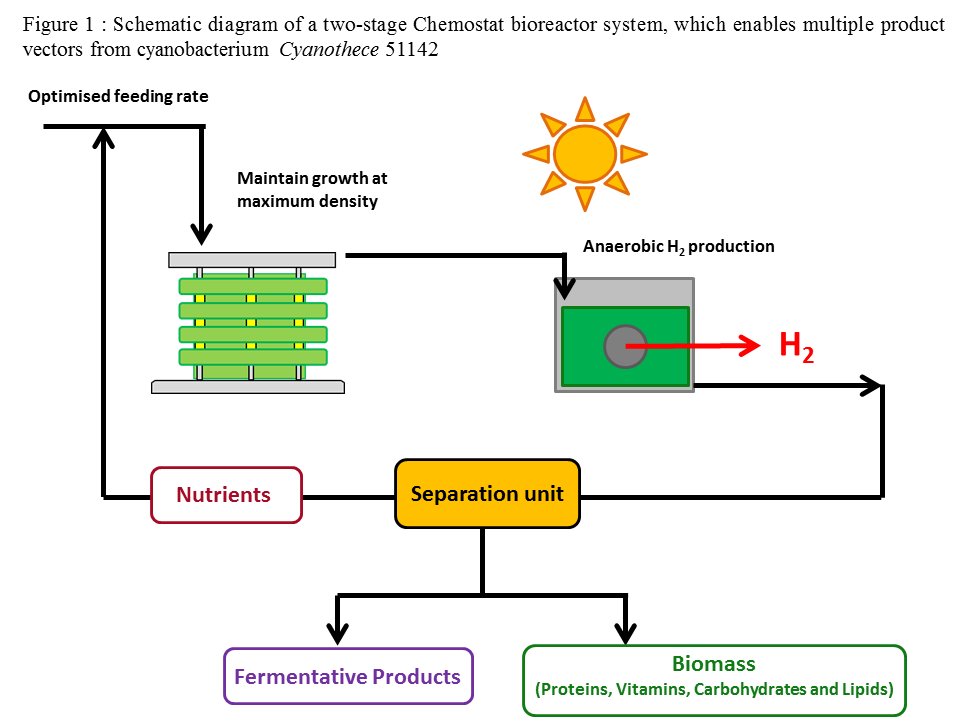
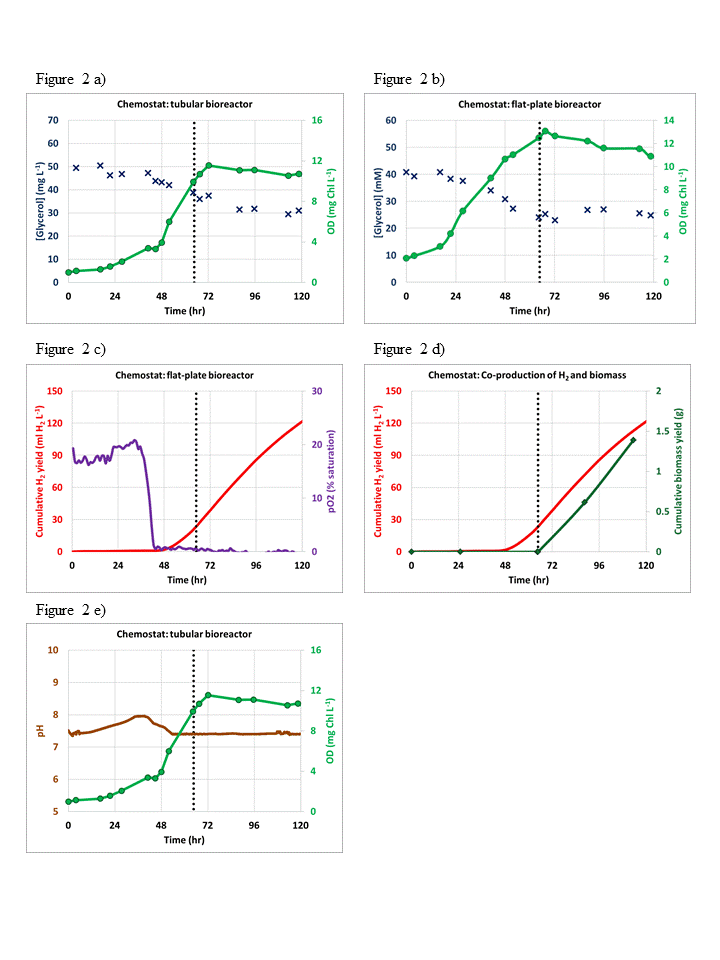
Figure 2: Results from a two-stage Chemostat bioreactor system during start-up and steady state conditions. The time starting to operate in Chemostat mode is presented as black dot lines.
a) and b) Constant values of glycerol concentration (carbon nutrient) and optical density (OD) in both tubular and flat-plate reactors, indicating the optimised feeding rate of nutrient
c) Anaerobic conditions (pO2 = 0) are maintained throughout the experiment in the flat-plate reactor. The onset of H2 production is observed as soon as the anaerobiosis is established.
d) In Chemostat mode, biomass is collected from the flat-plate reactor at the same time as gaseous H2 being extracted though our design membrane system.
e) To facilitate cyanobacterial growth, pH of aqueous culture in the tubular reactor is maintained by means of automated acid/base pumps
 |
References
2. EIA, International energy outlook, 2011.
3. EIA, Clean energy progress report 2011, OECD/IEA: Paris.
See more of this Group/Topical: Sustainable Engineering Forum