
 Google
 Yelp
 Facebook
 Twitter
 ChEnected
329006 3D Activity Map for Predicting the Performance of Commercial Pd-Based TWCs As a Function of the Catalyst Mileage and Pd Loading
3D activity map for predicting the performance of commercial Pd-based TWCs
as a function of the catalyst mileage and Pd loading
Sung Bong Kang, In-Sik Nam*, Byong K. Cho,
Chang Hwan Kim**, Se H. Oh**
Department of Chemical Engineering/School of Environmental Science and Engineering,
Pohang University of Science and Technology (POSTECH), san 31 Hyoja, Pohang, 790-784, Korea
** General Motors R&D and Planning Center, 30500 Mound Road, Warren, MI, 48090-9055, USA
*Corresponding author; Tel: +82-54-279-2264, Fax: +82-54-279-8299, E-mail: isnam@postech.ac.kr
The two key parameters determining the TWC activity under real driving conditions are the catalyst mileage (i.e., time-on-stream) and its noble metal content. An effective way for the optimum design of a commercial TWC converter is to develop the catalyst activity function that can be used to predict the TWC performance as a function of both the catalyst mileage and the noble metal loading.1 Though the concept of the activity function of a catalyst is soundly based on the theory of catalytic kinetics, it has rarely been applied in practice due probably to the difficulty involved in obtaining catalyst samples – required in developing such a function – covering a wide range of the catalyst mileages and their noble metal loadings.2
With the alteration of the Pd metallic surface area (MSA) of the commercial Pd TWCs, a deactivation function has been developed recently to predict the change of the catalytic performance as a function of the field-aged catalyst mileage ranging from 4k (stabilized) to 98k miles.3 In addition, an activity function has also been developed to describe the effect of the Pd loading on the TWC performance of the commercial 4k Pd-based catalyst, using a series of catalyst samples with the Pd loadings from 20 to 240 g/ft3.4
In the present study, a comprehensive activity function in the form of a 3-dimensional surface has been derived in terms of both the Pd loading and mileage of the catalyst, which can be used to predict the performance of a commercial Pd-based TWC over a wide range of the Pd loading from 20 to 240 g/ft3 and the mileage from 4k to 100k miles. The derivation has been carried out in two steps. In the first step, we have demonstrated that the catalytic activity as a function of the catalyst mileage can be well correlated by a 2nd order deactivation kinetics, regardless of the Pd loading of the catalyst. In the second step, a 3D activity surface (a) has been obtained as a function of both the Pd loading (L) and mileage (M) as depicted in Figure 1 by integrating the second order deactivation kinetics model with a ref (L) as the boundary condition, where a ref (L) is the activity function of the reference catalyst (i.e., Pd-based TWC at 4k miles) as a function of Pd loading as reported previously.4
The overall reaction kinetic model was obtained by combining the 3D activity map and the detailed TWC reaction kinetics over the reference catalyst (i.e., 4k Pd240), and it has proven to be capable of predicting the Pd-based TWC performance with respect to both the Pd loading and mileage. It is remarkable that the newly developed 3D activity map reasonably captures the highly nonlinear catalytic activity as a function of the Pd loading at any levels of the catalyst mileages as shown in experimental data (closed symbol) in Figure 1. The capability of the activity map has been further validated by the reasonable accuracy of its prediction of the performance of another series of commercial and Lab-prepared Pd-based TWCs with respect to the catalyst Pd loading and mileage. Thus, the 3D activity map has so far been quite useful and reliable in describing the performance variation of any Pd-based TWCs as a function of the two key parameters in the design of a modern TWC catalytic converter.
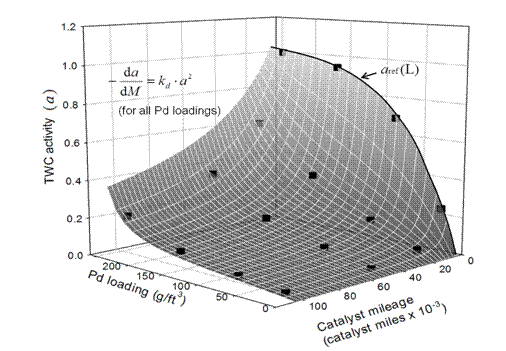
Figure 1. The 3D activity map for the commercial Pd-based TWC as a function of both the Pd loading and mileage.
References
1. J.A. Moulijn, A.E. Van Diepen, F. Kepteijn, Appl. Catal. A.:Gen., 212 (2001) 3.
2. W. Boll, S. Tischer, O. Deutschmann, Ind. Eng. Chem. Res., 49 (2010) 10303.
3. S.B. Kang, H.J. Kwon, I.-S. Nam, Y.I. Song, S.H. Oh, Ind. Eng. Chem. Res., 50 (2011) 5499.
4. S.B. Kang, S.J. Han, S.B. Nam, I.-S. Nam, B.K. Cho. C.H. Kim, S.H. Oh, Chem. Eng. J., 207-208 (2012) 117.
See more of this Group/Topical: Catalysis and Reaction Engineering Division