
 Google
 Yelp
 Facebook
 Twitter
 ChEnected
329337 Enhanced Mixing of Particulate Matter in Multi Orifice Silos
Enhanced Mixing of particulate matter in multi orifice silos
Silos and hoppers have a ubiquitous existence in several industries which handle material in a powdered form. In some instances silos/hoppers act as a feeder to a particular process while in some other instances silos are used for processing material (e.g. nuclear pebble bed reactors). One of the key factors which affects the efficient design of a silo is the flow pattern and mixing of the material which drains down the silo and exits from the orifice. Typically, a silo (flat bottomed) or a hopper (conical bottomed) consists of a single orifice/exit either located centrally or at the periphery, which is wide enough to prevent jamming of the flowing particles. Such systems have been widely studied using experiments and numerical simulations to understand the flow and mixing behaviour of the particles.
In this work we provide newer insights about particle dynamics occurring in a flat bottomed silo having more than one orifice. We employ discrete element method (DEM) simulations to study the flow and mixing of the spherical particles draining down the silo. The method employs a Hertzian contact model and is simulated by the large-scale atomic/molecular massively parallel simulator (LAMMPS) developed by Sandia National Laboratories. In parallel, experiments are carried out using model granular particles, whose motion (near the wall) is captured using high speed camera imaging. Position of every particle is tracked over several images to determine their mean and fluctuating properties. The mixing index is quantified by counting different types of particles exiting from different orifices.
For the silos operated with "n" orifices each being wide enough, we observed that the overall flow behaviour, measured in terms of the component of mean velocity profiles, is equivalent to the "n" silos with a single exit orifice acting in parallel with little or no interaction between different regions of flow. However, very interesting behaviour is observed when width of every orifice is equal to that which can induce jamming. This causes spontaneous jamming at different orifices at different times, leading to co-existence of regions of flow and no flow which interact with each other dynamically.
To explore this behaviour systematically, we created a protocol in the simulations whereby the orifices are artificially closed and opened in a prescribed sequence and for a predetermined time period. We observe that such systematic closing/opening of the orifices caused the particles initially far apart from each other, to mix whilst coming out of the orifices. Figure 1 shows two snapshots taken from a typical simulation. The mixing efficiency is obtained by measuring the concentration of particles coming out of different orifices relative to their initial position higher up the silo. The observed behaviour in simulations is being validated by experiments conducted using a model granular system. The early results clearly show that the multi orifice silo operated using the abovementioned strategy leads to an improvement in particle mixing as compared to silos with a single orifice.
|
|
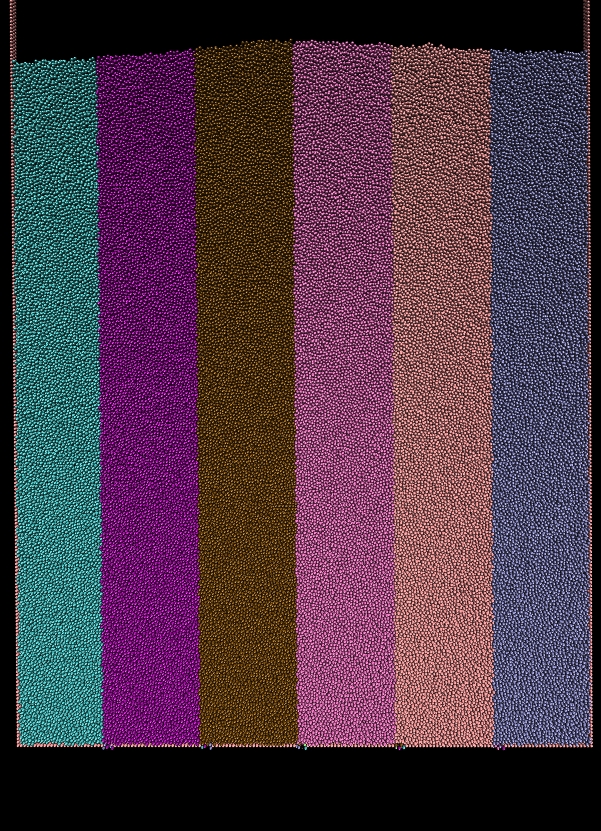
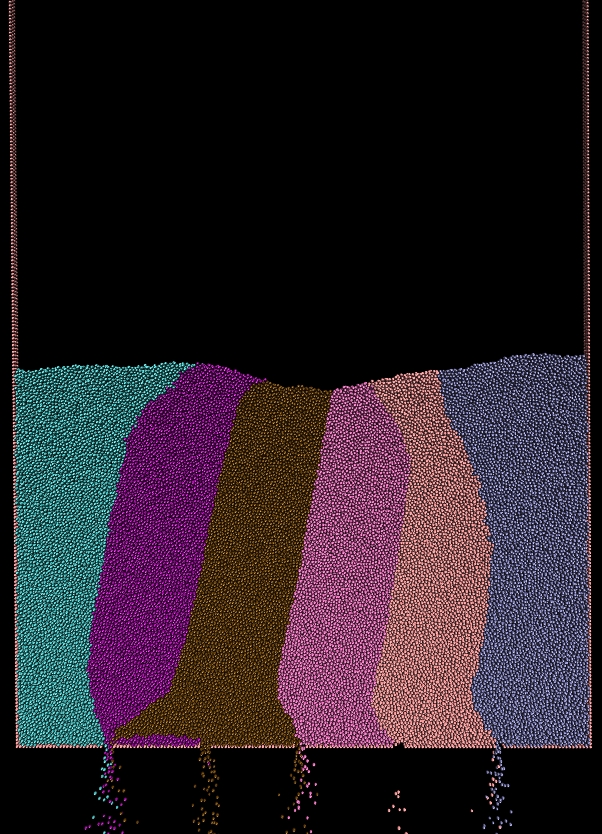
(a) (b)
Figure 1. Snapshot of silo drainage: (a) at initial time, and (b) at a subsequent time when silo is close to half empty. The silo is filled with identical particles but colored differently for ease of visualization. Notice the flow of brown colored particles from three different orifices shown in b.
See more of this Group/Topical: Particle Technology Forum