
 Google
 Yelp
 Facebook
 Twitter
 ChEnected
329373 Recovery of Phosphorus From Sewage Sludge and Sewage Sludge Ashes With the Thermo-Reductive Recophos Process
The principle of the RecoPhos process is the fractioned extraction of phosphorus and heavy metals from sewage sludge and its ash at high temperatures under reducing conditions. The RecoPhos process transforms a problematic waste into several streams of secondary raw materials, leaving behind a minimum of solid waste. The aim of the planned RecoPhos project is to develop a completely new P-recycling process, which can avoid several of the known chemical-technical problems that are still limiting the possible success of phosphorus recycling.
<>
<>Introduction
There is no possibility to find a replacement for the resource phosphorus. It is an essential element for all life forms and its exploitable deposits are getting scarce quickly [1]. This and also the fact that phosphate mining and refining has severe bad effects on the environment, like enormous land use; and the production of vast amounts of dangerous wastes [2], will make it inevitable in the near future to recycle phosphorus from every suitable P-containing waste. Sewage sludge (coming from municipal wastewater treatment) is considered to be one of the most important alternative Phosphorus sources, as in this sludge all of the phosphorus discharged by humans is concentrated and can, if properly collected and treated, be re-used completely. Its inorganic dry matter (= ash content) has a phosphate content of 30 up to 70% of the content of phosphate rock produced from natural phosphate ores [3]. In the project, the process will be developed using modeling and lab scale experiments. Using these results, the basic design of a pilot scale plant will be carried out, a market study will be performed and the environmental impact of the process compared with the status quo will be evaluated in a Life Cycle Assessment (LCA) study [4].
<>The RecoPhos process
The core technique of the RecoPhos process, the so-called InduCarb reactor, works after the same chemical principle as the Woehler process [5], producing amongst others white phosphorus as a product.

The above shown summary reaction runs in the inductive heated bed of carbon as illustrated schematically in figure 1.
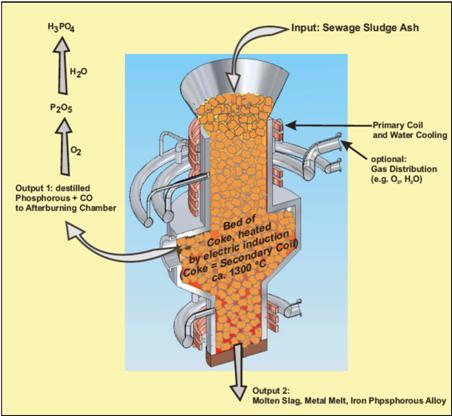
Figure SEQ "Abbildung" \*Arabic 1: InduCarb reactor in the RecoPhos process
RecoPhos approaches the suitability of the following gas treatment aggregates very similar as used in waste and sludge incineration plants:
- Quench (temperature > 280 °C) for the removal of low boiling heavy metals and compounds as dust, leaving the phosphorus gaseous;
- Quench (temperature < 100°C) for the recovery of white phosphorus from the off-gas stream;
- Scrubber for the removal of acidic compounds and Hg;
- Dry and wet electrostatic precipitator for the removal of dusts and aerosols;
- Activated carbon adsorber and cloth filter or activated carbon cloth filter in appropriate positions;
- Afterburner, if the production of phosphoric acid is wished.
To be able to perform experiments, a fully operational continuous bench scale RecoPhos plant will be designed and constructed in the course of the project. This comprises the planning and basic engineering of the reactor as well as of periphery like frequency converters, off-gas cleaning and automation technology.
<>
<>Modeling and Simulation
The mathematical modeling and simulation consists of two parts: thermodynamic process simulation, and mathematical modeling of the inductive heated chemical reacting packed bed of carbon particles. The design will be constantly enhanced according to the experimental results. As a last step, using the most important results, the basic design of a pilot scale will be created.
The modeling of the InduCarb reactor also consists of two parts. At first the creation of a macroscopic model is necessary to get an overview of the occurrence in the reactor. Also it will be possible to get the dimensions for a reactor design. The aim of the model calculation is to find the necessary parameters for the dimensioning of the reactor. The correct choice of the reactor volume is decisive for the attainable conversion in the process. Furthermore statements relating to the design should be possible. The optimal height to diameter ratio of the reactor is an important statement here. Furthermore, modes of operation could be optimized in an existing reactor. Knowledge of the interactions between the processes in the reactor gains a deeper insight into the process. So you can make settings for targeted experiments.
The second part is a mesoscopic model that will be developed by MUL adapting on an existing transient, 2-dimensional heterogeneous model. The goal is to optimize the heat input, the product quality and the energy efficiency.
All over it is necessary to find out the key components and the reactions in the InduCarb reactor. Also a reducing of the surface of the carbon bed during operation has to be examined. Furthermore the input of additives should be checked (e.g. for minimizing the consumption of the reduction agent carbon or for an alternative energy supply to the reactor).
<>Summary
Recycling of Phosphorous from sewage sludge provides a sustainable solution for production of this finite resource essential for human nutrition. It will also be a solution to the environmental problems of Phosphate rich effluents from waste water treatment plants. To this end, the RecoPhos project employs the innovative InduCarb reactor design in which the ashes from sludge incineration plants will trickle down an inductively heated packed bed of Carbon. The reactions taking place inside the reactor for production of high quality Phosphorous are based on the same principle as the well-known Woehler process. The final design of the overall process will be based on the results of modeling and simulation in conjunction with experimental research at the pilot scale.
<>Acknowledgement
The RecoPhos research project has received funding from the European Union Seventh Framework Programme (FP7/2007-2013) under grant agreement no. 282856.
<>Literature
[1] Cordell, D.; Drangert, J.-O.; White, S. (2009). The story of phosphorus: Global
food security and food for thought. Global Environmental Change 19: 292-305
[2] Sartorius C., von Horn J., Tettenborn F. (2011) Phosphorus recovery from
Wastewater – State-of-the-art and future potential, International conference on
Nutrient Recovery and Management 2011, January 9-12, Miami, Florida, USA
[3] S. Donatello, D. Tong, C.R. Cheeseman. (2010). Production of technical grade
phosphoric acid from incinerator sewage sludge ash (ISSA). Waste
Management 30, 1634–1642
[4] RecoPhos Grand Agreement, Annex I – Description of Work, 2011
[5] Corbridge, D.E.C. (1995). Phosphorus: An outline of its chemistry,
biochemistry and uses. Elsevier. pp. 556.
See more of this Group/Topical: Process Development Division