
 Google
 Yelp
 Facebook
 Twitter
 ChEnected
329384 Adsorption Of Xylene Isomers In MOF UiO-66 By Molecular Simulations
ADSORPTION OF XYLENE ISOMERS IN MOF UiO-66 BY MOLECULAR SIMULATIONS
Miguel Angelo Granato1, Vanessa F. Duarte Martins1, Alexandre Filipe P. Ferreira1 and Alírio E. Rodrigues1
1 LSRE - Laboratory of Separation and Reaction Engineering – Associate Laboratory LSRE/LCM, Faculdade de Engenharia, Universidade do Porto, Rua Dr. Roberto Frias, 4200-465 Porto, Portugal
Abstract
This work presents results of molecular simulations on adsorption of the four xylene isomers in the porous zirconium terephthalate UiO-66(Zr). The grand-canonical Monte Carlo simulations (GCMC) are compared to multi-component adsorption equilibrium data obtained by breakthrough experiments (Bárcia et al., 2011). Additionally, the adsorption behavior of each pure isomer was evaluated, in order to better understand the multicomponent adsorption. The adsorbate molecules were simulated using four different models:
- TraPPE-UA (Wick et al., 2000): In this model, the aromatic pseudo-atoms [CH(aro) and R‑C(aro) for the link to aliphatic side chains] are treated as a single interaction center as well as the CH3‑sp3 and the CH2‑sp3 aliphatic pseudo-atoms.
- OPLS (Jorgensen et al., 1993): It is an all-atom (AA) model used for the substituted benzenes except the CH3-sp3 aliphatic groups which are treated as united atoms centered on the carbon.
- Extended TraPPE (Wick et al., 2002): This new TraPPE–UA representation of the arenes contains a positive partial charge (qcenter = +2.42 e), placed at the center of the ring, and two negative partial charges representing the p‑electron clouds (qpi = -1.21 e), placed at a distance of 0.785 Å from the ring center and on a line perpendicular to the arene plane.
- Charged‑AUA model introduced by Nieto-Draghi et al. (2007a, b). This model describes the interactions inside the p‑cloud of electrons by a positive partial charge (qcenter = +8.13 e), and two negative partial charges (qpi = -4.065 e), located at 0.4 Å above and below the ring plane on its hexagonal symmetry axis.
The simulations confirm that the experimentally observed ortho-selectivity is preferential in relation to the other isomers. Access to the small cages seems to be favored for ortho-xylene due to its more compact bulky structure that provides more advantages in terms of rotation degrees of freedom. Furthermore, it was found that there is a competition between the other three isomers (para-xylene, meta-xylene and ethylbenzene) for adsorption in the big cages. Molecular simulations allow prediction of single component adsorption isotherms, heats of adsorption, and selectivity properties of xylene isomers mixtures which are essential for the development of adsorption based separation processes.
|
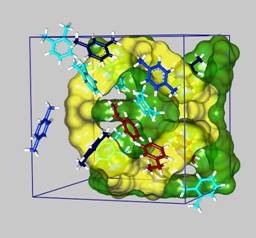
Figure1 .Example snapshot of four components adsorption in UiO66. Green: accessible surface; light blue: o-xylene; blue: p-xylene; dark blue: m-xylene; dark red: ethylbenzene.
References
Bárcia, P.S.; Guimarães, D.; Mendes, P.A.P.; Silva, J.A.C.; Guillerm, V.; Chevreau, H.; Serre, C.; Rodrigues, A.E. “Reverse shape selectivity in the adsorption of hexane and xylene isomers in MOF UiO-66.” Microporous and Mesoporous Materials, 139, 67‑73 (2011).
Jorgensen, W.L.; Laird, E.R.; Nguyen, T.B.; Tirado-Rives, J. “Monte Carlo Simulations of Pure Liquid Substituted Benzenes with OPLS Potential Functions.” J. Comput. Chem., 14, 206‑215 (1993).
Nieto-Draghi, C.; Bonnaud P.; Ungerer, P. “Anisotropic United Atom Model Including the Electrostatic Interactions of Methylbenzenes. I. Thermodynamic and Structural Properties”. J. Phys. Chem. C, 111, 15686‑15699 (2007a).
Nieto-Draghi, C.; Bonnaud P.; Ungerer, P. “Anisotropic United Atom Model Including the Electrostatic Interactions of Methylbenzenes. II. Transport Properties”. J. Phys. Chem. C, 111, 15942‑15951 (2007b).
Wick, C.D.; Martin, M.G.; Siepmann, J.L. “Transferable Potentials for Phase Equilibria. 4. United-Atom Description of Linear and Branched Alkenes and Alkylbenzenes.” J. Phys. Chem. B. 104, 8008‑8016 (2000).
Wick, C.D.; Siepmann, J. I.; Klotz, W. L.; Schure. M. R. “Temperature effects on the retention of n-alkanes and arenes in helium–squalane gas–liquid chromatography Experiment and molecular simulation”. J. Chromatogr. A, 954, 181–190 (2002).
See more of this Group/Topical: Separations Division