
 Google
 Yelp
 Facebook
 Twitter
 ChEnected
329430 Synthesis of Nano Ag in SBA-15 Using Supercritical Carbon Dioxide and the Influence of Different Co-Solvents On the Morphology of the Nanophase
1 State Key Laboratory of Fine Chemicals, School of Chemical Machinery, Dalian University of Technology, 116024, Dalian, China
2 Dalian Institute of Chemical Physics, Chinese Academy of Sciences, 116023, Dalian, China
* Corresponding Author: Jian-zhong Yin, jzyin@dlut.edu.cn; Tel. and Fax. +86-411-84986274
Supercritical fluid deposition (SCFD) method can provide a simple, effective and fast approach to synthesize Ag nanopartiles and nanowires in the nanoscale channels of mesoporous silica. A systematical study was conducted about depositing inorganic precursor AgNO3 into mesoporous SBA-15 using supercritical carbon dioxide (scCO2) as solvent with the addition of a little co-solvent (ethanol, water, the mixture of ethanol and water, the mixture of ethanol and dilute nitric acid) at 50°C and 18MPa within only 1h. Ag/SBA-15 was obtained after deposition followed by calcinations at 300°C in air. It was found that the metal loading and the morphology of the nanophase were quite different when using different co-solvents. When using ethanol as well as the mixture of ethanol and water as co-solvent, the morphology of nanophase in the samples was nanoparticle, while it was nanowire when adding only 0.5ml 8.7wt% nitric acid in the CO2-ethanol system. It is obviously that the addition of H+ plays an important role in the formation of Ag nanowire in the channels of SBA-15. However, addition of nitric acid may influence the dielectric constant, the surface tension and the viscosity of the systems thus the adsorption of AgNO3 (solute) on SBA-15 (adsorbent) from scCO2/co-solvent (solvent) were different. And the adsorption of the precursor on the substrate would influence the dispersion of the precursor in the channels of substrate thus determine the morphology of the nano-phase. It's quite a complicated question and more research is underway.
Table 1 Preparation conditions of Ag/SBA-15 using different co-solvents at 50°C,18MPa (AgNO3: SBA-15=200mg: 200mg)
sample
| Co-solvent (mL)
| Metal loading (wt %)
| |
ethanol
| the other
| ||
1
| 5
| 0
| 0.39
|
2
| 5
| 0.5( deionized water)
| 20.19
|
3
| 5
| 0.5(8.7wt% HNO3)
| 10.59
|
4
| 0
| 0.5( deionized water)
| 0
|
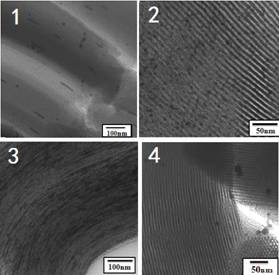
Figure 1. TEM image of Ag/SBA-15 composite using different co-solvent: (1) 5mL ethanol; (2) 5mL ethanol and 0.5 mL deionized water; (3) 5mL ethanol and 0.5mL 8.7wt% HNO3 (4) 0.5mL deionized water ;
Referecnes
1. M. Ni,Q. Q. Xu and J. Z. Yin, J. Mater. Res. 27, 2902(2012)
2. Q. Q. Xu, Y. Q. Wang, A. Q. Wang, J. Z. Yin Y. Liu, Nanotechnology. 23, 285602 (2012).
3. Q. Q. Xu, C. J. Zhang, X. Z. Zhang, J. Z. Yin and Y. Liu, J. Supercrit. Fluids. 62, 184 (2012).
4. M. Ni, Q. Q. Xu, G Xu, E. J. Wang and J. Z. Yin, Progress in Chemistry. 23, 1611(2011).
5. J. Z. Yin, Q. Q. Xu and A. Q.Wang, Chem. Eng. Commun. 197, 627(2010).
See more of this Group/Topical: Materials Engineering and Sciences Division