
 Google
 Yelp
 Facebook
 Twitter
 ChEnected
329703 Macro-Mixing of the Dispersed Phase in An Immiscible Liquid-Liquid Stirred Reactor
Macro-mixing of the dispersed phase in an immiscible liquid-liquid stirred reactor
Dang Cheng, Xin Feng, Jingcai Cheng, Chao Yang *
Institute of Process Engineering, Chinese Academy of Sciences,
Beijing 100190, China
Abstract
Liquid-liquid dispersions in mechanically agitated vessels are frequently encountered in chemical industry. The dispersed drops are continuously broken and coalesced, which make such processes extremely difficult to be well controlled. Numerous investigations have thus been devoted to the two-phase dispersed systems because of their practical importance and complexity [1]. Although they were widely studied in scientific and engineering circles, there is still little information regarding the mixing in either or both phases in stirred liquid-liquid dispersions. The knowledge of macro-mixing, which is usually globally characterized by mixing time (also termed as blend time), is essential when the mixing rate is comparable with or slower than the chemical reaction rate. Under these circumstances, the liquid-liquid mixing efficiency is found to have a profound impact on the overall performance, e.g., production costs and product selectivities.
Mixing is a very complex process in liquid-liquid dispersions, which can occur either in the continuous phase or in the dispersed phase or in both phases. Recently, Zhao et al. [2] investigated the macro-mixing of the continuous phase in an immiscible liquid-liquid stirred reactor using the conductivity technique, in which the tap water was taken as the continuous phase and several oil phases were used as the dispersed phases, and their study revealed the non-linear effect of the dispersed phase holdup on the continuous phase mixing time. The macro-mixing process in the continuous phase of a multiphase system is achieved by convective (bulk) and turbulent (eddy) motions. However, the problem of mixing amongst the dispersed phase (drops), i.e., the dispersed phase mixing, is of special interest for such practical applications as suspension and emulsion polymerization, i.e., reactions occurring in the dispersed phase, in which the dispersed phase mixing may greatly influence the productivity and selectivity. Experimental measurements and theoretical studies have shown that the dispersed phase mixing had a significant influence on the average reaction rates and product selectivities in non-first order or mass transfer controlled reactions occurred in the dispersed phase [3,4].
The dispersed phase mixing is fulfilled by means of intense drop interactions (dispersion, breakup and coalescence), which control the species concentration distribution among drop population. The drops are naturally completely segregated in liquid-liquid dispersions, if there is no dispersed phase mixing or there is no segregation (no concentration difference among drops) at an infinite dispersed phase mixing rate (or interaction rate) between the dispersed drops. Rietema [5] stated that the two extreme cases did not really exist in practical industrial processes and usually there was a finite interaction rate or partial segregation. Thus in many practical reactors the dispersed phase cannot be considered to be either totally unmixed or perfectly mixed. On analyzing the problem, there arises the question to what an extent the drop concentrations can be mixed and how long it usually takes for an added nontransferring tracer to be mixed to an expected extent. However, it is particularly noted that quantitative measurement of the macro-mixing process in the dispersed phase is still an unresolved problem, despite of its practical importance.
In our previous works [2,6,7], the macro-mixing and two-phase flow in the continuous phase in immiscible liquid-liquid stirred tanks have been studied by experiment and numerical simulation. In this work we focus on experimental measurement of the dispersed phase mixing time, which is defined as the time required to achieve certain degree of macroscale homogeneity of an inert nontransferring tracer injected into the liquid-liquid dispersion, using the planar laser induced fluorescence (PLIF) method. The PLIF technique requires that the dispersed phase invisible in the continuous phase by matching the refractive indices of the immiscible liquid-liquid pair in order to obtain clear images, particularly for the measurement at high holdups of the dispersed phase. The ideal liquid-liquid pair is selected for the PLIF experiment: NaI (in an aqueous solution of 0.02 M Na2S2O3) as the dispersed aqueous phase and silicone oil as the continuous phase.
Experiments are carried out in a batch manner in a transparent Plexiglas stirred reactor (cylindrical, flat-bottom). The diameter (T) of the stirred reactor is 120 mm and the total height is 216 mm. Four vertical baffles with width (B) of 12 mm are equipped equally-spaced at the wall. The liquid height for all experiments is set at H=T. Different types of stirrers are used, namely, Rushton disk turbine (RDT), half circle blade disk turbine (HCDT), 45° pitched blade turbine downflow (PBTD) and 45° pitched blade turbine upflow (PBTU). The four impellers have the same diameter (D=T/2). An outer transparent Plexiglas square tank (160 mm°Á160 mm°Á216 mm) is installed around the stirred reactor to minimize the optical reflections and distortions at the cylindrical wall.
A Nd:YAG laser (Beamtech Optronics Co., Ltd., China) is used as the illumination source. The laser emits a beam of 532 nm wavelength. The fluorescence emitted by the tracer is recorded by the digital CCD camera (Imperx, Inc., USA, 12 bits) placed perpendicularly to the plane of the laser sheet. The size of the recorded pictures is 2048°Á2048 pixels2 which corresponds to a measurement field of 15 mm°Á15 mm. A 105 mm objective (Micro-Nikkor 105 mm f/2.8G) and a sharp-cut glass filter (560 nm) are used on the camera to eliminate the overlapping effect of illumination and emission, and also to ensure that the reflected or scattered laser light does not interfere with the fluorescence measurement during PLIF image acquisition. Rhodamine B (A.R.) is used as the tracer, which is a nontransferring dye indissolvable in silicon oil. Before starting the experiments, it is necessary to determine the linear response range between light intensity and the concentration of Rhodamine B in single-phase and two-phase systems for our specific laser, camera, and setup geometry.
In our experiments, a very small volume of the aqueous standard solution containing Rodamine B is injected quickly into the experimental system. The way of defining a degree of macro-mixing is through the spatial variance of the concentration, which is defined as
 (1)
where mx
and nz are the numbers of pixels at radial and axial
direction for the characterized zone, respectively, and i and j
are position indices of a pixel in this zone. This criterion is based on the
decay of the normalized concentration variance, where  is the average gray value
for the specified zone over 200 fully mixed images, and
 is the average gray value
for the specified zone over 200 images before tracer injection (t=0). It
can be seen from Figure 1 that a plot of the calculated variance is shown in a
semi-log scale.
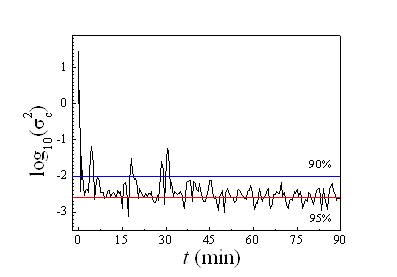
Figure 1. Degree of mixing versus time (PBTU, C=T/2, N=410 rpm, ¦Ád=10%)
The curve in
Figure 1 expresses the decay of the concentration fluctuations after injection
of the tracer. Theoretically, if the dispersed phase mixing rate is high enough,
the  value can vary
from zero for an unmixed state to -±for perfect mixedness. Whereas, it is
noted from Figure 1 that cannot even reach
the 95% homogeneity (i.e. =-2.6), suggesting that the
tracer in the dispersed phase cannot be mixed to a perfectly mixed state. This
is a notable difference between the turbulent dispersed phase mixing and the
continuous phase or single liquid phase mixing. The mixing time is thus defined
as the time when
 , i.e.,
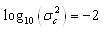 ,
which is a 90% approach to the perfectly mixed state. The tm
obtained from this criterion is 31.8 min.
The variables studied are tracer injection position, impeller type, impeller off-bottom clearance, agitation speed, dispersed-phase holdup, viscosity of the continuous phase. An effective model for predicting the dispersed phase mixing time is also developed in this work.
Keywords: dispersed phase mixing; mixing time; liquid-liquid; stirred reactor
References
[1] DE Leng, RV Calabrese. Immiscible liquid-liquid systems. Handbook of Industrial Mixing: Science and Practice (EL Paul,VA Atiemo-Obeng, SM Kresta, Eds.), New York: John Wiley & Sons, 2004.
[2] YC Zhao, XY Li, JC Cheng, C Yang, Z-S Mao. Experimental study on liquid-liquid macro-mixing in a stirred tank. Industrial & Engineering Chemistry Research, 2011; 50(10): 5952-5958.
[3] RL Curl. Dispersed phase mixing: I. theory and effects in simple reactors. AIChE Journal, 1963; 9: 175-181.
[4] RS Miller, JL Ralph, RL Curl. GD Towell. Dispersed phase mixing: II. Measurements in organic dispersed systems. AIChE Journal, 1963, 9: 196-202.
[5] K Rietema. Segregation in liquid-liquid dispersions and its effect on chemical reactions. Advances in Chemical Engineering, 1964, 5: 237-302.
[6] D Cheng, X Feng, JC Cheng, C Yang. Numerical simulation of macro-mixing in liquid-liquid stirred tanks. Chemical Engineering Science, 2013, revision under review.
[7] F Wang, Z-S Mao. Numerical and experimental investigation of liquid-liquid two-phase flow in stirred tanks. Industrial & Engineering Chemistry Research 2005, 44(15): 5776-5787.
* To whom correspondence should be addressed. Tel.: +86-10-62554558. Fax: +86-10-82544928.
E-mail address: chaoyang@home.ipe.ac.cn.
See more of this Group/Topical: North American Mixing Forum