
 Google
 Yelp
 Facebook
 Twitter
 ChEnected
329773 A Tunable Hierarchical Porous Carbon Structure for Studying Electrochemical Energy Conversion
A Tunable Hierarchical Porous Carbon Structure for Studying Electrochemical Energy Conversion
Chunzhen YANG and Kwong-Yu CHAN*, Department of Chemistry, The University of Hong Kong, Pokfulam Road, Hong Kong
Abstract
A well-defined porous carbon structure with tunable parameters provides a platform for systematic
study of transport and confinement effects on electrochemical conversion. Synthesized via silica
template techniques, the hierarchical structure has a hollow core within a mesoporous shell (HCMS)
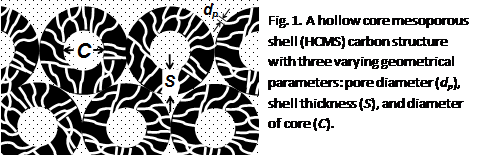
with uniform pore size, shell thickness, hollow core diameter, as shown in Fig. 1.
By varying the synthesis parameters, the structural parameters can be tuned to study
1) combined effects of surface area, mesopore size, macropore size, and hierarchy of porosity
on ionic transport and adsorption in electrochemical capacitance behavior;
2) how distribution of platinum or other electrocatalyst nanoparticles in the porous structure
affect catalytic faradaic reactions;
3) how distribution of mixed metal nanoparticles such as PtRu and varying of Pt and Ru content
in the porous structure affects faradaic reactions such as methanol oxidation; and
4) the effectiveness of a mathematic model in analyzing electrochemical conversion in porous
structures.
Electrochemical capacitance is studied with a series with meso-shell thickness stepwise increased
from 0, 25, 50 to 100 nm while keeping an identical 330 nm hollow core and mesopore of 3.9 nm.[1]
A thicker shell has a higher surface area with a proportional increase of electrochemical capacitance
which however, can only be fully realized at low scan rates/currents. At high currents, ionic transport
limits the electrochemical capacitance of a thick mesoporous shell. Electrochemical impedance
spectra (EIS) obtained on the family of HCMS carbon structures were fitted to equivalence circuits
described by models of network structures.[2] The results reveal the need to match the AC
frequency with the characteristic time constant of a structure for optimum active and reactive power.
For fuel-cell electrode conversion, the distribution of Pt and PtRu nanoparticles in a mesoporous
carbon can vary in different synthetic protocol. Uniform Pt particle distribution can be achieved with a
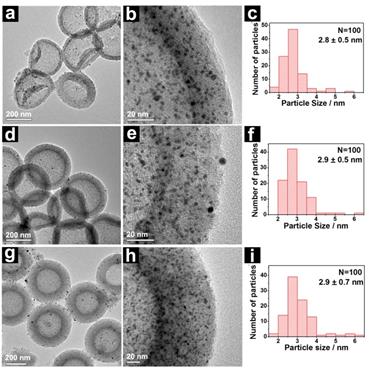
CPDP method [3] as shown in Fig. 2. Different electrocatalysts with varying Pt distribution can be
compared for activity and utilization in methanol oxidation. The particles dispersed into a thicker shell
are more stable and give better performance over time, as shown in voltage cycling and extended
methanol oxidation.
SHAPE \* MERGEFORMAT
| Fig. 1. A hollow core mesoporous shell (HCMS) carbon structure with three varying geometrical parameters: pore diameter (dp), shell thickness (S), and diameter of core (C). |
SHAPE \* MERGEFORMAT
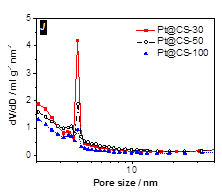
| Fig. 2 TEM images of Pt nanoparticles loaded in mesoporous carbons of same hollow core diameter, C = 330 nm but different Shell thickness (a)-(c) Pt@CS-30, S=30 nm ; (d)-(f) Pt@CS-50, S=50 nm ; (g)-(i) Pt@CS-100, S=100 nm; (j) pore size distribution of the porous structures loaded with Pt. |

References:
[1]. F. Li, M. Morris and K.Y. Chan*, “Electrochemical Capacitance and Ionic Transport in the
Mesoporous Shell of a Hierarchical Porous Core-Shell Carbon Structure”, J. Mater. Chem. 21
(2011) 8880-8886.
[2] Chunzhen Yang, Chi-Ying Vanessa Li, Fujun Li, Kwong-Yu Chan*, “Complex Impedance with
Transmission Line Model and Complex Capacitance Analysis of Ion Transport and Accumulation
in Hierarchical Core-Shell Porous Carbons”, J. Electrochem. Soc. (2013) to appear.
[3] F. Li, K.Y. Chan*, and H. Yung, “Carbonization over PFA-Protected Dispersed Platinum: An
Effective Route to Synthesize High Performance Mesoporous-Carbon Supported Platinum”, J.
Mater. Chem. 21 (2011) 12139-12144.
See more of this Group/Topical: Engineering Sciences and Fundamentals