
 Google
 Yelp
 Facebook
 Twitter
 ChEnected
329947 Catalysis of Gold Nanoparticles Within Cross-Linked Lysozyme Crystals
Preparation of bio¨Cnano hybrid materials has been the focus of numerous studies because of their broad range of potential applications in catalysis, drug delivery, medical imaging, and chemical sensing [Wei, Wang et al., 2011]. Among various biological components that could be used as templates for the fabrication of bio-nanocomposites, protein assemblies with different nanostructures, such as fibrils, tubes, and cages, have received special attention due to diverse structures and promising functionalities [Abe, Tsujimoto et al., 2012]. Nevertheless, bridging from the nanoscale to the macroscale and to create macroscopic hybrid materials for practical application remains a challenge. Therefore, it is desirable to explore macroscopic protein assemblies as templates for the fabrication of novel composite materials with functional properties [Liang, Wang et al., 2013].
Here we show that lysozyme molecules in their crystalline state can be treated as macroscopic templates for the construction of novel composite catalysts with good recyclability (Scheme 1). Firstly, tetragonal lysozyme crystals were prepared according to our previous crystallization conditions [Liang, Jin et al., 2013]. The stabilization of native crystals with glutaraldehyde resulted in cross-linked lysozyme crystals (CLLC) that were pale yellow in color and robust physically. Then, soaking the CLLC in HAuCl4 solution allowed the accumulation of Au3+ in the interior pores of crystal. Subsequently, the coordinated Au3+ underwent progressive reduction to form Au nanoparticles (AuNPs) in situ after the addition of NaOH. Furthermore, we demonstrated that these prepared AuNPs-at-CLLC (Au@CLLC) hybrid materials exhibited good catalytic activity toward nitrophenol reduction with excellent recyclability. The main ideas and conclusions are summarized as follows.
(1) Tetragonal lysozyme crystals that comprised four relatively large (110) side faces capped by four inclined (101) faces can be readily crystallized using our previous conditions. It is known that protein crystals present highly ordered three-dimensional arrangements of protein molecules with the properties of high porosity (0.5 to 0.8), large surface area (800 m2/g to 2000 m2/g), and a wide range of pore sizes (2 nm to 10 nm). In addition, various functional groups that responsible for coordinating metal ions are exposed on the surface of solvent channels of crystal lattices. Given these advantageous properties, protein crystals can be treated as promising matrices for nanoparticle immobilization. Light microscope of CLLC did not show obvious structural distortion originated from the stabilization treatment. Meanwhile, SAXRD pattern of the CLLC shows characteristic diffraction at 2¦È = 2.88°, 3.47°, 4.51°, and 6.91°, indicating the crystalline form of CLLC has remained largely unchanged.
(2) AuNPs were synthesized within the solvent channels of CLLC using a reductant-free and green synthetic route. The CLLCs were immersed in HAuCl4 solution for the sequestration of metallic precursors. Reduction of the coordinated Au3+ by tyrosine and tryptophan residues of lysozyme under alkaline condition resulted in intact red metallized CLLC. Meanwhile, no characteristic SPR of AuNPs was observed in the supernatant solution as shown in the UV-vis spectrum. HRTEM measurements of the AuNPs formed within CLLC demonstrated that the particle sizes were almost 1.5 nm to 3.0 nm with narrow size distribution. These results indicated the crystalline porous structures of CLLC can effectively limit the migration and aggregation of AuNPs. Moreover, the small sized crystalline AuNPs was demonstrated by the relative weak characteristic diffraction peaks as shown in XRD patterns. FTIR analysis confirmed the involvement of tyrosine and tryptophan residues in the reduction of Au ions.
(3) we choose the reduction of 4-nitrophenol as a model system to evaluate the catalytic properties of the as-prepared Au@CLLC hybrid catalysts. The reaction over Au@CLLC catalyst was almost completed within 360 s for the first round. The pseudo-first-order kinetics with respect to 4-nitrophenol was used to evaluate the kinetic reaction rate of the current reaction, and the apparent rate constant was estimated from the slop to be 14.92 °Á 10-3 s-1. The recovered hybrid catalysts exhibited similar catalytic activity in the first three rounds of the reaction, and can be successfully recycled and reused in twenty successive reactions with a conversion of >96%. These results clearly indicate that the CLLCs are a good supporting material for AuNPs because of their physical robustness, high specific surface area, and three-dimensional nanostructure property.
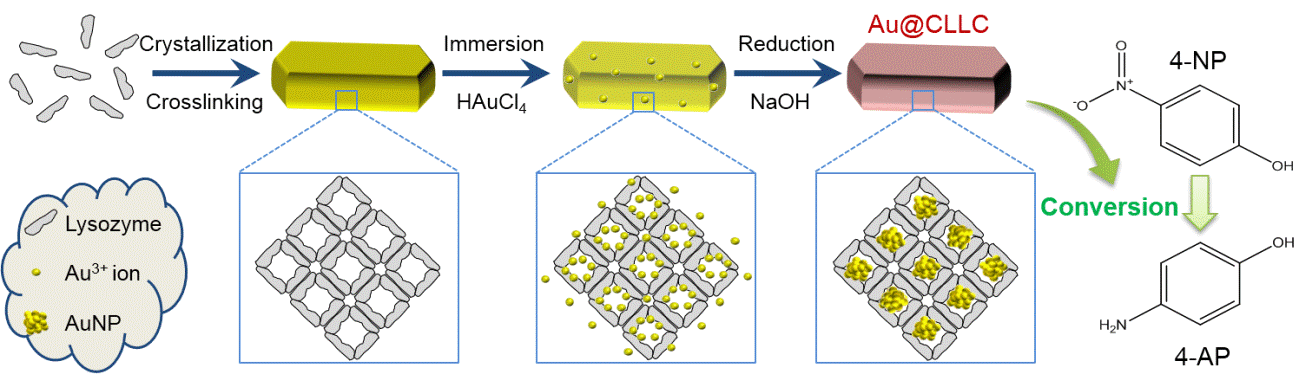
Scheme 1. Schematic illustration of the lysozyme crystallization, crosslinking and preparation of Au@CLLC composite materials for the catalytic conversion of 4-nitrophenol.
This work was supported by the Natural Science Foundation of China (Nos 21276192, 51173128 and 31071509), the Ministry of Science and Technology of China (Nos 2012YQ090194, 2012BAD29B05 and 2012AA06A303), and the Ministry of Education (No. NCET-11-0372).
References
1. Wei H., Wang Z. D., Zhang J., House S., Gao Y. G., Yang L. M., Robinson H., Tan L. H., Xing H., Hou C. J., Robertson I. M., Zuo J. M. and Lu Y. Time-dependent, protein-directed growth of gold nanoparticles within a single crystal of lysozyme, Nature Nanotechnology, 6, 93-97, 2011
2. Abe S., Tsujimoto M., Yoneda K., Ohba M., Hikage T., Takano M., Kitagawa S. and Ueno T. Porous protein crystals as reaction vessels for controlling magnetic properties of nanoparticles, Small, 8, 1314-1319, 2012
3. Liang M., Wang L. B., Su R. X., Qi W., Wang M. F., Yu Y. J. and He Z. M. Synthesis of silver nanoparticles within cross-linked lysozyme crystals as recyclable catalysts for 4-nitrophenol reduction, Catalysis Science & Technology, DOI: 10.1039/c3cy00157a, 2013
4. Liang M., Jin F. M., Liu R., Yu Y. J., Su R. X., Wang L. B., Qi W. and He Z. M. Shape evolution and thermal stability of lysozyme crystals: effect of pH and temperature, Bioprocess and Biosystems Engineering, 36, 91-99, 2013
See more of this Group/Topical: Nanoscale Science and Engineering Forum