
 Google
 Yelp
 Facebook
 Twitter
 ChEnected
330286 Catalytic Lignin Valorization By Liquid Phase Reforming
Catalytic Lignin Valorization by Liquid Phase Reforming
Anna L. Jongerius,1 Joseph Zakzeski,1 John R. Copeland,2 Guo Shiou Foo,2 Carsten Sievers,2 Pieter C.A. Bruijnincx,1 and Bert M. Weckhuysen1*
1 Inorganic Chemistry & Catalysis, Debye Institute for Nanomaterials Science, Utrecht University, Utrecht, Netherlands
2 School of Chemical & Biomolecular Engineering, Georgia Institute of Technology, Atlanta, GA
Introduction
Lignocellulosic biomass is becoming an increasingly important alternative resource for biofuels production. Lignocellulosic biorefinery operations must produce chemicals as well as energy vectors, however, in order to be competitive, making use of all the major components of lignocellulose including lignin. Indeed, the aromatic lignin polymer holds great potential for the sustainable production of renewable aromatics and phenolics, to be used as chemical building blocks or as fuel additives.[1] The catalytic valorization of lignin is highly challenging, however, as a result of its recalcitrance and highly heterogeneous nature. It is important to note in this respect that the structure of lignin depends both on the plant species as well as on the biomass pretreatment process. A generic method for catalytic lignin valorization for the production of value-added aromatics or phenolics needs to address issues with lignin solubility and agglomeration.
We previously reported on the aqueous phase reforming (APR) of lignin,[2] analogous to the APR of oxygenates such as glycerol and sorbitol, for the co-production of hydrogen and aromatics. Lignin APR was hampered by limited solubility of various lignins in water and extensive solid formation by recondensation under the hydrothermal conditions applied. Further improvements in the processing conditions of this lignin valorization process were therefore desired in order to improve yields and minimize recondensation. A simple switch to ethanol/water as solvent for the catalytic conversion of lignin, now referred to as liquid phase reforming (LPR), greatly improved solubilization, prevented agglomeration and resulted in an significant increase in aromatic monomer formation.[3]
Experimental details
Lignin solubilization and LPR reactions were studied using a semi-batch 200 mL autoclave equipped with quartz windows or a 40 mL Parr autoclave both equipped with a back-pressure regulator set at 58 bar. A typical treatment involved lignin in a 1:1 H2O/ethanol mixture heated to 498 K with 1 wt% Pt/Al2O3 and a co-catalyst added for the LPR reactions. Catalyst stability was studied by XRD, 27Al NMR, N2 physisorption, TEM and TGA analysis.
Results and Discussion
Different types of lignin, i.e. kraft, organosolv and bagasse lignin, can be readily dissolved in ethanol/water mixtures at moderate temperatures without formation of agglomerates. Lignin solubilization is accompanied by a reduction of the molecular weight of the dissolved lignins due to cleavage of the lignin ether linkages, as shown by quantitative 2D HSQC NMR and GPC analysis (Figure 1). The enhanced dissolution of the various lignins, including kraft, organosolv, bagasse lignin, in ethanol/water mixtures at elevated temperatures, facilitates improved catalytic depolymerization with supported metal catalysts (Figure 2).
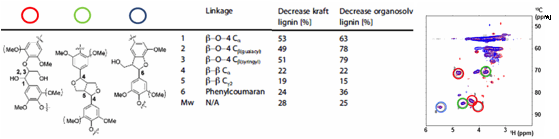
Figure 1. Influence of solubilization of kraft and organosolv in ethanol/water on Mw and extent of cleavage of selected linkages as determined by 2D HSQC NMR.
In the presence of a 1 wt% Pt/Al2O3 and either an acid or a base as co-catalyst, yields of up to 17% of isolated monomeric aromatics can be obtained, which is an order of magnitude higher than previously obtained with lignin APR. The yield and type of mono-aromatics is found to depend on the type of lignin, process conditions and catalyst used. The stability of the Pt/Al2O3 catalyst in ethanol/water under the typical liquid phase reforming conditions is studied in the presence of various aromatics and lignin itself. Boehmite formation and Pt particle sintering (typically observed under hydrothermal conditions [4]) was observed in ethanol/water, but was found to be greatly suppressed by the presence of lignin (Figure 2). [5]
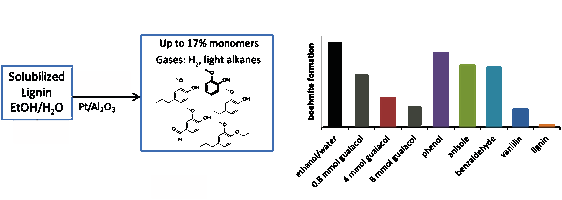
Figure 2. left: LPR results in improved monomer yield; right: influence of aromatics and lignin on catalyst stability (expressed as extent of boehmite formation).
Conclusions
The generic lignin solubilization holds potential for catalytic depolymerization by heterogeneous catalysts, as illustrated by the liquid phase reforming process. The explored route can thus contribute to the better integration of lignin in future biorefinery operations. The products obtained by liquid phase processing can, for instance, be subjected to a subsequent hydrodeoxygenation step to lower the oxygen content and reduce the complexity of the product mixture.
References
1. J. Zakzeski, P.C.A. Bruijnincx, A.L. Jongerius, B.M. Weckhuysen, Chem. Rev. 2010, 110, 3552.
2. J. Zakzeski, B.M. Weckhuysen, ChemSusChem 2011, 4, 369.
3. J. Zakzeski, A.L. Jongerius, P.C.A. Bruijnincx, B.M. Weckhuysen, ChemSusChem 2012, 5, 1602.
4. R.M. Ravenelle, J.R. Copeland, W.G. Kim, J.C. Crittenden, C. Sievers, ACS Catal. 2011, 1, 552.
5. A.L. Jongerius, J.R. Copeland, G. S. Foo, J.P. Hofmann, P.C.A. Bruijnincx, C. Sievers, B.M. Weckhuysen, ACS Catal. 2013, 3, 464.
See more of this Group/Topical: Catalysis and Reaction Engineering Division