
 Google
 Yelp
 Facebook
 Twitter
 ChEnected
330584 Restructuring of Aggregates and Their Primary Particle Size Distribution During Sintering
Particle suspensions and films often exhibit unique properties that depend on particle size distribution, like the opacity of titania pigments, the color of quantum dot or plasmonic nanoparticle suspensions and the superparamagnetism of iron oxide nanoparticles to name a few. Typically a narrow size distribution facilitates harvesting these effects from paints to solar cells, bio sensors and light emitting devices.
Aerosol processes allow rapid and scalable production of nanoparticles over a wide range of sizes. In such processes, however, particles grow typically by Brownian coagulation that places a lower limit to the width of the size distribution, the so-called self-preserving size distribution with a geometric standard deviation of about 1.45. Such a constraint would limit aerosol-made particles in applications requiring narrow size distributions. Furthermore, when primary particles (PP) with different high temperature residence time histories (e.g. from different reactor streamlines or reaction rates) are mixed, fractal-like particles with quite polydisperse PP size distributions (PPSD) are obtained. This polydispersity, however, can be reduced by PP sintering that proceeds inversely proportional to particle size, similar to condensation that is routinely used in generation of monodisperse aerosols.
Sintering can lead to a narrower PPSD than their parent aggregates. The narrowest PPSD was obtained when TiO2 aggregates were produced by TiCl4 or titanium isopropoxide oxidation followed by coagulation and sintering (Heine and Pratsinis, 2007). This was observed also with flame-made ZnO nanocrystalline aggregates exhibiting a blueshift of their absorption spectrum with decreasing ZnO crystallite size from about 8 to 1.5 nm (Mädler et al., 2002). A narrow crystal size distribution is required for this quantum-size effect.
During sintering of aggregates of polydisperse PP, restructuring takes place, the average PP size increases and the PPSD narrows affecting particle performance in a number of applications (Fig. 1, Eggersdorfer and Pratsinis, 2013). Here, aggregate sintering by viscous flow (Eggersdorfer et al., 2011), lattice and grain boundary diffusion (Eggersdorfer et al., 2012) is simulated by multiparticle discrete element methods focusing on PP growth dynamics and elucidating the restructuring of aggregates during their coalescence. The effect of initial PPSD and sintering mechanisms on the evolution of PP polydispersity and surface area mean diameter are presented. Each sintering mechanism results in a distinct evolution of PPSD but quite similar growth in average PP diameter. Grain boundary diffusion has the strongest impact among all sintering mechanisms and rapidly results in the narrowest PPSD as it has the strongest dependence on PP size. During sintering of aggregates with initially monodisperse PPs, the PPSD goes through a maximum width before narrowing again as PPs coalesce. A power law holds between projected aggregate surface area and number of PPs regardless of sintering mechanism and initial PP polydispersity. This law can be readily used in aerosol reactor design and for characterization of aggregates independent of material composition, initial PP polydispersity and sintering mechanism.
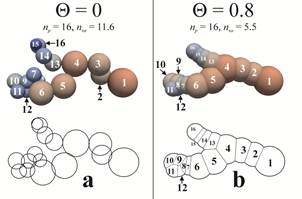
Figure 1. The geometric standard deviation Rg of PP size distribution for a) agglomerates and b) aggregates is calculated with the diameters d of their constituent PPs at dimensionless time . The sinter neck or grain boundaries between neighboring particles are sketched with thin lines. For aggregates, the d represents the maximum extension of the PP or crystal size (truncated sphere). The number of PPs, np, remains constant while the average PP number, nva, decreases during sintering due to the decreasing surface area of the aggregate.
Financial support by ETH Research Grant (ETHIIRA) ETH-11 09-1 and the European Research Council under the European Union's Seventh Framework Programme (FP7/2007-2013)/ERC grant agreement n° 247283 is gratefully acknowledged.
Eggersdorfer, M.L., Kadau, D., Herrmann, H.J. and Pratsinis, S.E. (2011) Langmuir 27, 6358-6367.
Eggersdorfer, M.L., Kadau, D., Herrmann, H.J. and Pratsinis, S.E. (2012) J. Aerosol Sci. 46, 7-19.
Eggersdorfer, M.L., Pratsinis, S.E. (2013) AIChE J. in press.
Heine, M.C. and Pratsinis, S.E. (2007) J. Aerosol Sci. 38, 17-38.
Mädler, L., Stark, W.J. and Pratsinis S.E. (2002) J. App. Phys. 92, 6537-6540.
See more of this Group/Topical: Particle Technology Forum