
 Google
 Yelp
 Facebook
 Twitter
 ChEnected
330933 Combinatorial Design of Selective Gel Materials for Extractive Fermentation
Due to limited global supplies of fossil fuel resources, rising prices, and environmental problems, future energy needs must be met in part or entirely by fuels derived from renewable resources. Production of ethanol (EtOH) and n-butanol (BuOH) from non-food feedstocks, namely cellulosic biomass, has received much attention. If cellulosic bio-alcohols are to become an economically sustainable source of fuel in the future, drastic improvements to process economics must be realized, however. One of the main problems facing the biofuels industry is the fact that fermentations of cellulose-derived sugar mixtures tend to produce very low concentrations of the alcohol, which in turn leads to a high energy cost for biofuel recovery by traditional multi-stage distillation. For example, typical concentrations of BuOH obtained are less than 20 g/L due to the toxicity of the BuOH, while typical concentrations of EtOH are much lower than the values found in pure sugar fermentations, due to the presence of toxic inhibitor compounds in cellulose-derived sugars. Thus, design of alternative separation strategies such as pervaporation and extractive fermentation, which are amenable to low alcohol concentrations, remains a challenge.
Because liquid-liquid extraction suffers from fouling and emulsion problems, approaches based on polymeric membranes or absorbent solids are favored for alcohol recovery. The usual problem in designing materials for selective transport applications is a trade-off between selectivity for the desired product and solubility of the product, however. In other words, materials that absorb significant quantities of the alcohol usually have poor selectivity, absorbing significant amounts of water. As a result, the definition of an optimum material composition for pervaporation requires consideration of both transport rates and product purity. Ultimately, the material must transport alcohol at a high enough rate to maintain reasonable productivity, while maintaining low enough water content to reduce the cost of subsequent dehydration processes.
This work addresses a novel high-throughput screening approach for designing selectively swelling copolymer gel materials for use in extractive fermentation processes. The overall approach is based upon polyacrylate random copolymers in which one monomer (H) is more hydrophilic than the alcohol, and the other (B) is more hydrophobic, so that the cohesive energy density of the copolymers covers a wide range. The gels that absorb the greatest amount of alcohol are expected to be those having cohesive energy density similar to that of the targeted alcohol molecule. However, the gel that is most selective for alcohol in a mixed solvent situation will likely have a different composition, as more hydrophobic materials are less likely to absorb water. Thus, selection of an optimal material for extractive fermentation requires a more thorough analysis of the volumetric productivity of the reactor. To support such analysis, a high throughput screening approach has been developed to rapidly generate information concerning swelling, selectivity, and distribution coefficient of copolymer gel materials, information that is invaluable in process modeling.
A combinatorial matrix of gels is prepared, having orthogonal gradients in two key parameters, such as the mole fraction of the hydrophilic monomer (xH), and the mole fraction of acrylates belonging to the crosslinker molecule (xC). Testing of equilibrium swelling characteristics in pure and mixed solvents provides a library of information regarding the parameters influencing performance in separations applications. Typical results of the high-throughput screening methodology are illustrated in Fig. 1. A series of gels was prepared by co-polymerizing hydrophobic (B = butyl acrylate) and moderately hydrophilic (H = hydroxyethyl acrylate) chemical units. All gels were thereafter swollen in pure water and pure alcohols (n-butanol, ethanol) to obtain information about equilibrium swelling properties. Equilibrium swelling data reveal that some of the gels have very high affinity for alcohol and low affinity for water (data shown are for EtOH). For example, gels having xB = 0.7 to 0.9 and xC = 0.008 gained more than 1300% of their initial (dry) mass in EtOH, while gaining less than 5% their mass when swollen in pure water. However, examination of equilibrium swelling properties in pure components is not sufficient to determine an "optimal" material for a separation process. The performance of the material in a mixed solvent system (water + alcohol) may differ greatly, due to the greatly lowered chemical potential of the alcohol molecules in the external liquid mixture.
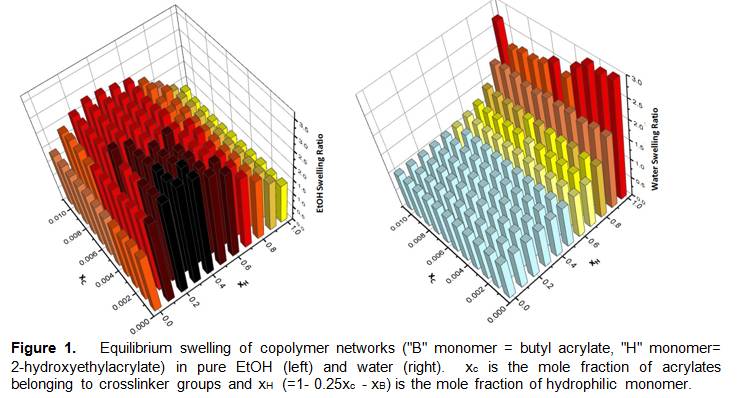
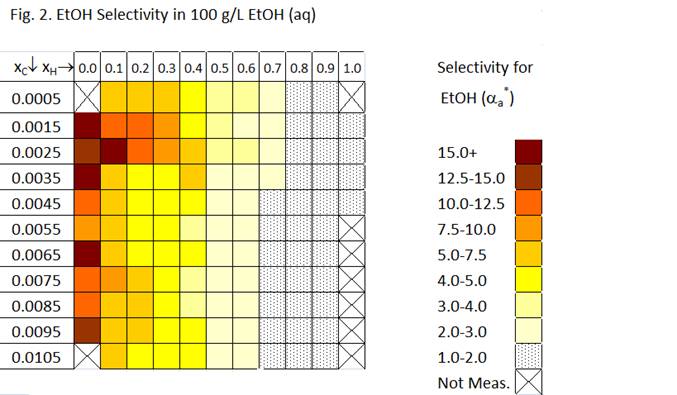
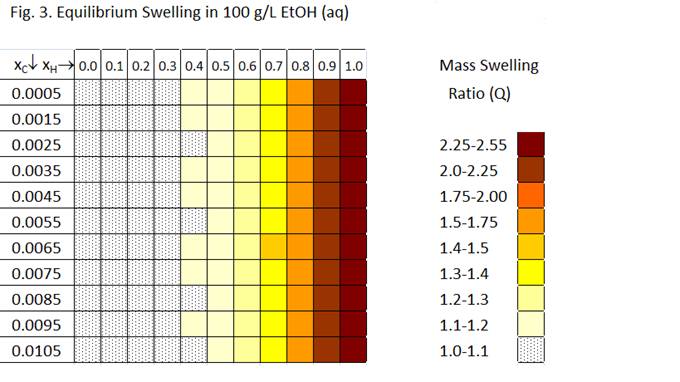
To determine values of the alcohol distribution coefficient and the selectivity for alcohol, additional combinatorial swelling experiments are therefore conducted in solvent mixtures of interest (e.g. 20 g/L BuOH or 100 g/L EtOH). The composition of the external liquid at equilibrium is measured by high-throughput HPLC. The equilibrium gel masses are also recorded, and a mass balance on the system permits rapid computation of selectivity and distribution coefficient of each gel. Fig. 2 shows calculated selectivities for the test system. The usual trade-off between selectivity and absorption capacity is apparent by comparing Figs. 2 and 3. Gels that absorb significant amounts of liquid, which are rich in the hydrophilic monomer, exhibit poor selectivity for the alcohol. Highly selective gels consisting of mostly the hydrophobic (B) component absorb too little EtOH to be useful in a practical sense. In addition, it is apparent that the gels that appeared optimal based upon pure solvent swelling (Fig. 1) actually have no special characteristics in mixed-solvent selectivity tests (Fig. 2). While the combinatorial approach produces a rich library of information concerning competitive swelling characteristics in the water-alcohol mixtures, no "optimal" material is identified a priori. Thus, it is apparent that selection of an "optimal" material requires consideration of the fermentation process characteristics.
A material optimization protocol is demonstrated for extractive fermentation by considering the volumetric productivity of a batch fermentor containing an absorbent gel, which depends both on the volume fraction of the absorbent material and the distribution coefficient for alcohol. While the absorbent material continuously removes alcohol from the system during fermentation, increasing the volumetric productivity of the liquid phase, the absorbent material also displaces some portion of the liquid phase, decreasing the effective fermentation volume. The optimum material maximizes the overall volumetric productivity of the system in units of (kg alcohol) / [(L reactor volume)*h]. It can be shown that an effective absorbent material must have a distribution coefficient for the alcohol, Da, significantly greater than 1 to achieve a significant improvement in volumetric productivity. Previous studies of extractive fermentation have often neglected this criterion, focusing only on the total amount of alcohol produced from a fixed liquid volume and ignoring the displacement of liquid by the absorbent material in a vessel of fixed size.
In practice, obtaining an absorbent material with Da > 1 is difficult and in fact, none of the materials in the test matrix shown in Figs. 1-3 meets this criterion, despite the attractive discrepancy in pure solvent swelling observed. Two strategies have recently been pursued for obtaining polymer gel materials having Da > 1. First, crosslinking a highly selective material in a solvent was explored to obtain gels having fewer trapped entanglements, increasing the equilibrium swelling ratio in the mixed solvent systems. Further combinatorial studies of the interdependent effects of solvent concentration and crosslinker concentration have been conducted to maximize swelling of a gel material with a constant ratio of H:B monomers. Second, the combinatorial methods were extended to create gels from acrylate-functional derivatives of Castor oil, a biomass-derived macromonomer. Based on previous studies of liquid-liquid extraction, Castor oil has an unusually high distribution coefficient for alcohol, motivating this portion of the work. The polyacrylate gels prepared from hydrophobic and hydrophilic ester modifications of Castor oil exhibit superior performance, with Da > 1. The remainder of the talk will address the performance of a model absorbent material in a batch extractive fermentation process.
See more of this Group/Topical: Materials Engineering and Sciences Division