
 Google
 Yelp
 Facebook
 Twitter
 ChEnected
331422 Experimental and Computational Study of the Causes of the Fishhook Effect in a Mini-Hydrocyclone
Experimental and computational study of the causes of the fishhook effect in a mini-hydrocyclone
Guofeng Zhu, Jong-Leng Liow
School of Engineering and Information Technology, UNSW Canberra @ADFA, Canberra, ACT, Australia 2600
The ability of a hydrocyclone to separate finer material is governed by the cut size scaling proportionally to the square root of the hydrocyclone diameter. A mini-hydrocyclone of 5 mm was studied experimentally and through computational fluid dynamics (CFD) simulation for its ability to separate a feed of sub-100 mm particles. When the feed contains particles smaller than 5-10 mm, the separation efficiency of the finest particle to the underflow rises as the particle size decreases. The rise in the separation efficiency value leads to a shape similar to a fishhook, giving the term fishhook effect. The fishhook effect leads to poor separation of the fine particles as well as contamination of the underflow with fines. The exact cause and physics underlying the fishhook effect has not been fully elucidated and a series of experiments were conducted to investigate the effect of feed flow rate, particle size distribution in the feed, and particle sphericity on the fishhook effect in a mini-hydrocyclone where the 50% separation efficiency (d50) is usually below 50 mm.
The mini-hydrocyclone was manufactured by micro-end milling to give a surface finish with a surface roughness less than 500 nm. A set of non-spherical beach sand samples was prepared by ball milling and screening and a set of spherical glass particles were obtained from Potter's Industries. Figure 1 shows the volume distribution of the samples. Figure 2 shows the separation of the 60 mm non-spherical sample at varying inlet velocities from 0.4 to 4.0 m/s, where the inlet Reynolds number (Rein) varied from 600 to 6000, placing the flow in the transition to low turbulent regime. As the inlet velocity is increased, the separation efficiency of the larger particles (>5 mm) leads to a lower d50 value indicating that a higher inlet velocity leads to a finer cut size. For an inlet velocity of 0.4 m/s, there is a flat base in the separation efficiency between 2 to 20 mm, which is progressively narrowed as the inlet velocity increases. The fishhook dip, the point at which the separation efficiency is the lowest, occurs around 3 mm and is independent of the inlet velocity. However the fishhook peak, the maximum separation efficiency in the small particle region past the fishhook dip, increases with increasing inlet velocities.
It is proposed that the fishhook effect is due to the entrainment of fine particles within the wake of the larger particles and this is found to be more pronounced when there is a large fraction of large particles in the feed. The fishhook effect was found to be small or negligible when tests were carried with two feed streams, one with non-spherical particles with a d50<18 mm and one with spherical particles with a d50<8 mm. It was also found that as the concentration of large particles (>10 mm) decreased, the separation efficiency at the fishhook peak decreased as shown in Figure 3.
Earlier work has shown that the fluid flow within the mini-hydrocyclone is unsteady but not fully turbulent and up to 2 million grid cells were used with the ANSYS Fluent package to obtain grid independence (Zhu et al. 2012). A particle entrainment model was developed whereby the fine particles are entrained by larger particles within a finite cell volume around the larger particles. The fine particles trapped within this cell volume takes on the velocity of the larger particle, while fine particle outside the cell volume have a velocity based on its interaction with the fluid. A user added function was incorporated into the ANSYS Fluent package to model the particle separation. Twenty three logarithmic levels of particle sizes distributed over the 0.72 to 90 mm range with 8000 particles in each size fraction were tracked. The results of a simulation is compared to the experimental result with a 1.0 m/s inlet velocity for the 60 mm non-spherical sample and shows good agreement in predicting the separation efficiency and shown in Figure 4. A simulation without the particle entrainment model shows the monotonic decreasing separation efficiency with decreasing particle size. The differences between the experimental and simulated results in the larger particle size range (>10 mm) can be attributed to the non-sphericity of the particles. A spherical sample, labelled s2, with a d90<50 mm and minimal particles below 8 mm was tested at the same inlet velocity and showed a separation curve in the larger particle size range closer to the simulation curve, confirming that the non-sphericity of the particles play an important role in the larger particle size range.
Reference
Zhu, G.F., Liow, J.L. and Neely, A. 2012 Computational study of the flow characteristics and separation efficiency in a mini-hydrocyclone. Chemical Engineering Research and Design, 90(12), 2135-2147.
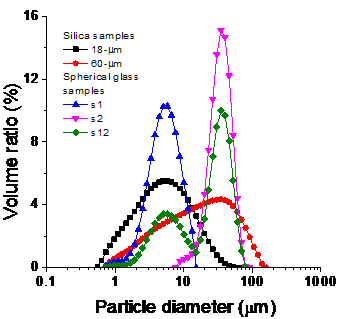
Figure 1: Particle size distribution of the particles used as feed into the mini-hydrocyclone
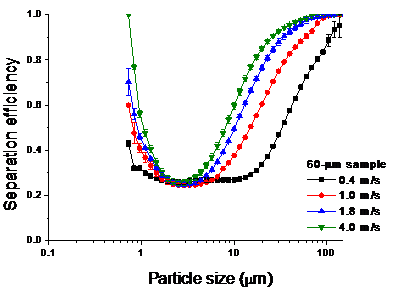
Figure 2: Separation efficiency curves of the 60 mm non-spherical sample for inlet velocities of 0.4, 1.0, 1.8 and 4.0 m/s. The standard deviation of the particle size analysis is of the order of the symbol size.
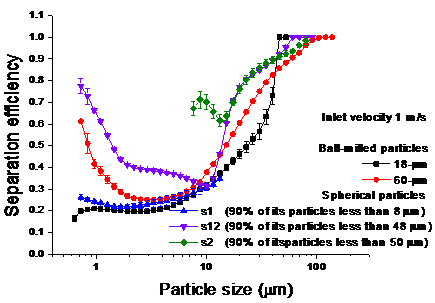
Figure 3: Separation efficiency curves for different particle feeds for an inlet velocity of 1 m/s.
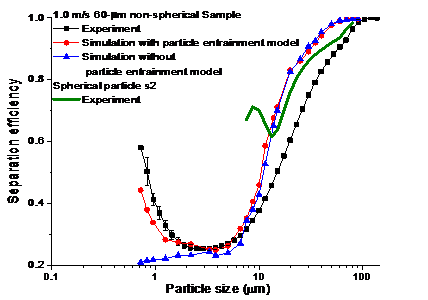
Figure 4: Comparison of the model results with the experimental results for an inlet velocity of 1.0 m/s and a 60 mm non-spherical feed sample. The spherical sample has a size range that has been screened to remove fine particle below 8 mm.
See more of this Group/Topical: Separations Division