
 Google
 Yelp
 Facebook
 Twitter
 ChEnected
331541 Stabilization By Atomic Layer Deposition of Copper Catalysts for Liquid Phase Reactions
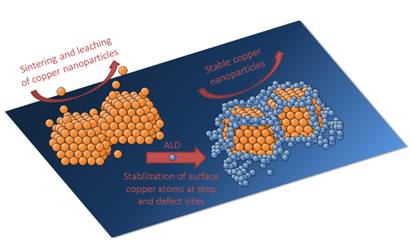
Precious metal catalysts are used extensively in the petrochemical industry and are anticipated to have a significant role in future biorefineries. While it would be desirable to replace precious metal catalysts (e.g., platinum) with base metals that are more abundant (e.g., copper), these base metal catalysts are susceptible to sintering and leaching under liquid-phase reaction conditions. Previously, we have reported a method to stabilize copper nanoparticles on g-Al2O3 by atomic layer deposition (ALD) of an alumina overcoat for the liquid phase hydrogenation of biomass-derived furfural. This overcoat provides resistance against sintering and leaching of the nanoparticles without significantly affecting the reaction kinetics. In order to broaden the impact of this result, a more fundamental understanding of the phenomena that lead to the pore opening of the overcoat and the stabilizing interaction between the overcoat and metal nanoparticle surface is required.
In order to achieve such a mechanistic understanding, traditional surface science and reaction kinetics studies are combined with in situ and operando measurements. For example, in situ and operando XAS measurements demonstrate that the copper nanoparticles simultaneously undergo sintering and leaching during reaction, but ALD overcoated catalysts remain stable during reaction. Additionally, hydrogen chemisorption, Fourier transform infrared spectroscopy, and scanning tunneling microscopy are used to demonstrate that a selective interaction between the overcoat and the least coordinated copper surface atoms causes the increased stability of the ALD overcoated catalysts. This fundamental understanding of the interfacial interaction is crucial to extending this result to other metals and overcoat materials.
An understanding of the pore opening process in the overcoat also has the potential to broaden the impact of the new overcoating technique by providing a degree of control over the final pore size. Solid state 27Al magic angle spinning nuclear magnetic resonance demonstrates significant restructuring in the overcoat during heat treatment. Powder X-ray diffraction also shows that the overcoat has restructured after heat treatment, and in situ small angle X-ray scattering (SAXS) shows the evolution of the pores during the heat treatment process. Using SAXS, we are also able to probe the effect of different heat treatment parameters (time, temperature, ramp rate) on the resulting pore size, which gives us the potential to further refine the selectivity of the catalyst via size exclusion.
See more of this Group/Topical: Catalysis and Reaction Engineering Division