
 Google
 Yelp
 Facebook
 Twitter
 ChEnected
331633 Kinetically Controlled Self-Assembly of Redox-Active Ferrocene-Diphenylalanine: From Nanospheres to Nanofibers
Self-assembly is a common process in biological and synthetic systems, which has been emerging as a powerful, bottom-up approach in the construction of well-ordered nanostructures. The inherent biocompatibility, ease of synthesis and facile chemical modification of peptide molecules render them excellent building blocks in the construction of well-defined supramolecular architectures. A well-known example is that of the diphenylalanine peptide (L-Phe-L-Phe, FF), which is the core recognition motif of Alzheimer's Ab polypeptide.1 Through a combination of specific molecular interactions such as van der vaals, hydrogen bonding, hydrophobic and ¦Ð-¦Ð stacking under different conditions (e. g. solvent or surface), Phe-Phe peptide can self-assemble into various nanostructures such as nanotubes,1 nanowires,2 microcrystals,3 and vertically aligned nanoforest.4 Due to the specific molecular interactions, Phe-Phe can be employed as a recognition module to design novel molecular building blocks. It is suggested that the modified motifs play a determinant role in the creation of novel functional peptide nanomaterials.
Putting metals into self-assembling peptides may provide us an opportunity to design molecular building blocks with new desirable properties. Ferrocene (Fc),5 one of the most stable and useful organometallic compounds, has been used as metal-containing component for the construction of various hybrid molecules from small molecules to polymers with various applications in biosensor, magnetic and stimuli-responsive materials, and asymmetric catalysis. Here, we showed the kinetically controlled self-assembly of a novel bioorganometallic molecule via the conjugation of ferrocene with diphenylalanine (ferrocene-diphenylalanine, Fc-FF, Figure 1a), and directly observed a morphological transition from metastable nanospheres to well-defined nanofibers by introducing an external mechanical force (i.e. shaking), which finally led to the formation of a stable self-supporting hydrogel (Figure 1b and c). Moreover, as the Fc moiety in this hybrid molecule serves as a redox-active site, its self-assembly process can be reversibly controlled by altering the redox state of Fc group (Figure 1d and e). The main ideas and conclusions are summarized as follows:
(1) Strong hydrophobic interaction among molecular units may lead to the formation of nanomaterials that depend largely on the pathway or kinetic control. For Fc-FF assemblies, after diluting the concentrated Fc-FF methanol solution in water, the solvent environment around Fc-FF molecules changed intensively, giving rise to strong hydrophobic interactions which were adequate for achieving efficient kinetic trapping, thus leading to formation of nanospheres. After exerting slight shaking, the metastable Fc-FF nanospheres can transform into thermodynamically stable nanofibers with simultaneously molecular rearrangement from unordered structure to ¦Á-helix. It is obvious that the self-assembly of Fc-FF is a kinetically controlled process. High-uniform nanospheres were formed by the fast self-assembly, whereas the nanofibers with helical superstructures were obtained from the slow self-assembly. External mechanical force can be used to overcome the energy barrier and thus to initiate the 'slow' self-assembly process. The strong hydrophobic interactions introduced by Fc group in water may play an essential role in this transition process.
(2) For Fc-FF molecule, the Fc group in its reduced state is hydrophobic, while its oxidized form (Fc+) is hydrophilic (Fig. 1d). This can give rise to a remarkable change in the hydrophobic-hydrophilic balance of Fc-FF, thus altering its self-assembly behavior. To demonstrate this, 1 mg ml-1 Fc-FF nanofibers was dispersed in 10% CH3OH/90% H2O. After introducing an appropriate amount of CeSO4 as oxidant, the yellow turbid Fc-FF nanofibers suspension turned into a blue transparent solution, and continuous addition of GSH to the solution transformed it back to yield a yellow turbid suspension again (Figure 1e, insets). SEM analysis revealed that the Fc-FF units could reversibly self-assemble into nanofibers after the oxidation-reduction cycle (Figure 1e). After the oxidation of Fc-FF into Fc+-FF, apart from an amorphous film deposited on the surface of the microscope glass coverslip, no characteristic morphology was observed. This indicated that the Fc-FF nanofibers may disassemble or disrupt into monomers or much smaller aggregates as the oxidation of Fc-FF into Fc+-FF. Moreover, continuous reduction of the Fc+-FF molecule into Fc-FF recovered its self-assembling ability, thus leading to the reassemble of well-defined Fc-FF nanofibers.
(3) Due to the stimulus (i.e. mechanical force, redox) responsive properties, the Fc-FF nanostructures may have great potential applications in areas such as biosensor, tissue engineering, controlled drug release. Moreover, considering the structural diversity of FF assemblies, the Fc-FF molecule may have the ability to form other novel nanosturcutres by controlling the self-assembly conditions.
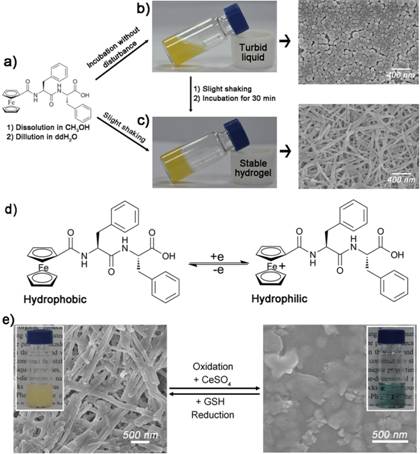
Figure 1. Self-assembly behavior of ferrocene-diphenylalanine. a) Molecular structure of ferrocene-diphenylalanine (Fc-FF). b) Photograph of the mixture incubated without any external disturbance. c) Photograph of the mixture after incubation by introducing slight shaking. d) Redox-control of the ferrocenyl group. e) SEM analysis showed the self-assembling behavior of Fc-FF molecules in their reduced and oxidized state. The insets showed the photographic images of 1mg ml-1 Fc-FF nanofibers dispersed in 10% CH3OH/90% H2O before and after oxidation.
This work was supported by the NSF of China (51173128, 31071509), the Ministry of Science and Technology of China (Nos. 2012YQ090194, 2013AA102204, 2012BAD29B05), the Program for New Century Excellent Talents in Chinese University (NCET-08-0386), and Beiyang Young Scholar Program (2012).
References
2. (a) Kim, J.; Han, T. H.; Kim, Y.-I.; Park, J. S.; Choi, J.; Churchill, D. G.; Kim, S. O.; Ihee, H., Role of Water in Directing Diphenylalanine Assembly into Nanotubes and Nanowires. Adv. Mater. 2010, 22 (5), 583-587; (b) Huang, R. L.; Qi, W.; Su, R. X.; Zhao, J.; He, Z. M., Solvent and surface controlled self-assembly of diphenylalanine peptide: from microtubes to nanofibers. Soft Matter 2011, 7 (14), 6418-6421.
See more of this Group/Topical: Nanoscale Science and Engineering Forum