
 Google
 Yelp
 Facebook
 Twitter
 ChEnected
332023 Adsorption of Benzene and Toluene in Supercritical CO2 On Molecular Sieving Carbon Using Stop & Go Method
Chromatographic measurements were made for the adsorption of organics (benzene or toluene) on molecular sieving carbon (MSC) in supercritical fluid CO2 mixed with organics. Supercritical CO2 mixed with small amount organics (benzene or toluene) flowed as carrier in chromatograph. Adsorbates applied as impulse used same or different organics mixed with supercritical CO2. Supercritical chromatograph packed with MSC was used to detect impulse responses of organics. Adsorption equilibria and adsorption dynamics parameters for organics were obtained by moment analysis of the impulse response peaks.
Stop & Go method was used as one of the simulation methods of perturbation chromatography which examine adsorption equilibrium and rate. Experimental adsorption equilibria and adsorption rate parameters for organics and CO2 were obtained using Stop & Go simulation. Fig. 1 shows basic concept of this simulation which was N completely-mixed cell in axial direction of column. If the flow stopped only dt second, the adsorbate was made batch adsorption into each cells. After dt second, think material balance in adsorption and desorption of each cell within a stopped time frame.
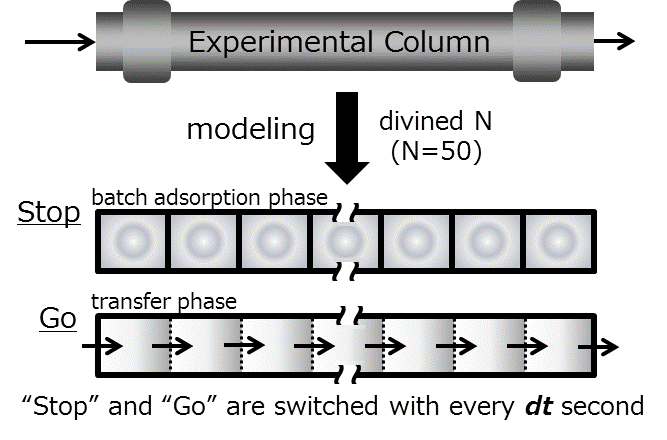
Fig. 1 Stop & Go method basic concept
See more of this Group/Topical: Separations Division