
 Google
 Yelp
 Facebook
 Twitter
 ChEnected
332170 Inhibited Growth of Staphylococcus Aureus and Pseudomonas Aeruginosa On Paper Towels Through the Use of Selenium Nanoparticles
Inhibited Growth of Staphylococcus aureus and Pseudomonas aeruginosa on Paper Towels through the use of Selenium Nanoparticles
Qi Wang1, Thomas J. Webster1,2
1Bioengineering Program, 2Department of Chemical Engineering,
College of Engineering, Northeastern University,
Boston, MA 02115, U.S.A.
Introduction
In the hospital environment, hand washing has been identified as the most significant manner towards preventing the spread of microbial infections1, with hand drying as the critical last stage of the hand washing process. In some circumstances, such as for paper towels hanging in sink splash zones or those used to clean surfaces, they have been considered as potential sources of bacteria contamination.2 In this study, for the first time, selenium nanoparticles were coated on normal paper towel surfaces through a quick precipitation method. In addition, their effectiveness at preventing biofilm formation was tested in bacterial assays involving Staphyloccocus aureus and Pseudomonas aeruginosa. The results showed that the selenium coatings successfully introduced antibacterial properties to standard paper towels, revealing a promising selenium-based method to prevent bacterial infections on paper products.
Materials and Methods
Paper towels (Tork Advanced, MB550A Hand Towel, cut into round chips, 7.01mm in diameter) were coated with selenium nanoparticles through a simple and quick precipitation reaction. The reaction involves glutathione (reduced form, GSH) (97%, TCI America, Portland, OR) and sodium selenite (99%, Alfa Aesar, Ward Hill, MA) mixed at a 4:1 molar ratio. The paper towel samples were coated for 30s under a 200 rpm (round per minute) agitation to ensure a uniform coating. The coated substrates were rinsed in deionized water three times to remove the free, non-adherent, selenium nanoparticles and remaining reactants. SEM (Scanning Electron Microscope, HITACHI 2700) images of the paper towel substrate surfaces were taken to determine the size, coverage and distribution of selenium nanoparticles. AAS (Atomic Absorption Spectroscopy, Furnace, AA600) was used to measure the amount of selenium nanoparticles on the coated paper towels.
In order to test the effectiveness of selenium coatings on inhibiting bacterial biofilm growth, bacterial experiments were implemented. A bacteria cell line of S. aureus and P. aeruginosa was obtained in freeze-dried form from the American Type Culture Collection. Selenium coated samples were placed into a 24-well plate, treated with the prepared bacterial solutions (106 bacteria/ml) and cultured for either 24, 48 or 72 hours in an incubator (37°C, humidified and 5% CO2). After treatment, the samples were rinsed with a phosphate buffered saline solution twice and placed into 1.5ml microfuge tubes with 1ml of PBS. These tubes were shaken at 3000 rmp for 15 minutes on a vortex mixer to release the bacteria attached onto the surface into the solution. Solutions with bacteria were spread on agar plates and bacteria colonies were counted after 18 hours of incubation. All experiments were completed in triplicate and were repeated three separate times. Data were collected and significant differences were assessed with the probability associated with a one-tailed Student's t-test. Statistical analyses were performed using Microsoft Excel (Redmond, WA).
Results and Discussion
Figure 1 shows the SEM images of the selenium coated paper towels (image a) and uncoated paper towels (image b). On the selenium coated paper towel samples, the selenium nanoparticles were well distributed and completely covered the surface. The diameters for most of the selenium particles were around 50 nm. For the uncoated paper towel, there were no particles observed. According to AAS results, the concentration of the selenium nanoparticles on the coated paper towel surface was 69.00 g/m2. This concentration is about 4 times larger than concentration of selenium on the coated polycarbonate surfaces under the same coating conditions as published in a previous study3. The reason was that the fibrous structure of the paper towel significantly increased surface area to allow for more selenium nanoparticle deposition.
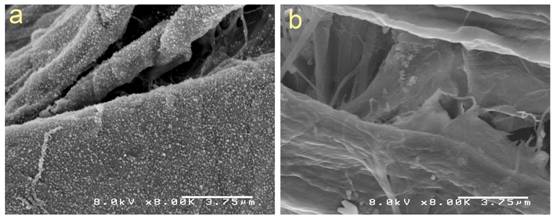
Figure 1. SEM images of selenium coated (image a) and uncoated paper (image b) towel samples. The concentration of selenium on the paper towel as measured by AAS was 69.00 g/m2 for the selenium coated paper towels and 0 g/m2 for the uncoated paper towels.
The results of bacteria test involving S. aureus and P. aeruginosa showed high effectiveness for the selenium coated paper towels at inhibiting bacteria growth on the paper towel surfaces, as shown in Figure 2. The selenium coatings significantly inhibited S. aureus growth by about 90% after 24, 48 or 72 hours and also successfully inhibited P. aeruginosa growth after 48 or 72 hours by 55% and 84%, respectively, on the surface of paper towels. Moreover, from the 24 hour culture time to the 48 hour culture time, there was an increase in bacteria numbers on uncoated paper towel samples, but was the constant to the 72 hours culture time, implying that the uncoated paper towel was saturated by bacteria after 48 hours of treatment. On contrast, the bacteria numbers on the selenium coated paper towels remained at a lower level not increasing from 24 to 48 to 72 hours, indicating successful inhibition of bacterial growth.
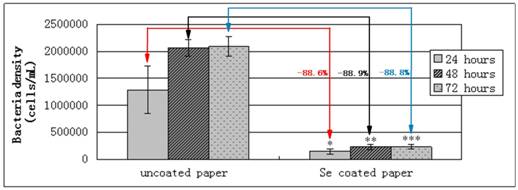
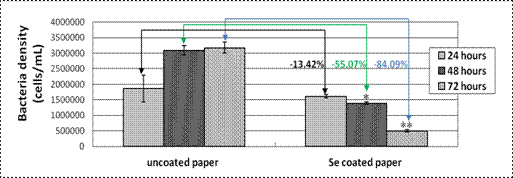
Figure 2. Staphyloccocus aureus (top graph) and Pseudomonas aeruginosa (bottom graph) growth on the surface of selenium coated and uncoated paper towels. Data is represented as mean ± standard deviation, n=3; *,**,***p<0.05 compared to the uncoated samples at the same time scale.
Conclusions
In conclusion, the effectiveness of selenium coated paper towels inhibiting bacterial growth reached about 80-90% after 3 days compared with the uncoated paper towels. Importantly, this was accomplished without using antibiotics. This study suggests that selenium nanoparticle coatings could be used as an effective way to decrease bacterial infections (specifically, S. aureus and P. aeruginosa) on paper products, which might have potentially important applications in the food packaging industry, medicine, and in clinical environments.
Acknowledgements
The authors thank Dr. Justin Seil for help with the bacteria experiments. Funding from Northeastern University is also acknowledged.
References:
[1]. McGuckin M. Improving hand washing in hospitals: a patient's education and empowerment program. LDI Issure Brief. 2001;7:1-4.
[2]. Hattula JL, Steven PE. A descriptive study of the hand washing environment in a long-term care facility. Clin Nurs Res. 1997;6:363-74.
[3]. Wang Q, Webster TJ. Nanostructured selenium for preventing biofilm formation on polycarbonate medical devices. J. Biomed. Mater. Res. A. 2012;100(12):3205-3210.
See more of this Group/Topical: Materials Engineering and Sciences Division