
 Google
 Yelp
 Facebook
 Twitter
 ChEnected
332308 Multi-Component Gas Adsorption On MSC5A By Chromatographic Method and Simulation Study
1. Introduction
The combination of chromatographic method and moment analysis of the response peaks is one of the useful techniques to study adsorption equilibrium and adsorption rate. Perturbation chromatography with the mixed multi component adsorbent gas carrier (two adsorbates) has been applied to several studies on adsorption. In this work, perturbation chromatography with multi component gas carrier (two adsorbates with inert gas) and non-equilibrium thermodynamics liner law was applied for discussion of the interference effect and the displacement effect (those are cross effects) on mass transfer in multi component gas adsorption as previous study for different gas mixture (He, CO2, C2H4, CH4 , N2). The study of mixed gases (C2H4+CO2,CH4+N2,CO2+CH4) were done in temperature of 313K, 323K,333K. Moment analysis method and stop & go simulation method were utilized to obtain each mass transfer parameters of adsorbate gases.
2. Experiment
The apparatus was similar to a conventional gas chromatograph. Adsorbent particles (molecular sieving carbon 5A, 20/30 mesh, Japan Enviro Chemical Ltd.,) were packed in a column. Carrier gas was a mixture of two or three components among He, CO2, C2H4,N2,CH4. Perturbation pulse was introduced into the carrier gas stream. Introduction of pulses was performed by 6-way valve. The pulse size was 1cc, which meant injection period was 1.4 sec. Then pulse response was detected by TCD cell. Output signal of TCD was transmitted to a personal computer through RS232C. This signal was also transmitted to the personal computer. Simulated chromatogram by a personal computer can be overlapped on experimental chromatogram shown in the monitor screen. Further, moment of pulse response, which is shown in the monitor screen, can be automatically calculated by the personal computer. Also this simulated chromatogram can be compared with experimental chromatogram to determine the equilibrium and the adsorption kinetic parameters. Here Markham-Benton equation as for adsorption equilibrium and linear driving force (LDF) approximation as for adsorption kinetics were adapted for numerical calculation, which was based on stop & go method. Overall mass transfer coefficients (Ksav) for LDF model were determined.
3. Result and Discussion
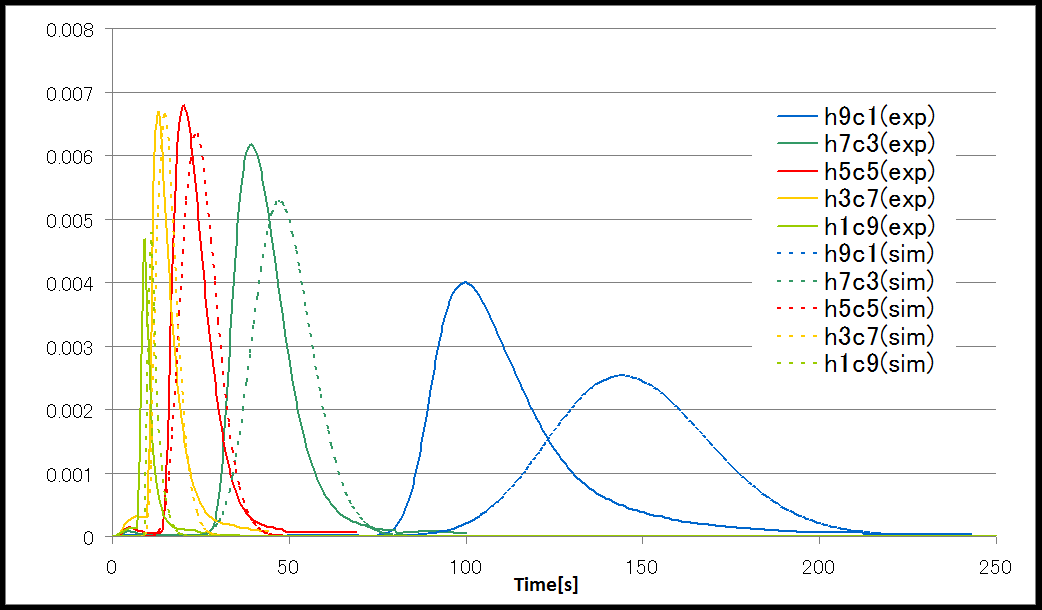
Fig.1 shows an example of comparison of experimental chromatogram with simulated chromatogram for MSC5A to obtain Ksav for LDF model. Experimental conditions were 333 K, column pressure 5 atm, flow rate 25 cm/sec and He + CO2 mixed gas carrier with CO2 pulse. Here CO2 concentration in the carrier gas was changed 10, 30, 50, 70 and 90 %. Retention time of simulation peak depend on langmuir parameter. Therefore experimental peaks differ from simulation peaks because of amount adsorbed from experiment and langmuir parameter differed.
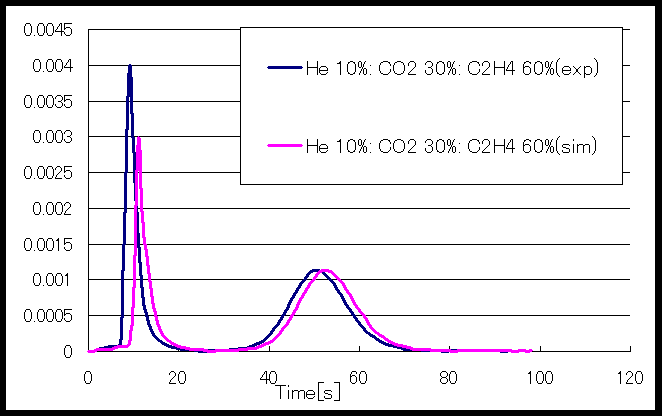
Fig.2 shows experiment and simulation results in an example case of binary adsorbate carrier mixed with He and an adsorbate pulse. Experimental conditions were 333 K, column pressure 5 atm, flow rate 25 cm/sec and He(10%)+CO2(30%)+CH4(60%) mixed gas carrier with CO2pulse. Simulation peak needs compensation becouse TCD signals different behavior from simulation's preassure change.
Fig. 1 Comparison of experimental peaks with simulation of He +CO2 mixed gas carrier with CO2 pulse at 333 K. Fig. 2 Comparison of experimental peaks with simulation of He(10%)+CO2(30%)+CH4(60%) mixed gas carrier with CO2 pulse at 333 K. 4. Conclusion Good agreements between experimental chromatogram and
simulated chromatogram, which were based on the modeling of Stop & Go
method, were observed in case of peturbation chromatography with mixed
adsorbate gas carrier. And micropore diffusivities obtained were interpreted by
chemical potential driving force consideration based on non-equilibrium
thermodynamics law.
See more of this Group/Topical: Separations Division