
 Google
 Yelp
 Facebook
 Twitter
 ChEnected
332349 Aerosol Assisted Synthesis of Gold Nanoparticles
Gold nanoparticles (AuNPs) also called gold colloids are the most stable metal nanoparticles [Daniel and Astruct 2004]. AuNPs are known to have some unique properties including the surface plasmon resonance (SPR), which arises from the collective oscillation of conduction electrons and, dominates the optical spectra of metallic nanoparticles (NPs) [de la Garza et al. 2010]. This makes them attractive for many potential applications in the fields of biotechnology (e.g. biosensors, cell and tissue engineering, open MR imaging), energy (e.g. high-K capacitors, solar cells) and information technology (e.g. fiber-optic communications systems, printable electronics) [Wu et al. 2008]. However, the properties and applicability of AuNPs are strongly dependent on the particles size, interparticle distance, nature of the protecting organic shell, and shape of the nanoparticles.
There are a number of methods used for the preparation of AuNPs including sol-gel and other solvent based methods, layer-by-layer self-assembly, and aerosol assisted methods [Daniel and Astruct 2004, Majumdar et al. 1996]. In particular, aerosol assisted methods like spray pyrolysis are promising as they can produce submicron-sized particles with high elemental and phase purity. However, the preparation of AuNPs with aerosol methods typically require high pressures, temperatures and/or the use of strong acids like HCl and HNO3 [de la Garza et al. 2010]. Furthermore, the particle size, concentration, chemical stability and degree of aggregation need to be controlled, since these properties strongly affect the optical, electrical, chemical and biological properties of the gold nanoparticles [Amendola and Meneghetti 2009].
In this paper we present an atmospheric pressure aerosol assisted synthesis of nanocolloidal gold. The aim of the study was to prepare plasmomic nanoparticles with well determined size, shape, morphology and composition using a single-stage, continuous aerosol synthesis route. Homoleptic cluster of (AuC2R)10 (R=2,6-dimethyl-4-heptanol) was synthesized [Koshevoy et al. 2012] and used as the precursor for the studies. The particle formation is based on the thermal transformation of the precursor in a high-temperature reactor (T=200 – 800 ºC). A systematic investigation of the influence of process parameters on powder characteristics, including particle and crystallite size, and surface properties, has been carried out.
The particle properties including particle size, shape and crystallinity could be altered by changing the reactor conditions. Phase-pure gold nanoparticles with the crystallite size between 2.4 and 4.2 nm were obtained depending on the process conditions. The result is very different from typical spray pyrolysis product where only one particle is formed from one starting droplet as here many nanosized Au particles are obtained from one droplet. A dramatic change in the color from bright yellow to very dark red of the collected powder was observed as the temperature increased (Figure 1 inserts). In addition, a clear transformation of droplet like particles formed at 200 ºC to solid gold nanoclusters obtained at 800 ºC was observed. At 200 ºC spherical liquid like particles were observed indicating that the particles were formed mainly by droplet drying (Figure 1 A-B). At the intermediate temperature, 400 ºC, spherical gold particle clusters were formed by thermal reactions taking place within the droplet (Figure 1 C-D). Finally, irregular agglomerates of gold nanoparticles with the primary size below 5 nm were obtained at 800 ºC (Figure 1 E-F). No significant sintering of the primary Au nanoclusters was observed even at the temperatures above 400 ºC. This can be partly explained by the steric hindrance of the side chains. In addition, at 800 ºC a surface layer was observed around the particles in TEM images. Based on the Raman measurements the surface layer consisted of carbonaceous material originating from the thermal decomposition of the precursor compound.
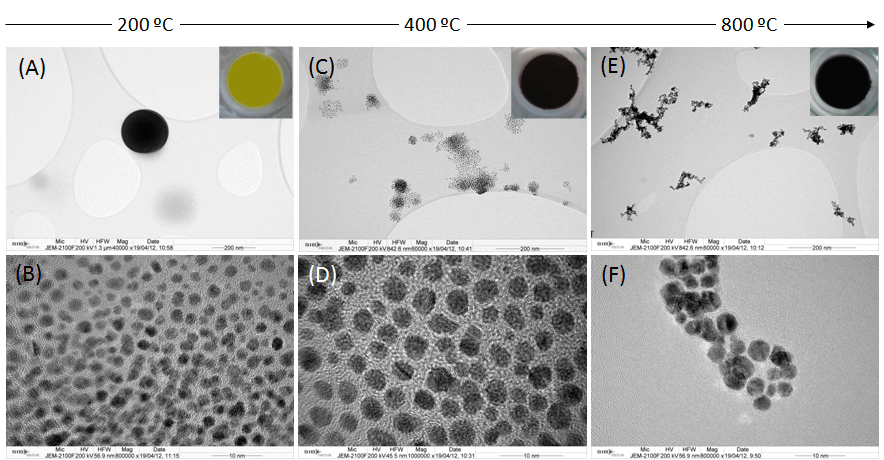
Figure 1. TEM images of AuNPs prepared at (A-B) T=200 ºC, (C-D) T=400 ºC and (E-F) 800 ºC. The particles collected on the filter are shown as inserts.
Acknowledgements
This work was supported by the strategic funding of the University of Eastern Finland under the NAMBER spearhead project.
References
Amendola, V. Meneghetti, M. (2009) J. Phys.Chem. 113, 4277.
Daniel, M.-C., Astruct, D. (2004) Chem. Rev. 104, 293.
de la Garza, M., Hernández, T., Colás, R., Gómez, I. (2010) Mater. Sci. Eng. B 174, 9.
Koshevoy, I.O., Chang, Y.-C., Karttunen, A.J., Selivanov, S.I., Jänis, J., Haukka, M., Pakkanen, T., Tunik, S.P., Chou, P.-T. (2012). Inorg.Chem. 51, 7392.
Majumdar, D., Kodas, T.T, Glicksman, H.D. (1996) Adv. Mater. 8, 1020.
Wu, D., Xu, X., Liu, X. (2008) J. Chem. Phys. 129, 074711.
See more of this Group/Topical: Particle Technology Forum