
 Google
 Yelp
 Facebook
 Twitter
 ChEnected
332380 Simultaneous Reaction and Purification Process for Continuous Production of High Quality Biodiesel From Acid Oils
Introduction
Even today, the refined edible oils are mainly used as feedstocks for biodiesel, fatty aid ester, and this causes an increase in the production cost of biodiesel. The side-stream products, such as soapstocks, acid oils and deodorized distillates, obtained during edible oil refining have been suggested for use as alternative feedstocks for biodiesel. Especially, the crude oils of palm and rice bran have a high content of free fatty acid and, hence the amount of acid oils generated is large, about 10-15 wt% of refined oil output. There are some industrial uses for acid oils such as ink, but most acid oils are burned out as waste. The acid oils consist of about 95 wt% of free fatty acids (FFAs) and 5 wt% of acylglycerols (TAGs) and these components can be converted to fatty acid ester by esterification or transesterification using homogeneous acid catalyst. However, these reversible reactions do not go to completion, so that the separation and purification processes to remove the by-products and unreacted reactants are necessary to produce the high quality biodiesel in compliance with all international standards. These processes cause a further increase in the production cost of biodiesel and there is no commercially realizable process for biodiesel production from acid oils.
The purpose of this research is to construct a simple and economical production process of high quality biodiesel from waste acid oils using the ion-exchange resins as catalysts and adsorbents.
Materials and methods
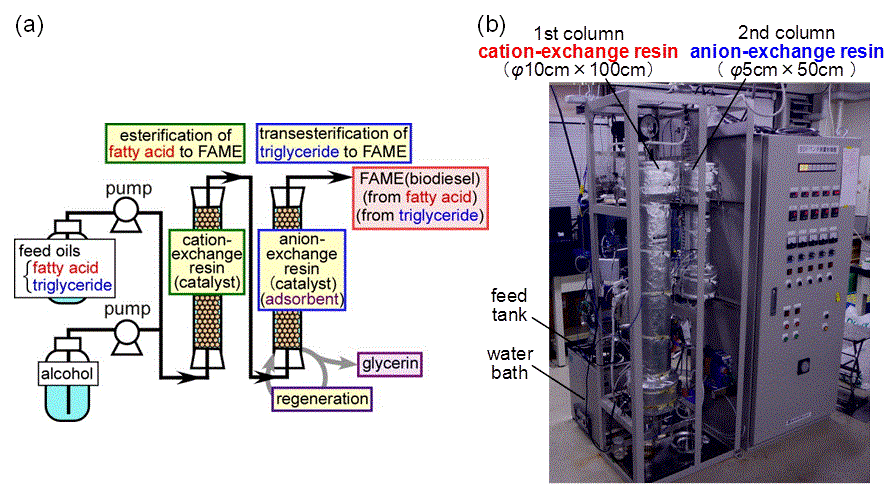
The acid oil was donated by the rice bran oil company. Figure 1 shows a schematic diagram and photograph of our production process. Two columns were individually packed with the cation-exchange resin, Diaion PK208LH, and the anion-exchange resin, Diaion PA306S, respectively, and then connected in series. The temperature of each column was kept constant at 50 °C. The mixed solution at the molar ratio of methanol to the total fatty acid residue in the oil of 2:1 was supplied to the bottom of the first column at the constant flow rate. The effluent from the process was analyzed to check the quality of biodiesel.
Results and discussion
Table 1 shows the analytical result of standard tests for biodiesel quality of product without purification except for removing residual methanol by evaporation. The contents of product and residual reactants fully met the standard values. This indicated that free fatty acids and acylglyceroles were converted to biodiesel by esterification and transesterification with cation- and anion-exchange resin catalysts, respectively. The content of byproducts also met the standard values without downstream purification processes to remove them. This was because the by-products, water and glycerol were adsorbed on the anion-exchange resin and the effluent was free from them. Other properties for contaminants and fuel properties were found to satisfy with the standards.
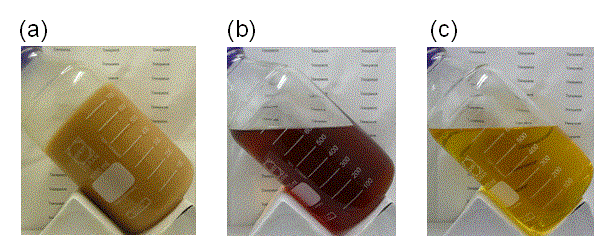
Figure 2 shows the photographs of the feed oil and the effluents from the first and second columns at room temperature. The feed oil was liquefied by the esterificaion through the first column. The dark brown pigment was removed by the adsorption through the second column.
Fig.2 Photographs
of feed oil (a) and effluents from the first (b) and second (b) columns at room
temperature Table 1 Analytical result of standard tests for
biodiesel quality of product
properties units standards product without purification EN14214 product FAME [wt%] ≥96.5 97.1 reactants acid value (FFA) [mg-KOH/g] ≤0.5 0.04 monoglyceridel [wt%] ≤0.8 0.48 diglyceride [wt%] ≤0.2 0.02 triglyceride [wt%] ≤0.2 0.03 byproducts water [mg/kg] ≤500 291 free glycerol [wt%] ≤0.02 0.00 total glycerol [wt%] ≤0.25 0.13 contaminants sulfur [mg/kg] ≤10 <5 sulfated ash [wt%] ≤0.02 <0.005 phosphorous [mg/kg] ≤4 <1 carbon residue (at 10% distillation residue) [wt%] ≤0.3 0.11 total contamination [mg/kg] ≤24 2 fuel properties density at 15°C [kg/m3] ≥860, ≤900 880.4 kinematic viscosity at 40°C [mm2/s] ≥3.5, ≤5.0 4.353 flash point [°C] ≥101 128.0 cetane number [-] ≥51 53.1 iodin value [-] ≤120 94.9 methyl linolenate [wt%] ≤12 1.2
See more of this Group/Topical: Environmental Division