
 Google
 Yelp
 Facebook
 Twitter
 ChEnected
332418 Development of a New Polygeneration Plant Based On Integrated Coal Gasification, Natural Gas Reforming and Carbonless Energy
Development of a new polygeneration plant based on integrated coal gasification, natural gas reforming and carbonless energy
Yaser Khojasteh Salkuyeh, Thomas A. Adams II
Department of Chemical Engineering, McMaster University, 1280 Main St W, Hamilton, Ontario, L8S 4L7, Canada.
Polygeneration is a processing technique that utilizes multiple feedstocks such as coal, natural gas and biomass to produce multiple energy products such as diesel, gasoline, methanol, hydrogen, dimethyl ether (DME), and electricity. It is a promising approach in terms of energy efficiency, profitability, and the ability to decrease dependency on limited and unsecure sources of crude oil. In addition, by producing a mixture of products, one can take advantage of synergies between each process to achieve both higher profits and better energy efficiency than standalone processes.
In this work, a novel polygeneration plant is proposed that uses coal, natural gas and also optionally high-temperature helium from a Gas Turbine Modular Helium Reactor (GT-MHR, a 4th generation nuclear power plant), and produces electricity, methanol and DME. In traditional processes which convert natural gas to liquids, a reformer unit is used to convert the natural gas to syngas; however, this reaction is endothermic and traditionally a large amount of extra natural gas has to be burned to provide this heat. The aim of integrating the GT-MHR unit into the polygeneration plant is to offer a novel strategy that supplies the heat requirement of the natural gas reformer in order to avoid this natural gas burning and reduce fossil fuel consumption.
As shown in Figure 1, two different types of gasifiers are used for liquid fuel and hydrogen production. The operating conditions and syngas composition of each gasifier are suitable for either liquid fuel synthesis or hydrogen production. Furthermore, incorporation of iron-oxide chemical looping gasification (CLG) is studied such that there is no direct carbon emission from this process. In this approach, the generated syngas is oxidized with oxygen carrier (Fe2O3 here) to get reduced solid (Fe) and high temperature CO2 and H2O gas phase stream. This CO2 stream can be easily purified by condensation of steam, achieving 100% CO2 capture. Then, the reduced metal will be oxidized in another reactor using steam and produces pure hydrogen and metal-oxide intermediate. For the final step of CO2 capturing, hydrate formation of CO2 is considered as a novel strategy that requires operating pressure less than typical liquefaction technologies and crystallization temperature above the freezing point of CO2. By using this, CO2 hydrate trucks can be used instead of CO2 transportation pipelines.
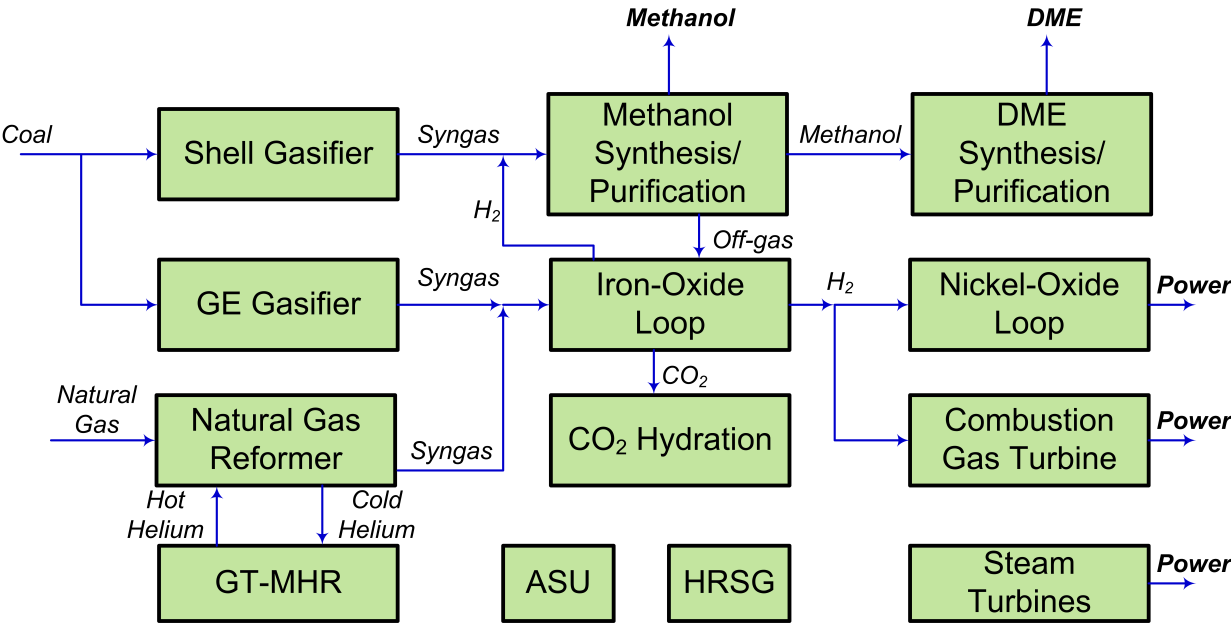
Fig. 1. Simplified block diagram of polygeneration plant.
To determine the operating conditions of each unit of this complex process, steady state simulations in Aspen Plus process simulator was performed. A sensitivity analysis for a wide range of coal to natural gas input ratios and power output to liquid fuel ratios is considered to determine the thermal efficiency of plant based on market demand. In addition, nickel-oxide chemical looping combustion (CLC) is modeled and compared with a conventional hydrogen combustion turbine for a range inlet temperatures. The results indicate that the optimal operating conditions and efficiencies vary widely depending on the desired product portfolios. For example, the results show that maximum net power generation can be achieved with temperatures between 1250 and 1325 °C for the NiO loop, but around 1400 °C is optimal for the combustion turbine. The results indicate the highest achievable efficiency is about 33% (HHV) for coal only and power generation only, which is greater than all other traditional coal-to-electricity processes with 100% carbon capture. Furthermore, by using the natural gas reformer with the GT-MHR unit, this efficiency can be increased to about 37.5% when just 40% of fossil fuel input is natural gas. In this case, about 7% of thermal input comes from GT-MHR plant. In addition, after adding DME and methanol to the product portfolio, the thermal efficiency can be increased up to 49.5% (HHV), while 50% of marketable output is electricity and 100% of CO2 wastes are captured. Overall, the efficiencies range from 33.3% to 53.3% (HHV) depending on the desired mixture of fuels and products.
See more of this Group/Topical: Computing and Systems Technology Division