
 Google
 Yelp
 Facebook
 Twitter
 ChEnected
332438 Rigorous Modeling of Novel Absorption-Stripping Process Configurations With Aqueous Piperazine for CO2 Capture From Natural Gas Combustion
This study evaluates amine scrubbing using 8 m piperazine (PZ) for CO2 removal from the flue gas of three natural gas-based applications. The applications and corresponding flue gas CO2 concentrations are as follows: Case 1, combined cycle (3% CO2), Case 2, combined cycle with exhaust gas recycle (6% CO2), and Case 3, natural gas-fired boiler (9% CO2). For each application, two bounding design scenarios were evaluated: high capital and low operating cost (high cap-ex, low op-ex) or low capital and high operating cost (low cap-ex, high op-ex). Capital and operating costs were not evaluated explicitly; rather, within the two major process areas (absorption and stripping), equipment level design modifications and process operating conditions were used to approximate the economic scenarios. Process and equipment models were developed in Aspen Plus® utilizing a rigorous thermodynamic and kinetic framework developed previously for the piperazine solvent. The focus of this work is the development and modeling of new process and equipment configurations for the natural gas applications.
Key developments in absorber design included solvent recycle configurations for intercooling in the absorber. The recycle design was used for two purposes in the natural gas applications. First, the water content in the entering flue gas of the combined cycle applications (Cases 1 and 2) was sufficiently low (< 7% water) that cooling of the gas to 40°C (absorber operating temperature) would not lead to condensation of water. This allowed the elimination of a separate direct contact cooler (DCC) upstream of the absorber in favor of a packed section at the bottom of the absorber with recycle of a high rate (~ 3 times the solvent feed rate) of cool, rich solvent to couple the function of cooling the inlet flue gas with absorption of CO2.
In addition, the liquid-to-gas flow ratio (L/G, mole to mole basis) in the column is much lower than in the typical coal applications (~12-14% CO2 in the flue gas) due to the high volume of flue gas treated. The resulting energy balance in the absorber leads to a maximum in column temperature (and corresponding equilibrium limited mass transfer) towards the top of the column. In other words, the heat generated by absorption of CO2 in the solvent is carried by the gas to the top of the column. Figure 1 depicts a temperature profile for Case 1 as an illustration of the expected temperature behavior in the gas applications.
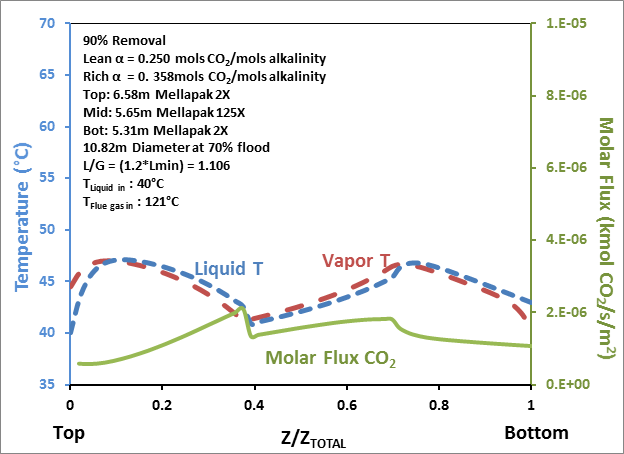
Figure 1: Molar Flux and temperature profiles, Case 1 (3%CO2) with DCC. Lean loading = 0.25 mols CO2/mols alkalinity, lean amine T = 40 °C, rich gas T = 40 °C, 3:1 recycle.
The solvent-recycle design depicted in Figure 2 is shown to cool the gas effectively by contacting it with a high rate of cooled solvent in a well-mixed section of the column, and, in turn, reducing the temperatures throughout the column. The high solvent rate per wetted perimeter also provides enhancement of mass transfer (via generation of turbulence in the recycle section). Sensitivity analyses identified solvent recycle rates to minimize total packing requirements (capital costs) and maximize rich loadings (minimize energy requirement in the stripping section).
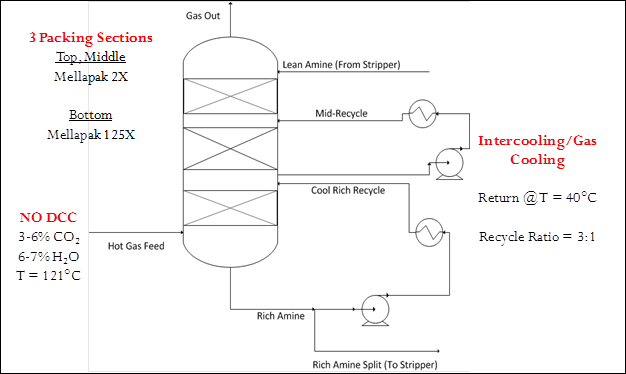
Figure 2: Case 1 and 2 Absorber PFD with Solvent Recycle, No DCC, Combined Cycle Gas Turbine.
In the stripping section, an inter-heated stripper was implemented with 5°C LMTD for the main cross exchanger (increased exchanger area) to represent a high cap-ex, low op-ex designs (Figure 3).
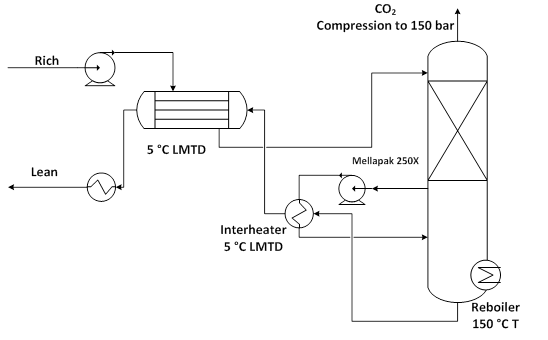
Figure 3: High cap-ex configuration of inter-heated stripper and 5 °C LMTD cross-exchanger
The inter-heated stripper configuration recovers additional heat from the reboiler via cross exchange of a solvent-draw from the stripper with the rich stream leaving the reboiler. The inter-heating also results in a cooler rich amine stream reaching the stripper since less heat is transferred in the main cross-exchanger (i.e., the heat was recovered in the inter-heater). The cooler rich amine stream entering the stripper reduces the amount of water vapor lost per mole of CO2 recovered and in turn reduces irreversible heat losses in the condenser.
In addition, a simple stripper with cold rich bypass and 10°C LMTD for the main cross exchanger (reduced exchanger area) was implemented for the low cap-ex, high op-ex designs (Figure 4).
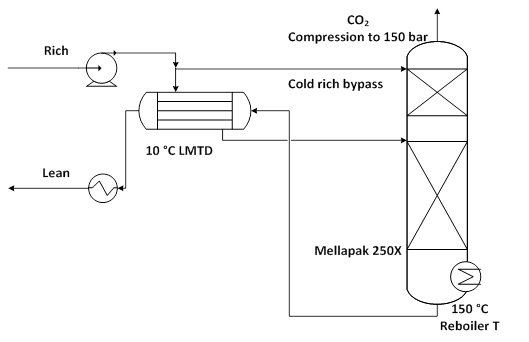
Figure 4: Low cap-ex configuration of simple stripper with cold rich bypass and 10 °C LMTD cross-exchanger
In this stripper design, the column consists of two packed sections. The cold rich amine stream leaving the absorber is split upstream of the main-cross exchanger. A fraction of the flow bypasses the main exchanger and is sent to the top of the stripper, reducing the water lost per mole of CO2 in the gas leaving the stripper (as in the inter-heated stripper design). For both stripper configurations, analysis of the equivalent work requirement was conducted, including sensitivity analysis identifying a range of operable lean and rich loadings for the natural gas applications.
See more of this Group/Topical: Topical Conference: CO2 Capture