
 Google
 Yelp
 Facebook
 Twitter
 ChEnected
332534 Efficient Production of 5-Hydroxymethylfurfural From Fructose Via Mechanical Stirring Control and High-Fructose Solution Addition
The production of transportation biofuels and chemicals from renewable biomass has been regarded as the most promising process for reducing our dependence on fossil feedstocks (Roman-Leshkov et al., 2007). However, the efficient utilization of biomass in multiple catalytic processes is still needed to be further investigated. Among current biochemicals, 5-hydroymethylfurfural (HMF) converted from carbohydrates has attracted intensely scientific interest. HMF is a versatile intermediate in the production of high value chemicals, such as alternative fuels, diesel fuel additives, industrial solvents and bio-derived polymers (Chheda et al., 2007). Among current carbohydrate resources of HMF production, such as cellulose, glucose, fructose and some other potentially industrial residues (Rosatella et al., 2011), fructose is the most effective monosaccharide in the research of acid-catalyzed conversion from biomass to HMF (Qi et al., 2011). The production of HMF from fructose can be accomplished in variety of processes. However, the major research for HMF preparation focused on the design of the catalyst and the choice of proper extraction solution to improve the reaction efficiency of the biphasic system in high sugar solution. However, several process intensification issues, such as the method for increasing the concentration of sugar solution, the control of stirring speed in the reactor, the type of the impeller, the size of the reactor and the separation of products from solvent, were still needed to be thoroughly investigated.
In this work, two simple operations, mechanical stirring control and high-fructose solution addition, were applied to the water/butanol system for enhancing fructose-to-HMF reaction using HCl as catalyst (Fig. 1a). The optimization of stirring speed led to a high HMF yield of 81.7% with 92.0% fructose conversion at 0.3mol/L HCl and 1000rpm (Fig. 1b). High-speed stirring promoted the reaction efficiency by enhancing the transfer rate of HMF and decreasing the water around HMF and fructose. During different reaction periods, the mass transfer rate of HMF has different effect on HMF yield. Via studying the kinetics of fructose-to-HMF reaction, it demonstrated that the lower value of reaction rate constant was benefit to obtain higher HMF yield in queous/butanol media. In order to stablely and continuously obtain a high yield of HMF with a high conversion of fructose, the high-fructose solution (54.6wt%) addition was investigated. The application of this simple process led to a maximum HMF yield of 83.3% with a fructose conversion of 93.8%, meanwhile HMF yields were all above 55% during the whole reaction process (Fig. 1c). The simple addition process greatly reduced the side-reaction and made the operation more continuously and stablely, and thus provided a practical and effective method toward HMF preparation in high-fructose solution.
This work was supported by the NSF of China (51173128, 31071509, 21276192), the Ministry of Science and Technology of China (Nos. 2012YQ090194, 2013AA102204, 2012BAD29B05), the Program for New Century Excellent Talents in Chinese University (NCET-08-0386; NCET-11-0372), and Beiyang Young Scholar Program (2012).
References
[1] Chheda, J.N., Huber, G.W., Dumesic, J.A. (2007) Liquid-phase catalytic processing of biomass-derived oxygenated hydrocarbons to fuels and chemicals. Angew Chem Int Edit, 46(38), 7164-7183.
[2] Qi, X.H., Guo, H.X., Li, L.Y. (2011) Efficient Conversion of Fructose to 5-Hydroxymethylfurfural Catalyzed by Sulfated Zirconia in Ionic Liquids. Industrial & Engineering Chemistry Research, 50(13), 7985-7989.
[3] Roman-Leshkov, Y., Barrett, C.J., Liu, Z.Y., Dumesic, J.A. (2007) Production of dimethylfuran for liquid fuels from biomass-derived carbohydrates. Nature, 447(7147), 982-985.
[4] Rosatella, A.A., Simeonov, S.P., Frade, R.F.M., Afonso, C.A.M. (2011) 5-Hydroxymethylfurfural (HMF) as a building block platform: Biological properties, synthesis and synthetic applications. Green Chemistry, 13(4), 754-793.
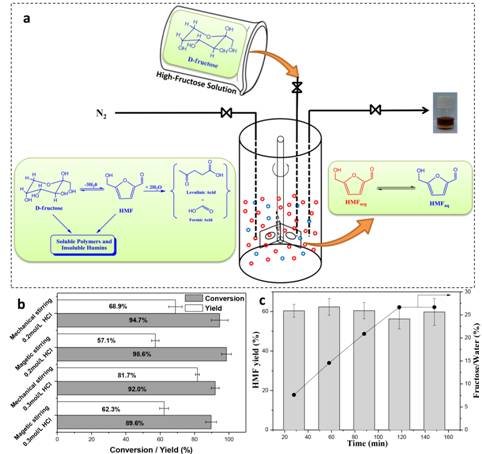
Figure 1 Dehydration of fructose to HMF. a) A typical reaction scheme for HMF production by mechanical stirring in biphasic phases; b) Effect of stirring type on fructose conversion and HMF yield in aqueous/butanol media; c) Effect of high-fructose solution addition process on HMF yield and mass ratio (fructose: water).
See more of this Group/Topical: Catalysis and Reaction Engineering Division