
 Google
 Yelp
 Facebook
 Twitter
 ChEnected
332604 Investigation of Adsorption On MSC5A in Supercritical CO2 – Chromatography and Monte Calro Simulation –
Fig.1. Experimental
apparatus Molecular simulation of multicomponent
adsorption equilibria was performed, and compared the
simulation results with experimental results. Simulation software is Materials
Studio (Version5.5) made by MSI. The Grand Caronical
Monte Carlo method (under constant chemical potential (΅), volume (V), and
temperature (T)) was used to get the equilibrium amount adsorbed. The purpose
of performing simulation is to capture visually the adsorption phenomenon and
to elucidate an adsorption mechanism on the molecule level. So, we created Pseudo activated carbon sub-micropore model (MSC68-test021 model) as adsorbent. By
performing molecular simulation, it is obtained average loading
[molecular/cell] and is possible to determine the amount adsorbed therefrom.
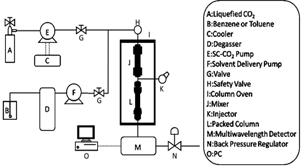 Chromatographic measurements were made
for the adsorption of benzene or toluene on molecular sieving carbon (MSC) in
supercritical fluid CO2 mixed with organics. Supercritical
chromatograph packed with MSC was used to detect pulse responses of organics.
Adsorption equilibria and adsorption dynamics
parameters for organics and CO2 were obtained by moment analysis of
the response peaks. Dependences of adsorption equilibrium constants,
K*, and micropore diffusivity, D, on the supercritical
CO2 density were examined. To use Markham-Benton
equation for obtaining the saturation adsorption amount, the adsorption
isotherms was carried out the curve fitting method of least squares by the
solver.
See more of this Group/Topical: Separations Division