
 Google
 Yelp
 Facebook
 Twitter
 ChEnected
332657 Fragmentation and Bounce of Nanosized Agglomerates Due to the Impaction
The impaction behaviour of aerosol particles has applications in fields such as powder processing, nuclear safety, and health research. Two major phenomena may occur during the impaction of agglomerated particle onto a surface. The first one is the plastic deformation of the agglomerate which may lead to fragmentation of the agglomerate if there is enough impaction energy available. The second process is the bounce of the particles whenever the adherence between the particle and surface can be overcome by the energies stored to elastic deformations.
To achieve better understanding on how these processes work and affect each other, the fragmentation and the bounce should be observed simultaneously. In this study, these processes were investigated for two agglomerate materials with varying agglomerate properties.
A method to study the simultaneous fragmentation and bounce of the particles was developed and it is described in detail by Ihalainen et al. (2012). The basic principle of the method was as follows. The aerosols in study were first size classified by their electrical mobility with a Differential Mobility Analyzer (DMA) to achieve relatively monodispersed aerosol population. This population was then introduced to a single stage Micro Orifice Uniform Deposit Impactor (MOUDI) in which the particles impact onto the impaction plate due to the inertia of the particles. The impaction velocity depended on the aerodynamic diameter of the particle and the air flow conditions at the impactor. To be able to estimate this impaction velocity, computational fluid dynamics simulations (CFD) coupled with Lagrangian method to analyze the particle trajectories were made. The sample flow from the MOUDI was collected to a low pressure sampling chamber which enables the analysis of the bounced with both online and offline methods. The deposited particles were collected both from the impaction plate and bounced fraction and analyzed using a Transmission Electron Microscopy (TEM). In addition to the TEM, the bounced particles were characterized with a scanning mobility particle sizer (SMPS). The mass fraction of the particles which bounce was estimated from the SMPS data using size dependent effective density. The effective density of the particles was evaluated using a combination of aerosol particle mass analyzer (APM) and SMPS.
The agglomerated particles of TiO2 and Fe were generated using atmospheric pressure chemical vapor synthesis (APCVS; Lähde et al, 2011). Titanium tetra isopropoxide was used to generate TiO2 agglomerates and iron penta carbonyl to produce iron agglomerates. The properties of the agglomerates were manipulated during the generation to find out how these changes affected the fragmentation and bounce. The properties varied for TiO2 particles were the primary particle size and the degree of sintering, i.e. the bridging between the particles. The average primary particle sizes used here were 27 and 16 nm. The oxidation state of the iron particles was varied by changing the amount of oxygen available during the particle formation phase. The oxygen concentrations used during the generation were 21 and 0.05 %.
The size distributions of the bounced particles for each particle type after impaction at about 150 m/s are presented in Figure 1. It shows that the original monodispersed size distribution has transformed to a wider distribution of smaller particles due to the fragmentation. Fig. 1 also shows that not all of the particles did break-up and some fractions of the particle populations remained intact during the impaction. This was pronounced at lowest impaction velocities for the TiO2 particles with higher degree of sintering and for the iron oxide particles. It can also be observed from Fig. 1 that the changing the agglomerate properties affected the fragment size. Increasing of TiO2 agglomerates sintering increased the size of the fragments meaning that fewer bonds per agglomerate broke up. This was due to the sintering which made the bonds between the primary particles stronger. The reduction of the primary particle size also resulted in larger fragments however the change was not as significant as in the case of sintering. The fragments of the iron oxide particles were larger than in the case of TiO2 at the same velocities and the oxidation level of the iron oxide particles was not found to have a significant effect on the size of the fragments.
The mass fractions of the fragmented and bounced particles increased as the impaction velocity increased in almost all of the cases. With TiO2, the smaller primary particle size reduced the bounce fraction compared to the case with larger primary particle size. There was no significant difference in bounced mass fractions between the iron oxide cases.
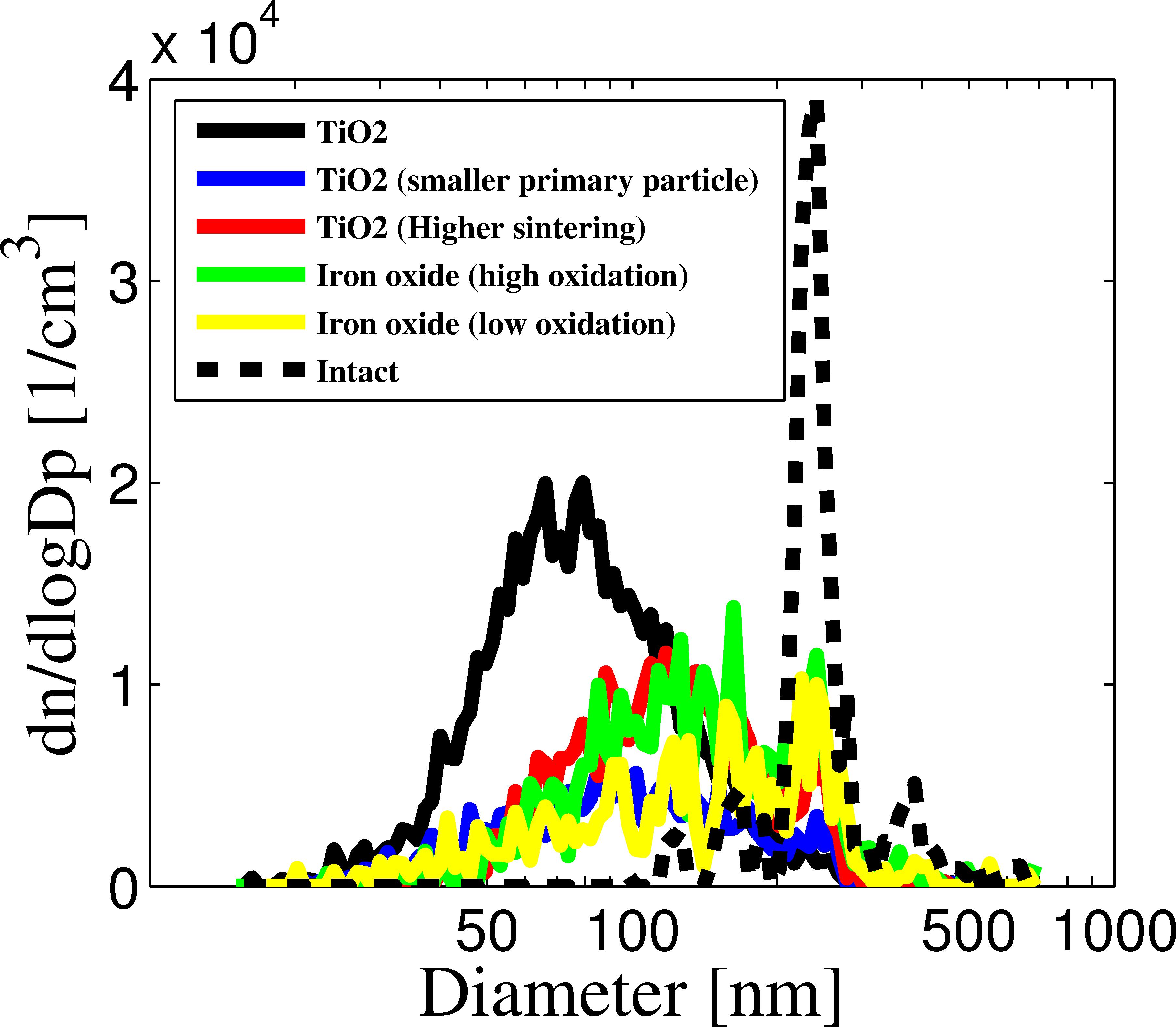
Figure 1. The number size distributions of the intact and the bounced particles at similar impaction conditions.
This work was carried out in support of the international ARTIST II program which is acknowledged for funding this work. The authors express their gratitude to those members of the Laboratory for Thermal-Hydraulics at PSI and of the Fine Particle and Aerosol Technology Laboratory at the University of Eastern Finland that participated in the experimental work and construction of the facility.
Ihalainen, M., Lind, T., Torvela, T., Lehtinen, K.E.J. and Jokiniemi, J. (2012) Aerosol Sci. Technol. 46:9, 990-1001.
Lähde, A., Kokkonen, N., Karttunen, A., Jääskeläinen, S., Tapper, U., Pakkanen, T.A., Jokiniemi, J (2011) J. Nanopart. Res. 13, 3591-3598.
See more of this Group/Topical: Particle Technology Forum